


Originally published in The Clarinet 53/4 (September 2026).
Copies of The Clarinet are available for ICA members.
The Origins of Mendelssohn’s Concertpieces for clarinet, basset horn, and piano, op. 113 and op. 114
An exploration of how a lovely convergence of Mendelssohn, Baermann, and sweet pastries led to the creation of two core repertoire works.
by Stephen Poppel
The story of the curious and quaint origins of Felix Mendelssohn’s (1809-1847) popular and beloved Concertpieces for piano, clarinet, and basset horn is well-known and widely available. Even the most casual internet search uncovers numerous tellings and re-tellings of the tale, according to which Mendelssohn produced the works in exchange for servings of his favorite pastries.1
All these accounts derive ultimately from the original one that appeared in a Munich daily newspaper, the Neuste Nachrichten und Münchener Anzeiger, on February 25, 1882. There the famed German clarinetist Karl Baermann (1810-1885), author of the method books that have given so many generations of clarinetists their grounding in technique, describes a visit that he and his clarinetist father, Heinrich (1784-1847), made to their long-time musical colleague Mendelssohn fifty years earlier, during the composer’s residence in Berlin. In a turn of the conversation to the subject of food, Mendelssohn declaimed his longing for two particular local pastries that he had enjoyed with the father-son clarinetist pair while they were all previously together in Munich—steamed dumplings and sweet cheese strudel. The younger Baermann leapt on this longing and offered a trade: he would serve up these delicacies in exchange for compositions for the trio of the three of them. Mendelssohn accepted, and rapidly produced the trios that were his part of the bargain.
The story is charming, and is worth enjoying in detail. While the original newspaper article is available in facsimile, the content may not be as accessible as it might be since it is printed in German, and in an old-style Fraktur font. To make it available to the readers of The Clarinet, I provide herewith a transcription of the original German and a translation into English. While Baermann’s account does not identify the two Konzertstücke by name, it is clear from the date and the description that these are the works in question.
The labeling of the delicacies in question requires some clarification. Although the German nudel suggests its English cognate “noodle” and would usually refer to the familiar pasta item that the word generally denotes, the Dampfnudel (steamed noodle) is a dumpling with a sweet filling and a cream sauce. Accordingly, the nudel term is better understood as the equivalent of its near-homonym Knödel—a dumpling. Many recipes for these dumplings, and for the strudel, may be found on the internet.
ACKNOWLEDGEMENT
My thanks to my fellow Chatham Chamber Ensemble member Robert Dembo, who first brought this story and its details to my attention, and to Natalia Shevchuk, who provided additional material; as well as to my colleagues Michael Buneman, Gerold Mohn, and Mirjam Thulin, who assisted with the German transcription and the English translation.
ORIGINAL TEXT2
Der k[önigliche] Professor Herr Karl Baermann sen.[ior] war so freundlich, unserer Einladung zu entsprechen and uns folgende interessante Episoden aus seinem Künstlerleben zu übermitteln.
“Kleines gibt das Mass für die Grösse”
Wenn ich Nachfolgendes veröffentliche, so geschieht dies hauptsächlich um eine Seite meines hoch- und allververhrten Freundes Felix Mendelssohn-Bartholdy näher zu beleuchten, welche, wie mir scheint, von seinen Biographen noch night genug hervorgehoben ist. Ich verstehe darunter seinen gemüthvollen, oft naiv kindlichen Humor, der durch nachstehende Anekdote vielleicht wohl am deutlichsten gekennzeichnet wird. So ist jedoch nöthig, um dieselbe besser zu verstehen, eine kleine Einleitung vorauszuschicken. Im Jahr 1827 lernte ich Mendelssohn in Berlin kennen, und 2 Jahre später nahm Mendelssohn einen längeren Aufenthalt in München, um einige seiner Kompositionen hier aufzuführen. Es waren dies unter anderen seine Sommernachtstraum-Ouverture und sein herrliches Klavier-Konzert. Letzteres schrieb er erst hier nieder, und dasselbe stand acht Tage vor der Aufführung, zur Verzweiflung des Kopisten, noch nicht fertig in der Partitur, bis ihn mein Vater, Heinrich Baermann, mit welchem er innigst befreundet war, einigemal in sein Zimmer einschloss, damit er endlich die Partitur vollende. Dass wir bei seinem hiesigen Aufenthalte viel zusammen waren und musizierten ist selbstverständlich, ebenso, dass Mendelssohn oft bei uns zu Mittag ass, wozu er sich aber stets, da er leidenschaftlich Süsses liebte, Dampfnudeln oder Rahmstrudel ausbat.
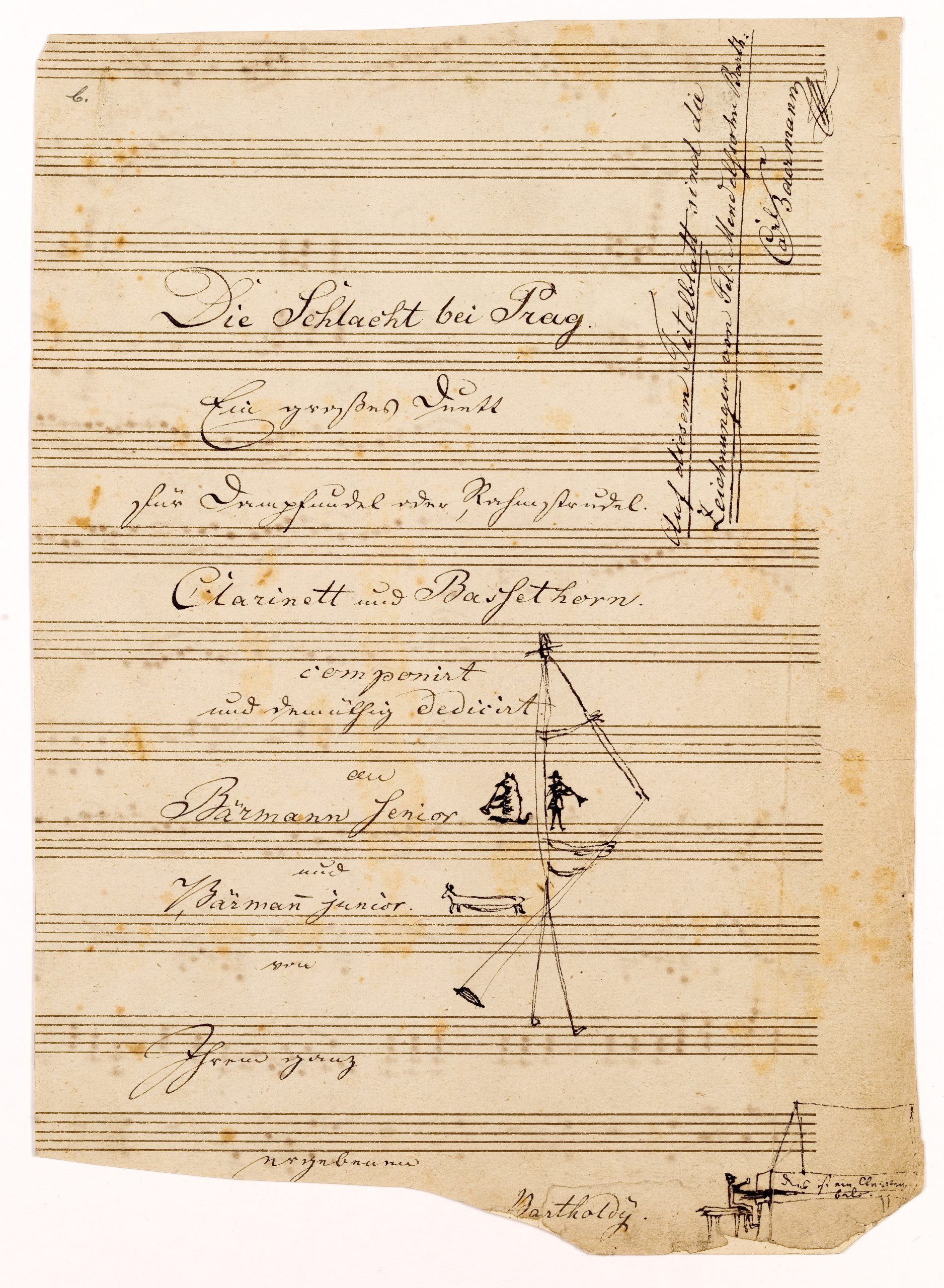
The manuscript title page of Mendelssohn’s Concertpiece, op. 113, with the composer’s cartoon drawings of himself and the Baermann dedicatees (courtesy of the Juilliard Manuscript Collection).³
Im Winter 1832-33 machten nun mein Vater und ich eine grössere Kunstreise nach Petersburg über Berlin. Wir blieben wohl einen Monat in letzterer Stadt, woselbst wir täglich abwechselnd bei Mendelssohn oder Meyerbeer waren. Eines Tages nun seufzte Mendelssohn bei Tische ganz jammervoll “Ach, Gott! wenn ich nur wieder so herrliche Dampfnudeln und Rahmstrudel bekommen könnte, als ich bei Euch gegessen habe.”
Mendelssohn hatte schon längst versprochen, für den Vater und mich ein Duo zu schreiben. Ich fasste daher seinen Stosseuftzer schnell auf und sagte: “Dafür könnte wohl Rath werden, wenn endlich einmal das Duo komponirt würde.” Mendelssohn sprang empor, fragte: “Ja, wer kocht’s denn?” Ich erwiderte dreist: “Ich koch’s.” — “Das wär ja Hinwerden närrisch, das wär’ ja gar zu prächtig,” rief Mendelssohn. “Topp, es gilt, mir die Nudl und die Strudl und Euch das Duo.” — Da, wie bekannt, die Musiker gewöhnlich keine Paläste und Hotels besitzen, so befindet sich bei den verheiratheten meistens die Küche sehr nahe an den Wohnzimmern derselben, ja es soll sogar vorkommen, dass ihre Frauen oben genannte Speisen in denselben Zimmern bereiten sollen (was jedoch gewiss eine Verläumdung ist). Kurz und gut, auf ähnliche Weise hatte ich einige Kenntniss in der Zubereitung der gewünschten Speisen bekommen und wagte auf gut Glück, den verwegenen Vorschlag zu machen.
Es wurde nun von Mendelssohn ein Tag festgesetzt, an welchem, wie er sagte, “die Geschichte los gehen soll.” Als ich mich zur bestimmten Zeit (9 Uhr Früh) bei ihm einfand, setzte er mir eine Küchenhaube auf, band mir eine Schürze um und steckte mir einen Kochlöffel in das Band der Schürze. Dieselbe Prozedur nahm er mit sich selber vor, nur statt des Löffels stecke er eine Feder hinter das Ohr, und führte mich, zum grossen Ergötzen seines Küchenpersonals, in die Küche hinab. Er selbst kehrte nun, wie er sagt, an seinen Klavierheerd zurück, woselbst er die Töne umrühren, kneten, salzen, pfeffern, zuckern, eine pikante Sauce dazu machen, und das Ganze an einem höllischen Feuer kochen wolle. Noch unter der Küchenthüre rief er mit erhobenen Armen: “Probatum est! und nun den Kugel- oder Kuchelsegen.”
Um 5 Uhr war die ominöse Stunde, wo Alles fertig sein musste, und als dieselbe schlug, schlug auch mir das Herz voll banger Sorge, ob die Dampfnudeln auch gehörig aufgegangenn seien. Doch zu meiner grössten Freuden präsentirten sich dieselben prächtig in der Höhen und die Rahmstrudel brodelten mir ganz melodisch in der Kasserole. Ich brachte nun meine Kocherei in verdeckten Schüsseln zu Tische und Mendelssohn war nun ganz ausser Rand und Band von meiner Kochkunst, und rezitirte die Worte Papagenos, wenn er in dem unterirdischen Gewölbe den Wein trinkt: “Himmlisch! Göttlich! Ich könnte jetzt gleich zur Sonne fliegen, wenn ich nur Flügel hätte”; dann setzte er sich an’s Klavier und sang nach der Melodie des Papageno-Glöckchenliedes: “Ein Mädchen oder Weibchen” etc. etc. nachfolgende Strophe:
“Dampfnudeln und Rahmstrudel
“Hab’ ich gegessen nun
“Wälz’ mich als wie ein Pudel
“Vor Wonne um und um.”
Denselben Abend probirten wir das Duo, und nach kleinen technisch instrumentalen Aenderungen waren der Vater und ich noch entzückter über die reizende Komposition, als Mendelssohn über die Nudl und Strudl, obwohl letzterer immer behauptete: meine Nudl-Komposition sei viel geistreicher als die seinige. Es wurde daher gleich eine Wiederholung der heutigen Szene verabredet, welche auch einige Tage später mit gleichem Erfolge stattfand. So besitze ich nun zwei theuere mir unschätzbare Andenken des grossen Meisters deren Erstes den humorvollen Titel trägt:
“Die Schlacht bei Prag, grosses Duett für Dampf-Nudel und Rahmstrudel, oder Clarinett und Bassetthorn, komponirt und demüthig dedizirt an Baermann senior und Baermann junior von Ihrem ganz ergebensten Felix Mendelssohn-Bartholdy.”
“NB. Zum ersten Male gespült bei Heinrich Bär, in der Bärenstrasse*), von den Bärleuten, Bärlin den 30. Dezember 1832.”
Nun könnte die Geschichte aus sein, sie ist aber noch nicht ganz aus.
Im Jahr 1843 kam ich wieder über Leipzig. Dass mein erster Gang zu Mendelssohn war, ist natürlich. Ich traf ihn erst in einer Konzertprobe. Als die Probe der Ouverture, die er eben dirigirte, zu Ende war, stellte ich mich ihm vor, wurden aber nach elfjähriger Zwischenzeit nicht gleich von im erkannt und ziemlich steif empfangen. Doch plötzlich änderte sich sein Gesichtsausdruck und mit dem Ausrufe: “Jesses, der Baermann!” sprang er mit beiden Füssen über die Barriere des Orchesters. Sein erstes Wort war alsdann: “Kann man denn noch Dampfnudeln kochen?” Ich bejahte lachend seine Frage und erst jetzt stellte er mich seinem trefflichen Orchester vor und lud eine grössere Gesellschaft für den nächsten Tag zu Tische. Somit musste ich wohl oder übel wieder in die Küche, musste die Schüsseln selbst auftragen, während Mendelssohn den Triumphmarsch aus Titus dazu spielte, Alles war nun in heiterster Stimmung.
Nun wünsche ich nur, dass der Leser an den vielen Dampfnudeln und Rahmstrudeln sich nicht “abgegessen”, bin aber überzeugt, dass das kunstsinnigen Publikum sich an Mendelssohn’s liebenswürdigem Humor erfreut hat, und ganz zufrieden wäre, wenn ich meinem hoch- und allverehrten Freunde noch obige Speisen bereiten könnte.
Als ein drastisches Gegenstück zu diesen Symposien bei unserem deutschen Meister möchte ich wohl eine Begegnung mit einem ebenfalls grossen, einem fremdländischen Meister beifügen.
In Berlin machte ich auch die nähere Bekanntschaft Spontinis, des Komponisten der “Vestalin”, “Olimpia”, “Nurmahal”, etc. etc.. Einige Jahre vor seinem Tode kam Spontini auf einer Reise nach Italien über München. Ich wurde sein steter Begleiter bei Besichtigung unserer Kunstschätze, für welche er grosses Interesse zeigte. Bei einem Gang durch die Arkaden des k. Hofgartens blieb er plötzlich stehen und sagte in seinem gebrochenen Deutsch: “Baermann, ich hab’ Sie für eine eigene Idee.” Ich sah ihn erwartungsvoll an, und er führ fort: “Ich haben nämlich gemach[t] eine grosse Vorstellung in Berlin fur die Monument von die Maëstro Mozart in Salzburg mit 4000 Thaler. Dafür haben die Witwe Mozart mir geschich[t] als recompense eine schöne Ring, welche hat getrag’ Maëstro Mozart selbst und hat bekomm’ von die Kaiser Maria Theresia. Ich werden alt und wenn ich sterben, weis ich nit eine Mensche auf die Welt, die würdich ist zu trag die Ring von Mozart nach Spontini. Ich haben nun die Gedank’ und las mach’ eine kleine Kapsl in die Monument zu Fuss von Mozart, leg die Ring hinein und darauf schrieb’: Spontini retour à Mozart”.–
Soviel mir bekannt, ist die “Kapsl” noch night in das Monument gesetz.
Karl Baermann senior
- Professor und p[rivater?]. Kammermusiker
*) Heinrich Beer, Bruder Meyerbeers, Behrenstrasse in Berlin
ENGLISH TRANSLATION
Royal Professor Herr Karl Baermann, senior, graciously responded to our invitation to provide the following interesting episode from his life as an artist.
“The detail is the measure of greatness.”
I relate the following in order to show a side of my highly honored friend Felix Mendelssohn-Bartholdy to which his biographers have not given enough attention—his congenial, even sometimes naively childlike sense of humor, as evident in the following anecdote.
I made Mendelssohn’s acquaintance in Berlin in 1827. Two years later he visited Munich for a performance of two of his compositions, the Overture to “Midsummer Night’s Dream,” and the piano concerto. He wrote out the concerto only after his arrival. To the despair of his copyist, eight days before the performance it still was incomplete—until my father, Heinrich Baermann, a close friend, shut him up in his room so he would finish the score. Obviously we spent a lot of time and made music together during his visit. We often dined together, and—given his passionate fondness for sweets—he always ordered steamed dumplings and sweet cheese strudel.
In the winter of 1832-33 my father and I made a big concert tour to Petersburg, via Berlin, where we stayed for about a month, visiting with Mendelssohn and Meyerbeer. One day Mendelssohn sighed piteously, “Oh God! If only I could again have those splendid steamed dumplings and sweet cheese strudel that I had with you [in Munich].”
For quite a while Mendelssohn had promised to write a duet for Father and myself. So I latched onto his lament and said, “You could have your wish if you’d finally write that duet.” Mendelssohn leapt up asking, “So who’d do the cooking?” to which I boldly replied that I would. “That would be as utterly insane as it would be splendid,” Mendelssohn exclaimed. “Agreed. Dumplings and strudel for me, and the duet for you.”
Now it’s well known that musicians don’t own any palaces or hotels, so in their domestic arrangements the kitchen is usually close to the living quarters, and it can happen that the wife might prepare these items even in the latter (though that may be a bit of a slander). Anyway that’s how I knew a bit about these recipes, and I tried my luck at this daring proposition.
So Mendelssohn set the day when, as he put it, “The tale will be told.” When I got there at the appointed time (9 in the morning) he plopped a chef’s hat on me, wrapped me in an apron, and stuck a cooking spoon in the apron’s tie. He did the same for himself, only instead of the spoon he stuck a quill pen behind his ear, and to the delight of the staff, led me into the kitchen. For his part he returned to what he called his piano-hearth, where he stirred, kneaded, salted, peppered, and sugared notes in order to make a spicy sauce to be cooked in a blazing fire. Periodically he showed up at the kitchen door, and with arms raised uttered, “Well concocted, blessed dumplings and dishes.”
At five o’clock the ominous time arrived when everything had to be ready, and my heart pounded with anxious worry about whether the steamed dumplings would rise properly. To my great delight they rose beautifully, and the sweet cheese strudel bubbled melodically in its casserole. I brought my culinary achievement to the table and Mendelssohn, beside himself over my artistry, declaimed Papageno’s paean to the wine in his underground vault: “Heavenly! Divine! If I had wings I could fly to the sun.” Then he sat down at the piano and, to the tune of Papageno’s glockenspiel song “Ein Mädchen oder Weibchen” etc. etc., sang the following verse:
“Steamed dumplings and sweet cheese strudel
Have I now savored
And round and round like a poodle
I am waltzing with joy.”
The same evening we tried out the duet, and after a few technical changes my father and I were both delighted by the charming composition, even as Mendelssohn was delighted by the dumplings and strudel, though he claimed that my cooking composition was better than his musical one. We agreed on a repetition of the scene a few days later, which happened with great success. So now I have two precious, invaluable souvenirs of the great master, the first of which bears the humorous title page:
“The Battle of Prague, Grand Duet for Steamed Dumplings and Sweet Cheese Strudel, or Clarinet and Bassett Horn, Composed and Humbly Dedicated to Baermann, senior and Baermann, junior by Their Most Respectful Felix Mendelssohn-Bartholdy.
N.B. Served up for the first time in the presence of Heinrich Baer, in Baer Street*), by the Baers, in Baerlin.”
The story might have ended here, but it did not.
In 1843 I returned to Leipzig. Naturally my first step was to call on Mendelssohn. I met him in a rehearsal, and I approached him when he was done conducting the overture. Not recognizing me after a twelve-year separation, he greeted me stiffly. And then suddenly his whole countenance changed and with a cry of “Jesus, it’s Baermann” he jumped out of the orchestra pit with both feet, with the first words, “So can you cook some steamed dumplings for me?” I laughed and agreed, and then invited his whole wonderful orchestra to a banquet the next day. So now, for good or evil, I had to return to my mixing bowls, while Mendelssohn accompanied with the Triumphal March from Titus. The mood was completely cheery.
Now my only hope is that the reader will not clear his plate of these many steamed dumplings and sweet cheese strudels, as I am convinced that the artistic public will find pleasure in Mendelssohn’s lovable humor, and I would be completely satisfied if I could again prepare these delicacies for my revered and respected friend.
As a sharp contrast to this account of our German maestro I’d add an encounter with an equally grand, though foreign, maestro.
In Berlin I also got to know Spontini, the composer of “Vestalin,” “Olimpia,” “Nurmachal,” etc. etc.. A while before his death Spontini came through Munich on his way to Italy. I was his constant companion on his visits to our art treasures, for which he displayed a great interest. While walking through the royal palace gardens he suddenly came to a halt, and in his broken German said: “Baermann, I have a great idea for you.” I looked at him expectantly, and he continued, “I did a major [benefit] concert to finance a 4,000 Thaler monument to Maestro Mozart in Salzburg. In gratitude, Mozart’s widow gave me a beautiful ring that Mozart wore that he had received from the Kaiser[in] Maria Theresia. I’m getting old, and when I die I don’t know anyone in the world who deserves to wear Mozart’s ring after Spontini. I’m thinking of making a small capsule for the ring in the monument at Mozart’s feet, with the inscription “Spontini back to Mozart”.–
As far as I know that “capsule” was never set into the monument.
Karl Baermann, senior Royal Professor and Private Chamber Musician
*) Heinrich Beer, Bruder Meyerbeers, Behrenstrasse in Berlin4
ENDNOTES
1 For example, a Google search on “origins of Mendelssohn’s Konzertstücke” leads to the wonderful articles by Jenny Maclay on her jennyclarinet.com website (https://jennyclarinet.com/2020/07/how-dumplings-inspired-this-composer-to-write-a-famous-clarinet-work/#:~:text=That%20piece%20was%20the%20famous,of%20the%20more%20unusual%20ones) and the blog posting by Peter Jost on the henle.de website, (https://blog.henle.de/en/2015/04/13/an-amusing-story-and-a-serious-problem-%E2%80%93-on-mendelssohn%E2%80%99s-first-concert-piece-for-clarinet-basset-horn-and-piano/). Maclay’s article provides a summary of the tale, but her source reference, to Karl Baermann’s 1882 “Erinnerungen eines alten Musikanten” (“Memories of an Old Musician”) is slightly misleading, as that article, published in several installments beginning on October 28, 1882, describes only the general background of the Baermann-Mendelssohn relationship that was the context for the composition. The actual story of the barter that produced it appears in an earlier February 25, 1882 article by Baermann, in the same Munich newspaper, the Neuste Nachrichten und Münchener Anzeiger, under the title of “Münchener Künstler. Erinnerungsblätter” (“Memoir of a Munich Artist”). The two Baermann articles are reproduced by Emily Worthington, of the University of York, at her magisterial “Digital Baermann” Website, at https://scalar.york.ac.uk/the-digital-baermann/erinnerungen-eines-alten-musikanten-von-karl-baermann-sen28-october-1882 and https://scalar.york.ac.uk/the-digital-baermann/munchener-kunstler-erinnerungsblatter-25-february-1. Jost’s more comprehensive posting, which includes a good translation of the episode in question along with a musicological analysis of Konzertstück no. 1, also shows photos of the two pastries central to the barter, as well as an image of the original “Schlacht bei Prag” Konzertstück title page. Remarkably, that, too, may be found on the Internet, from the holdings at Juilliard (https://juilliardmanuscriptcollection.org/phpviewer/index.php?path=MEND_K113). Baermann’s concluding anecdote about the Italian composer is a strange coda. Oddly, the search on google.com does not surface what might have been an obvious point of departure for this quest, the somewhat informative article in the German version of Google about the Konzertstück (https://de.wikipedia.org/wiki/1._Konzertst%C3%BCck_f%C3%BCr_Klarinette_und_Bassetthorn#cite_ref-1).
2 Neueste Nachrichten und Münchener Anzeiger 35, no. 56 (February 25, 1882), retrieved January 1, 2026, www.digitale-sammlungen.de/en/view/bsb00133867?page=421.
3 This document has remarkably survived the years, and now resides in the manuscript collection of The Juilliard School, for which it was purchased at a London Sotheby’s auction in 2000 (https://juilliardmanuscriptcollection.org/konzertstuck-no-1-op-113-for-clarinet-in-b-flat-basset-horn-in-f-and-piano-die-schlacht-bei-prag/). The corner of the page has been torn off, perhaps intentionally, removing the first part of the full form of the [Mendelssohn]-Bartholdy name. The text, in a copyist’s hand, was apparently a keepsake that Baermann received from Mendelssohn. The composer continued his Baer/Bär punning with a drawing of the elder Baermann as both a person playing a clarinet and a bear doing the same, with a sketch of a presumably younger bear next to the “junior.” Mendelssohn also inserted himself into the graphic whimsy, with a cartoon of himself at the keyboard, and the motto “Dies ist ein Cemmbalo”—seeing the deity in a harpsichord! The text depicted here (Die Schlacht bei Prag. ein großes Duett für Dampfnudel oder Rahmstrudel. Clarinett und Bassethorn. componirt und demüthig dedicirt an Bärmann senior und Bärman[n] junior von Ihrem ganz ergebenen [Mendelssohn-]Bartholdy) departs only very slightly from the wording recalled by Baermann in his memoir. In addition to the title and the cartoons, the page includes Baermann’s overwritten signed attestation to the authentic authorship of the cartoons by Mendelssohn. (Auf diesem Titelblatt sind die Zeichnungen von Fel. Mendelssohn Barth.) Interestingly, Baermann’s first name is spelled here as ”Carl,” as opposed to the “Karl” used in the printed memoir.
4 Mendelssohn’s puns are untranslatable.
 Stephen Poppel is a long-time avid clarinetist whose Chatham Chamber Ensemble performs in major New York City concert venues and provides an extensive outreach program to libraries and senior residences in New York City, upstate New York, and western Massachusetts. Along with his interest in music, he has pursued careers in both the not-for-profit and corporate sectors, in physics, history, banking, and finance, with a current focus on biomedical research ethics.
Comments are closed.