


Originally published in The Clarinet 53/4 (September 2026).
Copies of The Clarinet are available for ICA members.
Book and Music Reviews:
September 2026
BOOKS
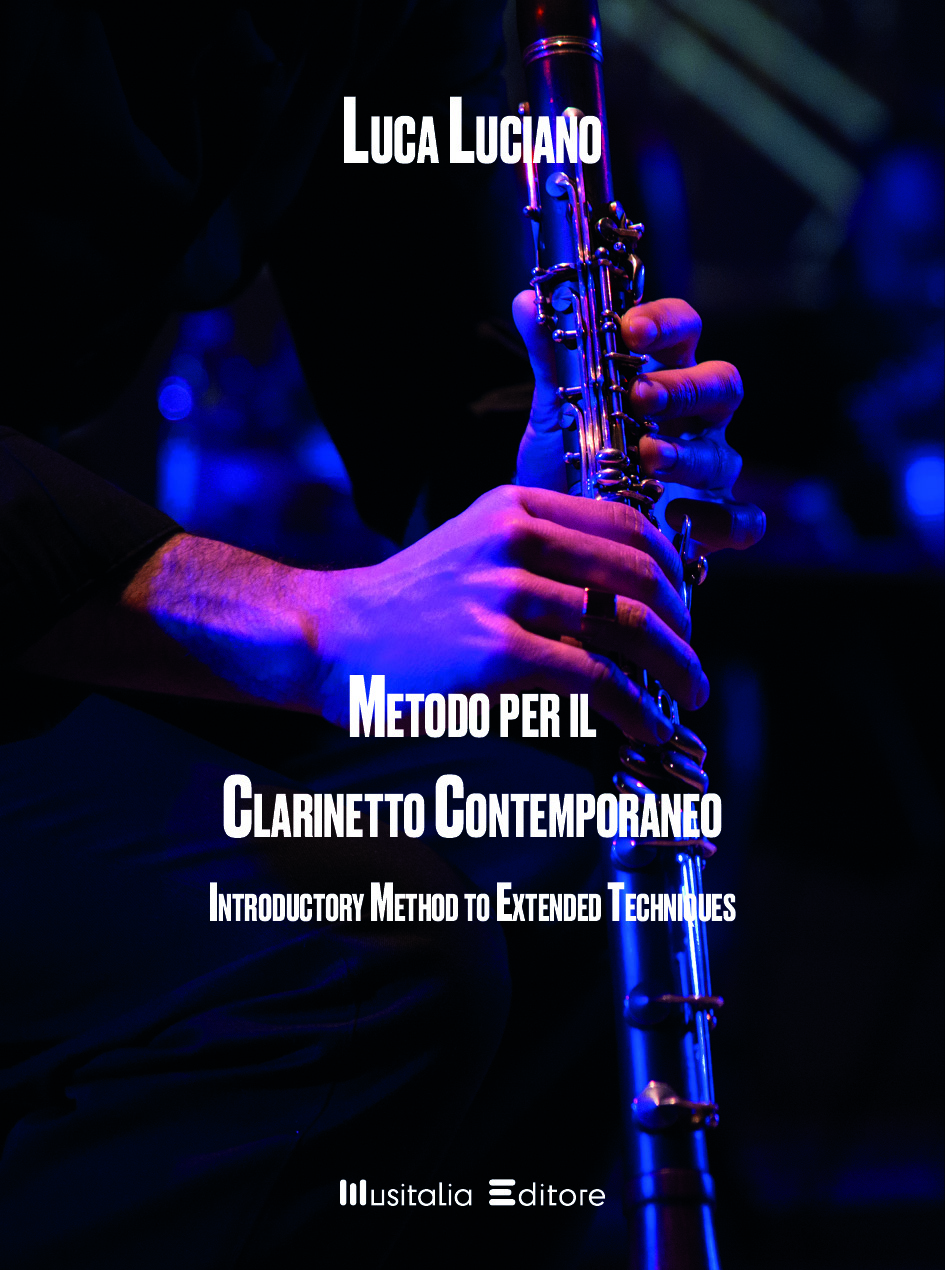 Luca Luciano. Metodo per il Clarinetto Contemporaneo (Introductory Method to Extended Techniques). Musitalia Editore, 2025. €29.90.
Acclaimed clarinetist, composer, and scholar Luca Luciano identified a need within the Italian- and English-speaking clarinet community for an accessible and progressive method with which to learn and teach extended techniques. His Introductory Method to Extended Techniques addresses this void as it seeks to avoid pedantry and encyclopedic density while “encouraging a process where [the included] techniques will in time become part of the preparation of any clarinetist.” He urges his readers/practitioners to go beyond the page and compose their own études using the techniques presented in the method: microtonal trills and tremolos, quarter tones, growl, flutter tonguing, glissando/portamento, multiphonics and dyads, voice in the instrument, and the “prepared” clarinet. He consciously limits the scope of his techniques, focusing on those likely to produce successful outcomes when conveyed with written instructions. Nevertheless, he includes a very helpful CD on which he performs each of the included études (34 separate études/compositions), providing clear models for the unique sounds of the various techniques.
Luciano divides his method into three parts. Part I contains most of the direct pedagogical material, with each technique receiving detailed explanations (in both Italian and English) and progressive fragments, exercises, and encouraging notes to help the player execute the techniques in various situations. Luciano provides fingerings where necessary but limits himself to one quarter tone or multiphonic fingering per pitch/sonority, so as not to overwhelm inexperienced players. The fingering diagrams use a combination of open/closed finger hole images as well as numerical shorthand from the standard Klosé/Rose fingering charts for keys. For those unfamiliar with this shorthand (i.e., 7, 8, 10bis, 11 ascending the four right-hand upper-joint side keys), locating such a fingering chart/diagram will be necessary, as one is not included with the method. Luciano’s directions for producing each effect, paired with his recordings, create efficient goals, and his experience as a professor clearly informs his delivery. His method takes a unique approach to multiphonics, spelling only the uppermost “goal” note on the staff for voicing purposes, thereby preventing inexperienced players from seeking to produce every pitch in the array of possible resultant tones. This also allows him to use the same fingering for different multiphonics; he instructs players to visualize “a different phoneme, for example an ‘ee’ rather than an ‘ah’,” as they aim for different pitches. Luciano’s final chapter in Part I, “The ‘Prepared’ Clarinet,” serves both to introduce players to novel treatments of the instrument (cigarette paper as resonators for tone holes, bell off, buzzing in the barrel, etc.), and as an inspirational template for further exploration.
Part II and the final part, labeled Appendix, contain Luciano’s compositions. The method’s introduction cautions, “It is paramount that the first part of the book is thoroughly absorbed before studying Part II and the Appendix.” Where the exercises and études in Part I focused on one technique at a time, the études in Part II each incorporate multiple techniques, sometimes simultaneously, to build fluency. The Appendix provides examples from Luciano’s own compositions, allowing diligent students to experience the techniques as they might appear in the wild. Luciano composes in a thoughtful and intuitive style, his background in jazz and free improvisation informing many of the gestures and colors. The limited technical scope of the études and compositions keeps the focus on facility with the extended techniques, avoiding the frustration that sometimes accrues while learning new complexity warhorses. Luciano’s method is a welcome addition to contemporary clarinet pedagogy and is recommended for anyone seeking an access point into extended techniques.
– Matthew Nelson
MUSIC
 Johann Sebastian Bach. Six Suites for Unaccompanied Cello, BWV 1007-1012. Arranged by Jeff Anderle. Alea Publications, 2025. $24.00.
_____. Six Suites for Unaccompanied Cello, BWV 1007-1012. Transcription by Daniel Dorff. Theodore Presser, 2026. $22.00.
_____. Six Suites for Unaccompanied Cello, BWV 1007-1012. Edited by Michael Drapkin. Drapkin Music Publications, 2026. $41.00.
Johann Sebastian Bach’s Six Suites for Unaccompanied Cello are without a doubt core repertoire for bass clarinet. They are played widely as both études and performance pieces, and by orchestral players and soloists alike. We know that even Eric Dolphy played Bach, as his handwritten transcription of the Prelude from Suite One exists and is housed in the Library of Congress.
Bach likely wrote the Six Suites at some point between 1717 and 1723, but both the original draft manuscript and an assumed fair manuscript (likely 1720-1730) are lost. We have four early manuscript editions by copyists by Anna Magdalena Bach, ca.1727-31 (Source A), Johann Peter Kellner, in 1726 (Source B), and Johann Nikolaus Schober, between 1750-99 (Source C). A fourth version by an anonymous copyist from the late 1700s (Source D) also exists. All four of these are available to view and study on IMSLP, and there are various Urtext cello editions based on these copies, which do have variations in details (e.g., slurring and ornamentation). All have differences, and the lack of the original manuscript to this day leaves us with endless questions as to the composer’s original intentions.
There are numerous ways of approaching the cello suites in terms of bass clarinet editions, as well as simply reading off a cello part. Three new editions have come along at the same time, and all offer a different approach and ideas. There can be endless discussions on which key to play them in and whether we should play them in bass clef or read a treble clef transcription, and these three add to this ongoing debate, but interestingly, all stay true to the original written pitch rather than offering a transposed edition.
Jeff Anderle has published his edition through Alea Publishing. The Suites are written at sounding pitch (so not transposed) and in treble clef, with this edition being very cleanly notated and easy to read. Keeping the suites at written pitch is also my personal choice, as it means we use our low C in several of the suites and thus the full bottom range of the instrument. The editor’s notes reveal Anderle’s approach and intentions and justify not adding any articulation to his edition. They can be found at the end of the book, and it is essential to read these notes first before attempting to play and interpret, so you can engage with the advice given. To quote Anderle, “Preparing the cello suites for public performances requires some critical engagement with the source material,” and “My goal with this decision is twofold: to optimize them for ease of playing on the bass clarinet, and to create opportunities for performers to utilize curiosity and critical thinking as they prepare their interpretation.” Anderle also acknowledges the challenges of translating these works from cello to bass clarinet, and I wholeheartedly agree with his view of “do what sounds best to you.” Ultimately, we can play these works in many ways, but they present one of the best opportunities in our repertoire to listen and focus on the sound we make. One interesting concept that is presented in this edition is looking at how we can replicate tonal changes of crossing strings for the same note, and Anderle has found some interesting fingering choices to help achieve this on the bass clarinet, something that is worth us all experimenting with.
Daniel Dorff has published his transcriptions and a study guide with Theodor Presser. The transcription and concept are almost identical to Anderle’s, with the only real difference being the differences in printing and paper between the two editions. Like Anderle, Dorff also gives a set of instructions by means of a study guide. Dorff appears to prefer to explore to discover your ideal interpretation. Whilst it gives freedom, I prefer Anderle’s approach of advising engagement with the various cello editions—especially the researched Urtext publications. That said, Dorff quite rightly addresses HIPP (historically informed performance practice) based questions around flexibility of factors such as ornamentation and embellishment, and factoring in that improvisation was common in the Baroque period. Should a player engage with HIPP research and take inspiration from the study guide, then this edition is worth exploring.
Published by Drapkin Music Publications, Michael Drapkin offers a different approach and has kept the suites in bass clef. This is my personal choice of clef—partly because it’s what I’m used to, but also because, as solo, chamber, and orchestral players, it is useful to have works to play that feature the bass clef, and it certainly helps us to improve our essential employability skills. Drapkin writes, “These suites were conceived for cello, not bass clarinet, and they are often written in ways that do not naturally ‘lie’ on our instrument.” His transcription takes this thought as a starting point, and some of his key decisions are around articulation and slurring. He also writes that “these suites are conceived for bowing, and cello slurs do not always translate to wind articulation. Many slurs have been rewritten to suit bass clarinet and resonance.” Whilst that is a good point made, I would argue that our breath is our bow, and our tongue acts as a change of bow direction. For me, becoming a cello and a cellist when I play these suites on bass clarinet is central to the success of making the pieces work as musically and as authentically as possible. Drapkin presents a unique way of articulating the Prelude of Suite One, but for me, this doesn’t work and takes away from the flow and line that the Urtext cello editions (based on the early handwritten copyist editions) indicate. Drapkin also chooses to put in some leaned emphasis marks—for example, the first upbeat to the Courante in the First Suite implies a long, bold emphasized note, but this contradicts the sound and feel of the up-bow that a cellist would use and the lift that goes with it onto the down-bow of the next bar. These decisions for me personally don’t work, and I would naturally revert to my own cello edition for slur and phrase indications.
The one really valuable transcription that features in all editions is that they all take away the tenor clef complications of Suite Six. It is very nice to now have treble and bass clef versions of this suite that are easy to read, as this is one of the suites that is often not explored by us as bass clarinet players due to the clef complications. I will look forward to looking at one of the treble clef copies and adding Urtext bowings to these.
In addition to the three new and Urtext editions, there are other publications for bass clarinet that can be consulted, including:
Frédéric Boulanger, Ocellario Éditions, 2014—transposed to sounding pitch and based on the manuscript attributed to Anna Magdalena Bach, as edited by Alfred Dörffel and published by Breitkopf & Härtel in 1879, as wells as the manuscript attributed to Johann Peter Kellner.
The Unaccompanied Cello Suites of J.S. Bach (1685-1750), expertly arranged for solo bass clarinet by Michael Davenport. Transposed to sound in the original key.
In “Precarious Presumptions and the ‘Minority Report’: Revisiting the Primary Sources of the Bach Cello Suites” (Bach: Journal of the Riemenschneider Bach Institute, 45, no. 2 (2014): 1-33), Zoltán Szabó wrote: “In March 2013, a new edition of Johann Sebastien Bach’s solo Cello Suites became available. I believe this to be the 106th new edition.”
So which edition?
Ultimately, for us bass clarinetists, the edition will be personal. Some will want to read in bass clef; others would like to read in treble clef. Others will want to play at written pitch, others at sounding pitch. Any of these are justified, and it’s great that we now have editions that give us all options. Whichever transcription we play of the Bach cello suites, it is imperative that we play them with the cello in mind. To have an understanding of bowing is vital in helping us as bass clarinet players to be able to interpret with appropriate phrasing and weighting of certain notes and beats. The first note of the Prelude of Suite Three, for example, is played with an up-bow and not a down-bow. If we replicate this on the bass clarinet, it really helps us create the right sound and capture suitable articulations and phrase lines. I enjoy listening to the recordings of Steven Isserlis and Yo-Yo Ma, who help me engage with cello technique combined with musicality.
For me, I will always read from the cello part. I’ve had my Urtext copy now for over 25 years, and it reminds me to be mindful and respectful of the composer’s original intentions. That said, I look forward to having a copy in written pitch of the Sixth Suite, which I have always struggled with due to the large amount of tenor clef writing in the cello part.
Finally, I would highly recommend reading The Bach Cello Suites: A Companion, by cellist Steven Isserlis (London: Faber, 2021), which really gave me inspiration and a fresh view on how to approach these on bass clarinet.
– Sarah Watts
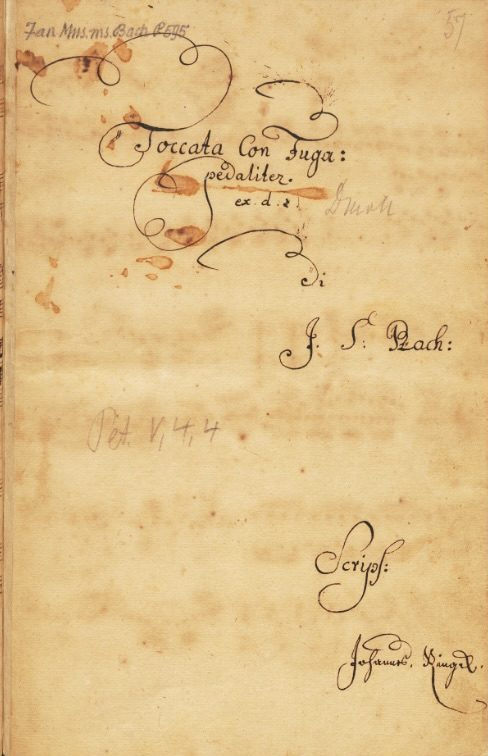 Johann Sebastian Bach. Toccata and Fugue in D Minor, BWV 565. Transcription for unaccompanied clarinet by Joseph Eller. Self-published, 2013. $15. [email protected]. Performance Link 1. Performance Link 2.
How do you make a clarinet sound like a keyboard instrument, with its wide melodic range, capability to play chords, and potential for multiple instrumental voices in counterpoint? This is the question that Joseph Eller, professor of clarinet at the University of South Carolina and principal clarinetist of the South Carolina Philharmonic, skillfully answers in his virtuosic and demanding solo clarinet transcription of Johann Sebastian Bach’s Toccata and Fugue in D Minor, BWV 565.
Eller utilizes the full range of the clarinet, dramatically beginning the iconic toccata on an altissimo B before cascading all the way to the lowest chalumeau E. He transforms what would have been chords on the organ into rapid and wide-ranging grace notes designed to emulate chord arpeggiation on a keyboard instrument. The toccata is the most demanding section of the piece, featuring a plethora of 32nd and 64th note passages, rapid intervals across register changes, and reaching all the way to altissimo C. That all being said, there is plenty of room for rubato and flexibility to both emote and to provide strategic points of relief for the performer.
The fugue is perhaps less imposing in terms of velocity, but more than makes up for it in terms of the musician’s stamina and endurance: nearly 100 measures of seemingly unending 16th notes mostly (but not always) confined to the clarion and chalumeau registers. The idea of counterpoint (so crucial to a fugue’s nature) is somewhat lost in this adaptation for clarinet, with Eller almost invariably assigning the head motive and the resulting melodic development and fragmentation to the clarinet. He generally uses the same register for each successive fugal voice as Bach does in the original version, but never at the expense of melodic contour and musical direction. The concluding recitative returns to the technical and stylistic challenges of the opening toccata: rapid scalar figures in 32nd notes and extensive use of grace notes to imitate densely voiced chords on a keyboard instrument that cannot be authentically rendered on the clarinet. The final Molto Adagio, where Eller transforms a homophonic texture into an increasingly tense succession of chordal arpeggiations for clarinet, provides a breathtaking conclusion to the piece.
Perhaps to remain faithful to Bach’s original version for organ, Eller provides very few editorial articulations, tempi, or phrasing ideas. By leaving these to the individual performer’s discretion, this becomes not only a technical exhibition for the instrument but also a grand study in musicianship and expression.
Eller’s transcription is an excellent balance of challenge and reward, on par with Stanley Hasty’s beloved transcription of Bach’s Chromatic Fantasy, BWV 903. Eller’s masterful studio performance of this publication (albeit with some occasional differences in register) is available on his commercial recording Bach in Time. This would make an excellent recital piece for an advanced student or professional, or simply as a wealth of study material for anyone interested in exploring Bach’s music on the clarinet at a high level.
– David Cook
 Various Composers. Tributes for unaccompanied clarinet. Edited by Manuel Martínez. Proventis Music, 2025. 126 pages, €59, spiral-bound print or digital. Performance Link 1. Performance Link 2.
Valencian clarinetist Manuel Martínez is praised for his unique programming and his versatile, virtuosic stylistic and technical abilities. He collaborates to deliver multimedia experiences in his show, Sonoro Infinito, blending cinematography and choreography with new compositions performed on multi-effects pedals. He is also known for his program, Iberian Resonances, a series of commissions for clarinet and piano by present-day composers who pay homage to traditional Spanish and Catalan music.
In his most recent project, Tributes, Martínez offers the clarinet community 33 unaccompanied solos written for him by colleagues, each a retrospective or reimagination of works by famous historical composers, spanning from the Medieval period through the late 20th century. Regarding his role in the project, Martínez writes, “We refined each piece in detail until reaching a balance between techniques, styles, languages, colors, and textures.” Martínez encourages clarinetists to perform these on any clarinet, from E-flat soprano to low clarinets. The short compositions give performers opportunities to learn about the two distinct artists represented in each, as well as a multitude of styles, some of which include contemporary notation. As an example, Antón Alcalde writes multiphonics with diagrams, pitch-specific whistling passages, finger snaps, and key clicks as part of his Bernstein West Side Story tribute, “East … Side, Tidbit?”
While there are no full recordings available of these pieces yet, Martínez has a teaser on his Instagram account, @manuelmartinezclarinet. He performs part of the first solo in the book, written by Johan de Meij, who is famous for his numerous works for band and orchestra. Il Barbiere Confuso references motives from Rossini’s comic opera, The Barber of Seville, and requires the clarinetist to perform key clicks, to sing through the mouthpiece, and sing outside of the instrument in a bel canto style, alongside standard notation and ornamentation from the Classical and early Romantic periods.
Several other short social media clips promote Tributes, recorded by Martínez and a few of the book’s composers. One such video features the prolific Stephen Melillo talking about his work, I Remember George. Melillo opens with a low E trill that smears up to an altissimo G, alluding to George Gershwin’s famous opening clarinet solo in Rhapsody in Blue. While all the notation is traditional, the work requires performers to subdivide well, to play in a swing style at times, and alternates between simple meter and 5/16 passages. The acclaimed clarinetist David Krakauer also publicizes his brilliant genre-blending composition, Doina/Taksim à la Kodály, on social media. He cleverly weaves a meditative, Klezmer-Romanian improvisatory solo with passages from Dances of Galánta by the Hungarian composer Zoltán Kodály. This music is presented without measures, but has clear sections marked by fermatas. The performer must use timbral fingerings, play notes raised a quarter tone, must ghost notes, and play in a rubato style.
Certainly, we have a few excellent collections in our clarinet repertoire filled with references to illustrious musicians from the past, such as Hommages by Béla Kovács and Victor Polatschek’s Advanced Studies for the Clarinet. However, this text is remarkable because of the 33 living, world-renowned composers who contributed, including Jack Stamp (Copland), Andy Firth (Rodrigo), Albert Gumi (Messiaen), Brian Banks (Hildegard von Bingen), and Gabriel Amargant (Stravinsky), as well as those cited above, to name a few. Though this review does not describe all the works, rest assured that each has the potential to be an excellent addition to your concerts across jazz, avant-garde, art music, and folk genres. Undoubtedly, clarinetists should place Manuel Martínez’s impressive compilation of unaccompanied solos, Tributes, in their libraries, as it offers an accessible way for them to learn a diverse range of musical styles and techniques representing 66 distinguished composers.
– Meghan Merciers
 Daniel Dorff. Slippery Slopes for Mixed Clarinet Sextet (or Ensemble). Theodore Presser, 2025. $34.99 (score and parts).
Slippery Slopes was commissioned by the Slippery Rock University Clarinet Choir under the direction of Amanda Morrison and premiered by that same ensemble in 2023. It is scored for four B-flat clarinets, two bass clarinets (low range limited to E-flat), and an optional B-flat contrabass clarinet part. The inspiration for the music carries personal significance for the composer. Dorff began composing it in September 2022, during which time he learned of the passing of his former teacher, Ron Reuben, bass clarinetist with the Philadelphia Orchestra for 38 years and former saxophonist in the Stan Kenton Band. This versatility between jazz and classical styles is audible in the piece, which gives classically trained clarinetists valuable exposure to jazz-influenced music within a notated classical context.
This single-movement work opens with a 38-measure slow, expressive introduction. Bass clarinet one is prominently featured and begins the piece with an optional high G above the staff. The texture of this section is largely chorale-based, making it an effective vehicle for developing ensemble blend and group dynamics. Originally conceived as a middle movement for a larger work, these opening bars ultimately took on a life of their own; in Dorff’s words, they “just wanted to get up and dance.”
The second section does indeed dance, beginning with an energetic Allegro in 7/8 with occasional 4/4 and 3/4 measures, requiring rhythmic precision from every player. Demanding 16th note passages appear in all parts—both solo and tutti—and that, combined with the mixed meters, will provide an excellent challenge for a strong college clarinet ensemble. The writing is exciting and evokes big-band harmonies and salsa rhythms, resulting in a six-minute piece that is gratifying to perform and enjoyable for the listener.
– Robyn Jones
 Paquito D’Rivera. 12 Clarinet Quartets (two versions: three B-flat clarinets and bass clarinet, or E-flat clarinet, B-flat clarinet, basset horn, and bass clarinet). Boosey & Hawkes, 2021. Two volumes, €80 or $106.50 per volume. Performance Link 1. Performance Link 2. Performance Link 3.
When I was asked to review “a set of clarinet quartets by Paquito D’Rivera,” I could not have imagined the monumental multi-volume collection of 12 quartets that I eventually received. I was astonished. Any one of these substantial works—some nearly 10 minutes long—could have been published separately. But here they are together, all at once, in an embarrassment of riches. This is the single largest publication for clarinet quartet that I know of, and it significantly enhances the repertoire.
While these quartets are appearing in print suddenly and en masse, they have actually been in gestation for decades. Diverse iterations can be found on YouTube in versions for brass, wind quintet, jazz combo, big band, strings, and various configurations of clarinets and saxophones, often accompanied by percussion or cuatro. Such is the eclectic output of Paquito D’Rivera, one of our instrument’s most creative, prolific, and enduring virtuosi. Several of the pieces in this collection are arrangements of his jazz tunes, while others are more formal compositions. But, truly, for D’Rivera, the lines are blurry. His music naturally bridges genres and forms, all of it steeped in the sounds and musical traditions of Latin America.
The pieces bear evocative titles such as Dizzyness, The Elephant and the Clown, Cuban Sharks, and Bachxophones. Brief but poignant explanations of their origins and influences are provided in the introduction. For example, Vals Venezolano was inspired by guitarist and composer Antonio Lauro, A Farewell Mambo (To Willy) recalls Cuban “actor-comedian-writer-empresario” Guillermo Álvarez Guedes, and La Fleur de Cayenne, the French name for hibiscus, evokes the “beautiful Caribbean flower” in the form of a Venezuelan joropo. The music is challenging—appropriate for advanced undergraduate, graduate, and professional ensembles. For most classical clarinetists, the Latin rhythms and patterns will be an extra challenge, though the writing is highly idiomatic. If you know D’Rivera’s Three Pieces or The Cape Cod Files, you will have an idea of the harmonic language and level of difficulty found here. All four clarinet parts are given equal treatment, with melodies and solos distributed across the ensemble. “Solo improv” sections include chord symbols for improvisers, with fully notated fallback solos for non-improvisers. While complex and technically demanding, the pieces remain accessible to listeners. This is music that will be embraced by musicians and audiences alike. For a great overview of these works, check out Fantasías Barcelónicas: Tribute to Paquito D’Rivera, a fine recording by the Barcelona Clarinet Players that includes seven of them.
Publisher Boosey and Hawkes has split the quartets into three volumes, with each volume offered in two different instrumentations: for three B-flat soprano clarinets with bass clarinet, or for E-flat piccolo clarinet with B-flat soprano clarinet, basset horn, and bass clarinet. As of this writing, they are available as downloads only, with an average price per volume of €80 or $106.50. This digital format will be preferable for some, but it may prove frustrating for others, including music libraries and traditional “low-tech” consumers. Given the importance of these works, they should be made maximally available in a range of formats, including à la carte at lower price points.
Paquito D’Rivera has poured a lifetime of experience and joy into these fresh, energetic quartets. They are ideal for sharing among friends, studying in educational settings, and presenting in public performance. They will undoubtedly serve as a lasting legacy of his artistry.
– Daniel Friberg
 Jeff Beal. Concerto for Clarinet and Orchestra. E.C. Schirmer, 2014. Full orchestral and band score $80.00. Solo part and parts rental. Performance Link.
Jeff Beal is an Emmy Award-winning composer, a highly regarded instrumentalist, and a respected composer in the concert, theater, and dance worlds. In preparing this review, I focused on Larry Combs’s recorded performance of his Concerto for Clarinet and Orchestra, in conjunction with studying the orchestral printed score. I hear this work first and foremost as a performer’s piece. Even with its combined symphonic and film-like orchestration, the clarinet remains the true center of focus, with the ensemble more often supporting and highlighting the soloist rather than engaging in a traditional soloist-orchestra dialogue. The work’s cinematic quality comes from Beal’s keen utilization of a large studio orchestra-type instrumentation (including a saxophone section) and his presentation of the clarinet within a wide spectrum of orchestral colors.
In Combs’s performance, I hear beautiful clarity of sound across the full compass of the instrument, along with a beautiful fluidity in scalar passages and register leaps that all work effectively with Beal’s inventive writing to give the piece a strong sense of continuity and forward motion. The work was written for Combs and commissioned by the Commission Project in 1997, and is about 16:50 in length. It consists of two movements: “Richest to Rags” (about 6:42–6:58) and “Famines to Feasts” (about 10:12, or roughly 11:30 if the recorded split ending is counted separately). Published by E.C. Schirmer, it is available in versions for clarinet and orchestra or wind ensemble. What I find especially compelling is that the work is both demanding and idiomatic for the clarinetist: the technical writing necessitates an artist-level player, but the technical aspects of the lines always serve the underlying musical shapes and ideas, which are rooted in Beal’s expressive language.
The first movement, “Richest to Rags,” contains many angular rhythmic figures that remind me of some of Stravinsky’s works, though filtered through Beal’s own jazz- inflected phrases. At times, I also hear aspects of Hindemith’s writing. Yet, the music never feels like imitation. Beal has absorbed aspects of these composers’ styles into a voice that remains distinctly his own, which is part of what makes the piece so refreshing. The ensemble writing is especially strong—colorful, carefully planned, and consistently supportive of the solo clarinet. For me, that balance is one of the movement’s strongest aspects, as it allows the clarinetist to play with a wide spectrum of dynamics, stylistic subtlety, and rhythmic nuance.
The second movement, “Famines to Feasts,” contains haunting melodies, blues-styled inflections, and a more jazz-influenced harmonic language that gives it a different character than “Richest to Rags.” I find this movement especially intriguing from the clarinetist’s perspective. The lyrical writing feels very comfortable to play on the instrument, especially in the clarion and chalumeau registers, and Beal clearly understands how a clarinetist can connect large intervals smoothly while sustaining a flexible, singing line. Beal’s subtle sense of rhythm and meter also comes through here, especially in passages in which rhythmic groupings seem to be superimposed over a fundamental meter. This never feels forced; it sounds organic and convincing. At moments, I also hear traces of compositional aspects of Brahms, Stravinsky, and even Charlie Parker—never as imitation, always as part of Beal’s own language.
What I admire most about this concerto is that it gives the soloist real expressive freedom—rhythmically, stylistically, and tonally—while still providing enough written structure for the larger phrases and formal shape to remain clear. That balance is rare. In both movements, Beal includes improvised sections built over jazz-type chord changes, and those passages change the nature of the concerto in an important way. They require the performer not simply to execute what is on the page at a high level, but to contribute something personal and musically convincing from within the piece itself. This is very different from the model of a fully controlled modern concerto, in which the composer dictates nearly every detail, and the soloist’s task is primarily one of realization. Here, the player must bring imagination, stylistic fluency, and a genuine sense of individuality to the performance.
For that reason, I think this work addresses a real void in the clarinet concerto repertoire. There are still too few clarinet concertos that successfully blend improvisation with enough written structure to sustain a large-scale form, while remaining accessible to an audience. There is also a shortage of clarinet repertoire that truly insists on substantive training in both jazz and classical styles. Clarinet training today is often highly specialized, and this concerto pushes directly against that specialization: it asks the performer to be thoroughly versed in jazz language, comfortable shaping improvised material over changing harmonies, and grounded enough rhythmically to move convincingly between notated, technically advanced passages and spontaneous improvisation over a rhythmic background with underlying chord changes. In that respect, Beal’s concerto does more than offer technical challenges. It stretches the performer musically and stylistically, much in the spirit of the collaborative tradition behind the clarinet literature of Mozart, Weber, and Brahms—except that here the expansion is not only technical, but also stylistic. To me, that is one of the work’s most valuable contributions. It should be played more often, and it should also serve as a model for other composers: not simply to write harder music, but to write music that asks more of the player’s complete musicianship, personality, and artistic range.
– John Cipolla
 Sami Seif. Duo for Flute and B–flat Clarinet. Self-published, 2024. Free. www.samiseif.com. Performance Link.
Duo for Flute and B–flat Clarinet was written in 2024 by Lebanese composer and music theorist Sami Seif (b. 1998). Seif’s music is known to be “inspired by the aesthetics, philosophies, paradigms, and poetry of his Middle Eastern heritage.” Self-taught to read and write music, he went on to formally train in piano, composition, and audio engineering, obtaining undergraduate degrees in composition and music theory from the Cleveland Institute of Music; he is currently a doctoral fellow at the CUNY Graduate Center. Seif’s opus included many works for chamber and solo winds, but this is his first work featuring clarinet; he indicates a “growing interest in writing more music that meaningfully engages the clarinet.” To learn more about the composer, visit www.samiseif.com.
Duo was dedicated to Maron Khoury, Israeli/Arab flutist and newly appointed second flute for the Metropolitan Opera Orchestra. The work was premiered by Caleb Chesnic (flute) and Ben Chen (clarinet) at the Greater Cleveland Flute Society Composer Connection Concert in 2025. The recording from this premiere can be found on YouTube and lasts approximately three minutes.
In the program notes in the score, Seif describes the work as “driven by perpetual motion, even in moments of apparent restraint. A central organizing principle is heterophony, a common feature of Middle Eastern musical traditions, through which closely related lines continually diverge and realign. Rather than moving through discrete sections, the music evolves through continuous transformation, maintaining forward momentum from beginning to end.” The score includes performance notes, which explain the notation of unmetered music, quarter tone fingerings for both flute and clarinet, etc. Additional extended techniques used in the work include tongue ramming (flute), humming and playing, flutter tonguing, glissando (clarinet), and improvisation on a given set of pitches.
The work begins with an eerie and ethereal melody in the clarinet, which is punctuated by percussive tongue ramming of the flute. This section is labeled cadenza. The eerie feeling is continued as one instrument presents a melodic line while the other trills. It is clear to see and hear the continuity of line between the interweaving instruments. The interaction between the two lines produces a unique sonic landscape that is the culmination of percussive effects of the flute, quick trills, the warmth of the clarinet in the upper chalumeau register, and quarter tones. The harmonies are surprising, often quickly alternating between dissonances and consonances.
The latter half of the work, labeled “flowing and hypnotic,” features quick interlocking motives between the flute and clarinet, alternating between fluttering in the flute and rapid 32nd notes. The flute flutter tongues while the clarinet plays rapid 32nd notes, and the flute plays rapid 32nd notes while the clarinet trills, producing a sort of hocket effect. The finale of this short work features a section that is improvised, given a set of pitches, both in a staccatissimo and legatissimo style, lasting for 10 to 12 seconds and five to six seconds, respectively. This section fades to an ordinary sustain, which transitions to playing and humming simultaneously, and finally ends with both performers humming only. In general, the piece feels rhythmically free, starting with a cadenza, and alternating between different simple and compound meters, including a measure in 3+4/8, ultimately skewing the listener’s sense of pulse.
Duo is very engaging to listen to because of the nature of its short sectionality and constant interaction of the alternating flute and clarinet parts. The composer creates great textural variety and an interesting soundscape through both traditional and extended techniques. This work would be appropriate for intermediate to advanced players who are looking to dip their toes into contemporary music with a limited number of extended techniques.
– Kelsey Paquin
Comments are closed.