


Originally published in The Clarinet 53/3 (June 2026).
Copies of The Clarinet are available for ICA members.
Book and Music Reviews:
June 2026
BOOKS
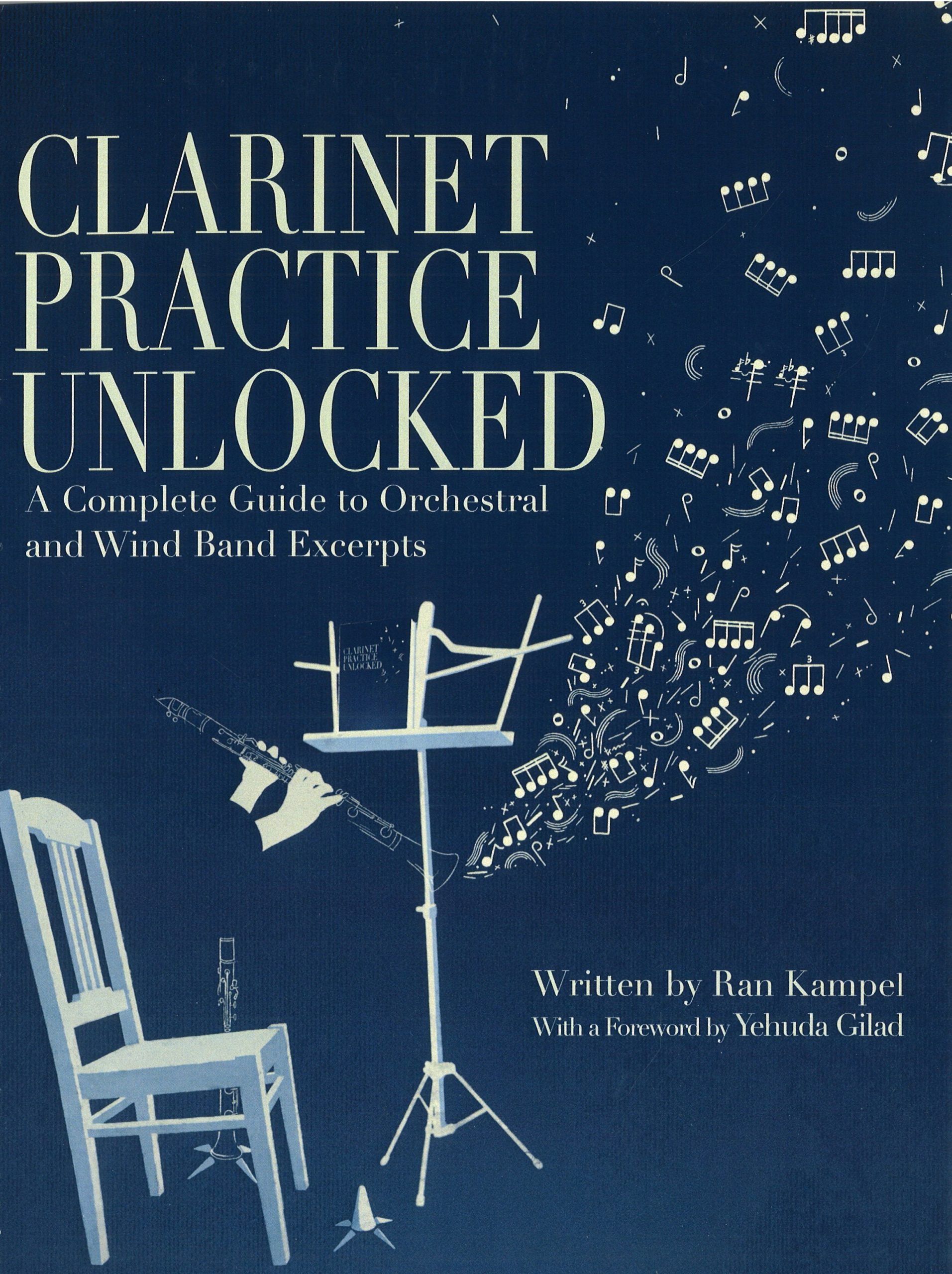 Ran Kampel. Clarinet Practice Unlocked: A Complete Guide to Orchestral and Wind Band Excerpts. Conway Publications, 2025. $32.
Ran Kampel’s A Complete Guide to Orchestral and Wind Band Excerpts presents a well-organized and unique approach to learning orchestral and wind band excerpts in preparation for auditions. Kampel’s approach blends thoughtful, positive-minded pedagogy, introducing 26 detailed practice techniques that are applied to the excerpt examples throughout the book. The book contains 80 standard excerpts from orchestral, opera, and wind band literature. The author presents his ideas about studying these excerpts in an encouraging tone that helps the player to learn this material more deeply and permanently than through mindless hours of simple repetition, which often does not result in long-term consistency.
The author’s encouraging words of “Be patient with yourself! Progress takes time and often is not linear,” resonated with me both as a player and as a teacher. The introduction begins by defining the purpose of practicing, followed by the value of facing failure, setting goals, tools needed to practice, ways to evaluate and optimize progress, and a strong emphasis on slow practice. The chapters focus on using a metronome, shaping the air, intonation, technique, dynamics, articulation, and breath. I found the author’s ideas about playing with air only to be quite effective, particularly in smoothly connecting intervals. I applied his technique of playing with air only to the Brahms Symphony No. 3 and Sibelius Symphony No. 1 excerpts provided, which helped me to hyper-focus on subtleties of my articulation and dynamics, all very enlightening. The chapter on using a metronome includes exercises on varied off-beats and on big beats of a bar. This helps the player focus on developing a strong inner sense of pulse, particularly while counting rests.
The author’s Practice Method 8, “Speed Games,” suggests playing excerpts at different tempi to reveal musical challenges that may be overlooked when playing at the normal tempo. For instance, when I practiced the Shostakovich Symphony No. 9, movement II excerpt at various faster tempi, I found that I was hearing the shapes of the lines more clearly, and then when I returned to a slower tempo, I was able to retain the forward-moving flow and shapes of those lines at the correct, slower tempo. I also tried this method with his suggested excerpt of Grainger’s Lincolnshire Posy, “The Brisk Young Sailor.” Playing this excerpt at a slower tempo helped me to refocus my practice on lyricism and the beauty of sound and dynamics, instead of focusing solely on speed and accuracy. The author’s approach to studying intonation, encouraging “flexibility” instead of “being right,” resonated with me both as a teacher and as a player. This is something that I focus on with my students, and I found the author’s explanations and rationale to be quite compelling.
The author’s focus on awareness of tuning both melodically and harmonically was clearly presented and thoroughly supported with practice examples. Some key points about intonation were: prioritizing tone quality over playing in tune with a compromised sound, focusing on playing with accurate tuning, intervallically in relation to preceding and following notes, giving extra focus to leading tones and thirds within a chord (thinking harmonically), retaining a memory of pitch at the end of a phrase, when beginning a new phrase after a rest, and retaining accurate pitch after breaths to not tend towards playing sharp. All these suggestions emphasize the importance of flexibility. The ideas and approaches in this book have been tested through many hours of practice by Kampel. Multiple excerpts support each chapter topic. The “Practice Reflections” follow the practice methods throughout the book, offering a personalized challenge to the student to reflect on their own practice. The final portion of the book contains a section of orchestral and wind band excerpts, to which the methods can be applied.
This resource should unequivocally be on the shelf of all teachers and advanced clarinet students. It offers a methodical approach to studying this repertoire and preparing for auditions, while also simultaneously strengthening the fundamentals of a player’s overall musicianship.
– John Cipolla
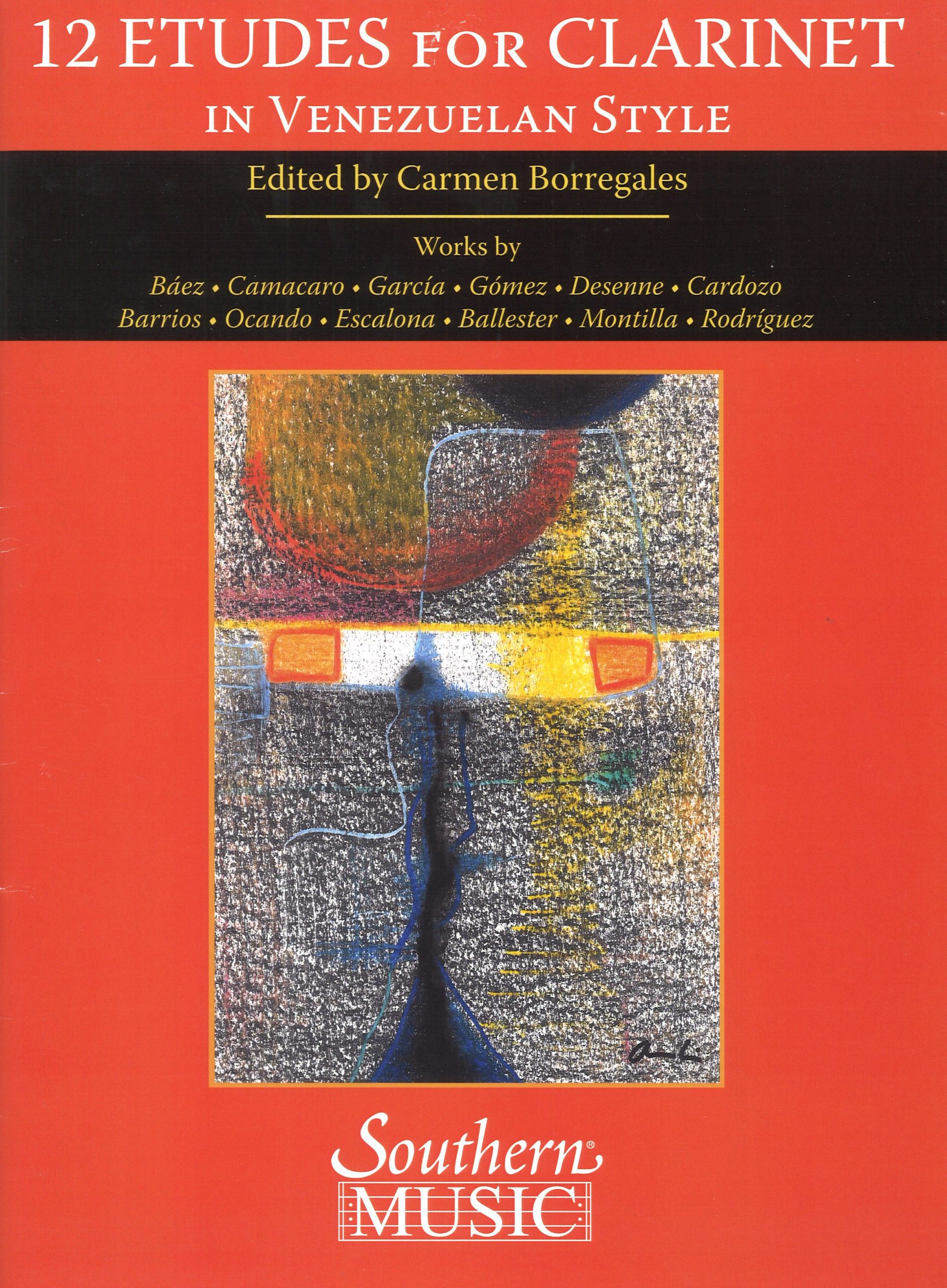 Various Composers. 12 Études for Clarinet in Venezuelan Style. Edited by Carmen Borregales. Southern Music Publishing, 2025. $19.99. Performance Link.
12 Études for Clarinet in Venezuelan Style, edited by Carmen Borregales, is a delightful and significant addition to the canon of clarinet repertoire. Each étude is meticulously crafted, making them excellent candidates for recital performance as well as important pedagogical tools for the advanced player.
Carmen Borregales is the former Principal Clarinetist of the Simón Bolivar Orchestra. Her musical education stems from the renowned El Sistema program in Venezuela, where she excelled as a young clarinetist. She has built a significant career as both an educator and musician around the world. Her extensive performance and teaching experience are evident in the meticulous editing of 12 Études.
Expressive and engaging, 12 Études will quickly join the ranks of the highest level of études for clarinet. Borregales commissioned 12 Venezuelan composers to write these pieces, providing them with specific genres, references, and skill/technique parameters. Each one is written in a different style that explores both the musical landscape of Venezuela and the full range of timbral and musical possibilities of the clarinet. Borregales has recorded all the études, and they are available on YouTube as a pedagogical reference to the stylistic, rhythmic, and expressive elements.
12 Études provides a write-up for each piece and composer, describing the purpose of each work and the history of its genre. In these descriptions, Borregales identifies the folk elements and pedagogical goals of the pieces, along with detail about the desired effects and outcomes. She also writes briefly and charmingly about the stylistic underpinnings and regional rhythms of each work. Composers include many notable musicians, such as Jorge Montilla, Andrés Barrios, Pablo Camacaro, and others. The works are elegantly and beautifully written, highlighting all of the gorgeous timbral and technical possibilities of the clarinet.
12 Études fulfills an important need in the clarinet ecosystem, not just for music from Venezuela, but also for effective contemporary études. This collection joins the landscape of études by Cavallini and Rose, while incorporating the articulations, syncopations, and phrasing of genres from Venezuela. The études marry traditional style with contemporary underpinnings in an effective and satisfying combination for both clarinetist and audience. Not only are the works significant pedagogical innovations, but they also effectively canonize folk traditions for the student or professional.
Since I received 12 Études, they have not left my music stand, and I have enjoyed using them extensively in my own teaching and practice. Challenging yet accessible, they are the perfect combination of technique and musicality. I highly recommend them to any teacher or player looking for fresh and inspiring works to add to their daily routine.
– Stephanie Zelnick
 Erin Cameron. Bass Camp: A Training Manual for Bass Clarinetists. Alea Music Publishing and Recordings, 2025. $20 PDF and hard copy.
Dr. Erin Cameron is an American clarinetist and bass clarinetist and is currently assistant professor of clarinet at Arkansas State University. She has studied at the University of North Texas, Bowling Green State University, and Northwestern University. Cameron has written a new guide to learning the fundamentals of bass clarinet playing. She states in the introduction that the book is intended for high school-age or early college-age musicians, or for those of any age who are new to playing bass clarinet. This text fulfills that goal, and in fact, I have already started incorporating the book into the lessons of my own bass clarinet students. The text is divided into three major sections: Long Tone Warm-ups, Scale Exercises, and Technique Pages, along with a series of appendices and a web-link that provides additional information on equipment (mouthpieces, reeds, ligatures, and instruments), recommended performers, method books, repertoire, and other online resources.
I appreciate the thoroughness with which Cameron has compiled and organized this material. The musical examples are printed large enough to be easily visible (those of you who know me know how important I find this). The book doesn’t try to overstep its mission. Cameron gets to the point, presents it thoroughly but not redundantly, and makes sure that the visual presentation is clear. There is no attempt to explore multiphonics or other extended techniques. Other books do a great job of this. But this book is concerned with fundamentals and does a wonderful job of presenting them. One other thought: in working with student bass clarinetists, I have noticed their hesitance to play notes in the clarion register at all, never mind the altissimo. This book doesn’t shy away from exploring those registers early on, which I commend. Cameron gets the student into clarion register work on the second page of the warm-up section, and into the altissimo on the fifth page. By page 10, the student is playing an altissimo G. I think that this is an important aspect of modern bass clarinet performance and should be encouraged. Highly recommended.
– Timothy Bonenfant
MUSIC
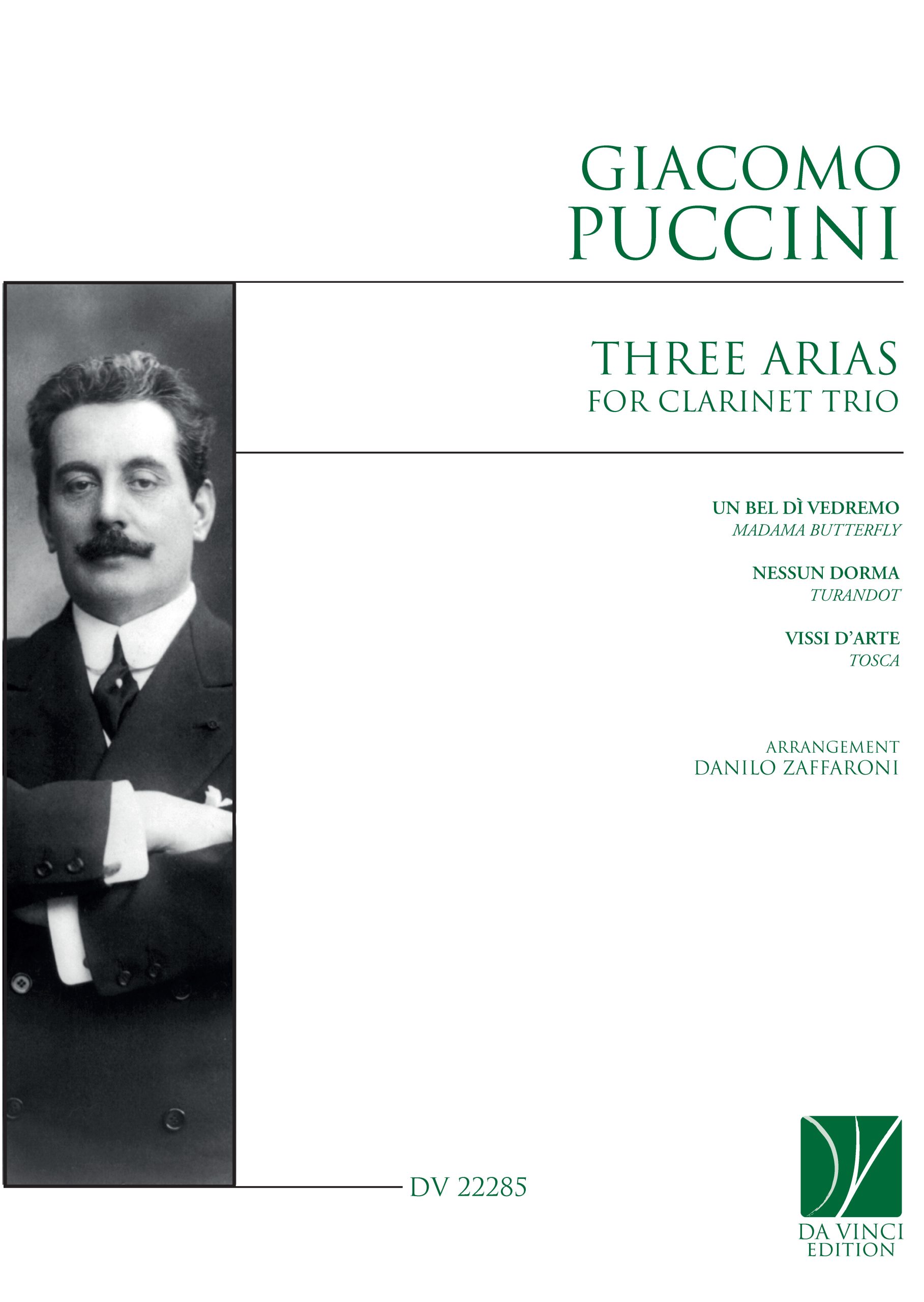 Giacomo Puccini. Three Arias for Clarinet Trio (three B-flat clarinets). Arranged by Danilo Zaffaroni. Da Vinci Edition, 2025. €16.90.
Here is a recent publication of three significant arias chosen from the many written by Giacomo Puccini (1858-1924) in his beautiful operas. Puccini was, after Bellini, Donizetti, Rossini, and Verdi, a very important proponent of the Italian opera repertoire in the last part of the 19th century and the first decades of the 20th century. His operas La Boheme, Tosca, Madame Butterfly, and Turandot gained tremendous popularity for their deep feelings described through both text and music, enriched by Puccini’s unique command of melody.
Danilo Zaffaroni, an Italian bassoonist, teacher, and composer, offers us three wonderful adaptations of Puccini arias arranged for three clarinets: “Un bel di’ vedremo” from Madame Butterfly (1904); “Vissi d’arte” from Tosca (1900); and “Nessun Dorma” from Turandot (1924, unfinished). Da Vinci Edition has prepared a very nice edition of these arrangements. Located in Japan, Da Vinci is also (and above all) a recording label with hundreds of publications. These aria arrangements are a good way to enjoy such masterpieces in a small, flexible chamber music ensemble. A very welcome addition to the repertoire!
– Luigi Magistrelli
 Jonathan Russell. Still Here for clarinet and piano. Self-published, 2022. $35. Performance Link.
Still Here for clarinet and piano by Jonathan Russell is a powerful work, composed in 2022. Another exciting aspect of this piece is that Russell also did an arrangement for clarinet and orchestra, and it premiered at ICA ClarinetFest® 2025. It is also interesting to note that it was commissioned by 52 clarinetists. The composer does an excellent job providing program notes for this four-movement work. He discusses how he was influenced by a selfie video of defenders of Ukraine in the face of Russian aggression in 2022, as they stated, “We Are Here. Still Here.” Russell states that he was moved by Ukrainian President Volodymyr Zelensky’s “calm resolve and courage.” Russell drew a parallel to his own Jewish heritage, which is represented in one of the movements.
The first movement begins with an eight-measure clarinet solo in the chalumeau register on double-dotted rhythms. It is soft and slow and has a mournful quality. It moves up in tessitura and intensity as well as tempo. The piano also plays a flowing line up and down, and the clarinet builds to a climactic high F before it shouts on a low E, recalling the opening dotted rhythm once more.
The second movement is a scherzo and is incredibly fast and energetic. The main theme uses eighths followed by 16ths and a pattern of 16ths in chromatic motion. Towards the middle, a klezmer tune appears, followed by a return to the theme from movement one. The composer says that he struggled to accept a “playful, humorous music that seemed to want to be a part of this piece … but then read an article about the thriving stand-up comedy scene in Ukraine and thought about the rich comedic tradition in my own Jewish heritage.” The third movement is, as the composer states, a “simple love song tinged with nostalgia.” The composer notes, “if you play with vibrato, this movement is a great time to use it!” It is moderately slow in 12/8 and has a cadenza to be played freely and improvisationally at the end.
The fourth movement has a wild, klezmer-like quality. It is marked “defiantly joyful.” It is indicated that players with experience might ornament and ad lib, but this is not required. Thematic material from earlier movements reappear, and the music returns to a low E (as in the outset of the first movement). Russell comments: “It comes back around to say, ‘We Are Still Here.’”
– Katrina Phillips
 Iván Enrique Rodríguez. Sonata Santera for clarinet and piano. Self-published, 2021. $35. Performance Link.
Sonata Santera (17’) is a three-movement work that, according to the composer, draws upon three ritual practices within Santería: the espojo (cleansing), the ofrenda (offering), and the bembé (an energetic, rhythmically driven celebration). These rituals are prevalent in Puerto Rico and throughout Latin America and reflect a syncretic cultural tradition shaped by African diasporic practices, Taíno heritage, and Catholic elements introduced through European colonization and the transatlantic slave trade.
Movement I, Espojo, is characterized by vigorous contrapuntal writing that alternates with expansive lyrical passages, consistently interweaving these contrasting textures throughout the movement. Rodríguez employs dramatic gestural flourishes to articulate formal divisions and heighten structural clarity. Episodes of call-and-response dialogue frame the principal thematic material and contribute to the sense of forward momentum. Precise rhythmic coordination is essential for both performers as these contrasting textures exchange prominence within the ensemble. Through these compositional strategies, Rodríguez creates richly stratified sonorities. The clarinet and piano function in a balanced, chamber-like partnership, each complementing the other’s timbral and expressive roles. The clarinetist must exhibit secure control of the altissimo register and articulate with agility across all ranges. At the same time, the pianist must exercise refined sensitivity in balancing the subtle shifts of texture and dynamic nuance.
Movement II, Offrenda, unfolds as a serene, contemplative meditation, characterized by a calm, flowing melody enriched by luminous harmonic colors. The performers are required to sustain a seamless legato and exercise refined control across wide intervallic spans. As the woven melodic lines traverse the full range of the instruments, Rodríguez’s sensitive lyricism evokes a spiritual, almost devotional atmosphere that resonates deeply with the listener. Subtle shifts of timbre, in conjunction with nuanced harmonic and dynamic contrasts, lend depth and dimension, effectively suggesting the reverent character of a sacred offertory.
Movement III, Bembé, bursts forth as a jubilant, dance-driven celebration, prominently featuring rhythmic clapping and chest-beating gestures propelled by an insistent, driving tempo. Rodríguez layers a sustained clarinet melody over the pianist’s compound rhythmic patterns, producing a buoyant, almost “flying” sensation. Technical flourishes in the clarinet’s upper register combine with hocketed exchanges between the two instruments, creating a percussive dialogue that heightens the work’s vitality and excitement. The movement unfolds in waves of accumulating energy, punctuated by brief, more reflective episodes in which sustained harmonies preserve the sense of flight while projecting a gentler, more introspective calm. At the culmination, the clarinet offers a final impassioned outpouring of joy before the music subsides into a tranquil close. Rodríguez thus reminds the listener that these three movements are not merely representations of a distant culture but living expressions that resonate vividly with both performers and audience alike.
Rodríguez’s deep engagement with history and cultural reference makes this work an exciting addition to the clarinet repertoire, offering vivid portrayals of contemporary cultural practices. Recommended for advanced collegiate performers through the professional level, the piece requires a rhythmically secure and highly collaborative artist capable of shaping nuanced colors throughout each movement. Its playful yet insightful interwoven textures position the work firmly in the realm of chamber music. Exciting, exuberant, and impactful, Rodríguez has crafted a composition that is sure to captivate any listener.
– Vic Chávez, Jr.
 Volodymyr Runchak, Anti-Sonatas No. 28, 29, and 53 for clarinet and piano. Self-published, 2003. Performance Link.
Volodymyr Runchak, born in 1960, is a distinguished and prize-winning Ukrainian composer whose oeuvre spans a broad spectrum of genres and instrumental combinations. Among his most compelling works are Anti-Sonatas No. 28, 29, and 53 for clarinet and piano. Though the numbering implies a long sequence of related works, these three movements function as a single, continuous triptych. The choice of numbering is deliberately ironic, subtly challenging conventional expectations while reflecting Runchak’s inventive approach to form and narrative.
The triptych is a deeply reflective and politically resonant work that meditates on war, trauma, devastation, and the persistent endurance of humanity and artistic expression. Its musical language is characterized by a modern, nuanced expressionism. Emotional extremes, fragmentation, and abrupt contrasts shape the discourse, while silence often carries expressive weight to sound. Tension permeates even the most subdued passages, creating an atmosphere that is simultaneously fragile and intense.
The technical demands for both performers are considerable and extend beyond conventional instrumental mastery. The clarinet part requires control of extended techniques, including pitch bends, flutter tonguing, and handling extreme registers, and nuanced timbral shifts. The pianist navigates virtuosic keyboard passages alongside percussive effects, clapping, knocking on the piano body, chanting, and other theatrical gestures. Together, the performers transform the stage into a dramatic environment in which musical and physical expression are inseparable. Certain passages recall historical precedents such as Igor Stravinsky’s The Soldier’s Tale and the experimental vocal writing of Luciano Berio.
Runchak provides detailed instructions for the work’s theatrical dimension. Performers must internalize both the musical material and the embedded choreographic elements. Although the directions are precise, they demand focus and allow space for personal interpretation, requiring both technical skill and interpretive maturity.
To offer readers and performers a description and interpretation of the composition, the following outline highlights the triptych’s dramatic trajectory and expressive devices.
The work opens with a soldier-like presence, characterized by gestures reminiscent of marching and abrupt commands. The clarinet emits virtuosic fast runs and harsh cries while quarter tones destabilize pitch, producing unsettled sonic terrain. Extreme dynamic contrasts heighten the sense of urgency and violence, and sudden silences interrupt the flow, intensifying the atmosphere of disruption. Gradually, a more lyrical and tentative voice emerges. The music is subdued and fragile, yet never fully stable. Interruptions recur, suggesting aftershocks of grief and memory. The clarinet ascends into the high register, occasionally approaching a scream, while repetitive figures circle insistently, evoking entrapment and psychological tension.
Clarinetist and pianist then chant, clap, and move rhythmically, half-singing and half-speaking in distorted fragments, sometimes in Bebop or swing-like patterns. These episodes introduce grotesque elements and often end abruptly, leaving silence that unsettles the listener and amplifies the work’s expressive intensity.
The clarinet is eventually divided into two separate pieces, creating the impression of a duet performed by a single musician. As the performers move or withdraw while playing, clapping, and chanting, the effect is fractured and uneasy while occasionally hinting at hope. This passage introduces a subtle playful energy, yet it is carefully controlled and fully integrated into the composition’s serious arc. It stands in clear contrast to the overt humor of Adolf Schreiner’s Immer kleiner.
Anti-Sonatas No. 28, 29, and 53 represents a major contribution to the contemporary clarinet repertoire. It demands not only technical mastery but also ethical and emotional commitment. While the work avoids graphic depiction, its thematic weight requires thoughtful programming. Considering its artistic power and urgent relevance, particularly from a Ukrainian composer whose homeland continues to endure war, the triptych merits wide performance and careful engagement from both performers and audiences.
– Barbara Heilmair
Screenshot
Karalyn Schubring. Cats’ ConunDrum for reed quintet (oboe, clarinet, alto saxophone, bass clarinet, bassoon). Self-published, 2024. $50. Performance Link. 2025 ICA Composition Competition Winner.
American composer Karalyn Schubring has written a wonderful new piece for reed quintet (oboe, clarinet, alto saxophone, bass clarinet, bassoon). Commissioned by Novus Reed Quintet and Paradise Winds, Cats’ ConunDrum was selected as the chamber music winner of the 2025 International Clarinet Association Composition Competition. The title has a double meaning, with “cat” referring to both jazz musicians and the numerous cats that could be found observing Schubring and the members of Paradise Winds while workshopping ideas for this piece. Similarly, the stylization of ConunDrum refers to Schubring’s belief that the piece would also be played with percussion (which has not, to my knowledge, been done yet, but I would love to hear such a performance!).
Originally composed in 2024, Cats’ ConunDrum draws on Schubring’s love of jazz-fusion grooves. She structures the piece in what could be described as either a rondo or what she describes as “a jazz head interspersed with soloistic sections.” Either way one wants to look at it, the main theme is a catchy, syncopated eight-measure tune reminiscent of Chick Corea’s “Spain.” The first solo section evolves gradually out of cascading 16th notes in the oboe before the clarinet and alto saxophone join in with the idea. Following another statement of the jazz head, the clarinet takes center stage in the second solo section before the alto saxophone takes over, followed by the oboe. The third solo section is the most lyrical, with Schubring casting long melodic lines against oscillating dyads in polyrhythm. Here she gives the bass clarinet and bassoon their first moment in the spotlight, generating a wonderful moment of textural variety.
At this point, Schubring masterfully begins developing the ideas she has already introduced in the piece, rather than continuing to incorporate entirely new material. She cleverly reworks the head into triple meter before fragmenting it away into an impressionistic descent of scalar fragments borrowed from the third soloistic section. This gives way to the most contrapuntal section of the piece, where each instrument plays its own melodic line, some based on previous material and others new. This passage requires careful counting and strong, rhythmically independent musicians. Schubring cleverly builds intensity through this section of dense counterpoint by increasing the rhythmic activity until the piece seems to reach a boiling point and collapse simultaneously. Her placement of the softest and most simple music at this point in the structure creates heightened anticipation for the inevitable: the return of the jazz head, but again with slightly varied accompaniment figures. These subtle changes in rhythm and voicing again create needed variety in what could otherwise be redundant in less skilled compositional hands. In the final soloistic section, the bass clarinet and bassoon get their most glorious moment to shine in a lush and impassioned melody not yet heard in the piece. A final iteration of the jazz head, cleverly varied with some meter changes, provides an exciting conclusion to the piece.
The score (transposed score) is meticulously notated, with careful attention given to individual dynamics among instruments, ease of reading, and clarity of notation. However, this is not to say that Schubring is overly prescriptive; she indicates in the score that “In keeping with the jazz inspiration behind this work, players are welcome to embellish any soloistic lines with their own improvised alternatives.”
While all five instrumental parts of this piece require excellent musicians with a strong sense of rhythmic accuracy and jazz inflection, most of the melodic responsibility falls on the oboe, clarinet, and alto saxophone. The scalar passages in parallel thirds and sixths between players will test even experienced players, as will the great variety of articulations and rhythmic figures Schubring calls upon in the spirit of jazz style. I enthusiastically recommend this piece for any reed quintet up to the task, particularly for those seeking a satisfying and toe-tapping closer for a concert.
– David Cook
Comments are closed.