


TCO Audio Reviews: Summer 2026
Karl Kolbeck, Audio Review Editor
Natalie Szabo, Associate Audio Review Editor, TCO
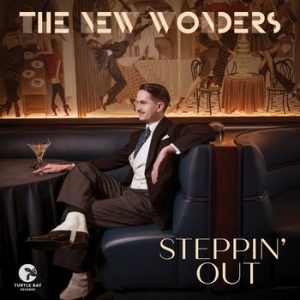 Steppin’ Out. Ricky Alexander, clarinet, alto sax, and vocals; Mike Davis, cornet and vocals; Josh Holcomb, trombone; Jared Engel, banjo; Andy Schumm, piano and cornet; Jay Rattman, bass saxophone and vocals; Colin Hancock, drums, cornet, and vocals. G. and I. Gershwin: Do Do Do; S. Williams and J. Palmer: Everybody Loves My Baby; E. Blake and N. Sissle: Love Will Find a Way; A. Schumm: Half-Seas Over; T. “Fats” Waller and A. Razaf: My Fate is in Your Hands; E. Burnett and G. A. Norton: My Melancholy Baby; P. Dresser: My Gal Sal; L. Armstrong: Cornet Chop Suey; W. Donaldson and G. A. Whiting: Helen Gone; V. Rose and B. Johnson: My Blue Heaven. Turtle Bay Records. Total time: 38:06.
Mike Davis and his band, the New Wonders, present Steppin’ Out, an album of the highest caliber of 1920s style New York hot jazz. Aside from Andy Schumm’s original composition, Half-Seas Over, all songs on the album are Davis’s own arrangements. Striving for authenticity, class, craftsmanship, and quality, the musicians on this album hit every mark, with a tight, polished, and expertly balanced ensemble sound that made absolutely evident the chemistry and shared vision between the band members.
Clarinetist and saxophonist Ricky Alexander can be first heard on the opening track, Do Do Do, which, according to Colin Hancock, became a theme of optimism for the band during their residency in Switzerland which inspired the creation of the album. The highlight of this track was the interplay between Davis’s cornet and Alexander’s saxophone solos. In Love Will Find a Way, Alexander’s clarinet sound first emerges from the texture in a sweet ascending line and is later showcased in the form of a beautiful low clarinet solo that is soft, warm, and subtle with shimmering vibrato. From track to track, Alexander plays with a light, playful, and flexible timbre, adding exciting flourishes between the vocal lines. From the riveting exchange between the trombone and clarinet solos in My Gal Sal to the high singing solo in Helen Gone, this album is bound to be a delight for fans of this classic jazz style and new listeners alike.
– Sarah Korneisel Jaegers
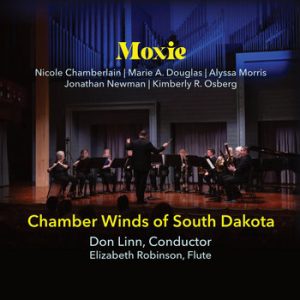 Moxie. Chamber Winds of South Dakota, ensemble; Don Linn, conductor; Elizabeth Robinson, flute; Stephanie Kocher, flute; Jennifer Wohlenhaus Bloomberg, oboe; Robin Michelle Sweeden, oboe; Michael Walsh, clarinet; Beverly Gibson, clarinet; James Compton, bassoon; Martin J. van Klompenberg, bassoon; Sam Gowen, horn; Amy Laursen, horn; Mark Stevens, piano. N. Chamberlain: Moxie; M. Douglas: Tray; A. Morris: Where the Colors Fall; K. Osberg: Passing Through; J. Newman: Concertino. Aerocade Music 017. Total time: 52:33.
In 2025, Moxie was released by the Chamber Winds of South Dakota. This ensemble was founded by flutist, Elizabeth Robinson and is made up of professional musicians from throughout the Midwest. They are conducted by Don Linn, who also serves as Artistic Director, and the two clarinetists performing are Michael Walsh, professor of clarinet at South Dakota State University, and Beverly Gibson who plays third and bass clarinet with the South Dakota Symphony Orchestra. Moxie features five pieces by living composers that vary in instrumentation.
The album begins with the titular piece by Nicole Chamberlain for woodwind quintet and piano. As the name suggests, Moxie is energetic, fun, and sassy, setting the stage for the technique and musicality that are to come in the subsequent pieces. The second work on the album, Marie A. Douglas’s Tray, is written for flute, clarinet, and horn. It is a moving depiction of the circumstances surrounding the murder of Trayvon Martin. This piece showcases the exquisite, clear chalumeau register of the clarinet as it blends spirituals with body percussion and contrasting tonalities, creating a unique “groove” throughout. Next on the album is Where the Colors Fall by Alyssa Morris. Written for woodwind dectet and described as a “deconstruction” of the hymn, High on a Mountain Top, this work has a pastoral feel, with the ensemble beautifully balanced between winding lines in the upper woodwinds, and low, languishing melodies in the bassoons and horns. The music grows cinematically and eventually reaches a unison chorale section, which highlights the lovely blend and intonation of the ensemble. Kimberly R. Osberg’s woodwind octet, Passing Through, is the next piece featured. It starts with heavy chords, reminiscent of an organ. Eventually there is a plodding rhythm set by the clarinet which moves the piece forward to an energetic section that allows us to hear the impeccable technique of the clarinetists before the work comes to a peaceful resolution.
The final work on Moxie is Jonathan Newman’s Concertino for Flute, Chamber Winds, and Piano. This three-movement work begins with a high, fast, unison section that features flawless intonation in the E♭ clarinet. The second movement is a series of luscious, slow chords, reminiscent of Debussy and leads into the final movement which consists of sultry technical work in the flute and clarinet, as time is kept by the bass clarinet and piano. Moxie is a fresh and thoughtful album that provides a unique perspective on chamber music, both regarding repertoire and instrumentation. The two clarinetists demonstrate great technical precision on all the instruments of the clarinet family.
– Madelyn Moore
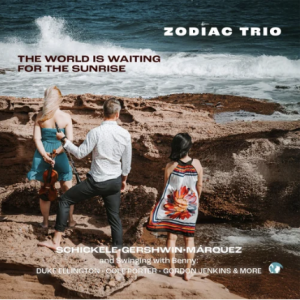 The World is Waiting for the Sunrise. Zodiac Trio, ensemble; Vanessa Mollard, violin; Kliment Krylovsky, clarinet; Riko Higuma, piano. P. Schickele: Serenade for Three; G. Gershwin/arr. R. Higuma: An American in Paris; A. Márquez/arr. R. Higuma: Danzón No. 2; B. Goodman/arr. Jean-Marc Brisson: Swinging with Benny. Blue Griffin Recording. Total time: 57:00.
The World is Waiting for the Sunrise is an eclectic and delightful album from the formidable talents that blend into the Zodiac Trio. Peter Schickele’s works are rarely simple, and the rumbling composite rhythms remain full of energy and rollicking fun despite increasing complexity and whiplash level dynamics. Contrasts are rampant throughout this piece and pianist, Riko Higuma has a sensitive touch that introduces nuances previously unimagined. Violinist, Vanessa Mollard and clarinetist, Kliment Krylovsky thread their voices fluidly while shapeshifting between textures and increasing the vocabulary of the violin and the clarinet in their resulting overlap. A standout moment includes the chalumeau register of Krylovsky’s clarinet playing as it creates a halo for the floating pitches in the violin and ends in the revelation of the piano’s melody. In the third movement, the unison rhythms and excitement keep the listener on a wild ride up until the last cadence thanks to the relentless energy and shaping of the artists.
It is delightful to see these musicians explore further avenues in their arrangements and pursue their interests regardless of original instrumentation. An American in Paris manages to capture the through-composed hilarity and bewilderment of this character piece with only three instruments, and some percussion of course. Krylovsky shines with his ebullient and flexible playing that is simultaneously supported or matched with his trio partners.
Danzón No. 2 is a similar revelation as it seems impossible to do the piece this much justice without betraying the original. The ingredient that makes this version delectable is the attention paid to the transitions and the ability of soloist and accompaniment to convey new urgency and new shades of previously introduced colors. The piano interlude especially conveys a new level of tragedy as the dance continues. In a similar vein, Higuma and Mollard rip into their parts to introduce some delicate, incisive, and effective altissimo in the clarinet part before the piece hurtles to its thrilling end. Future arrangements by Higuma are highly anticipated.
Moving to a sequence of jazz pieces, Swinging with Benny. The first quote, “The World is Waiting for the Sunrise,” is pure fun and bravado as Higuma tickles the keys and hits all the right inflections with great texture added by Kliment’s virtuosic noodling. The project of arrangements entitled Swinging with Benny continues with Cole Porter’s “Night and Day,” which feels intense and edgy like the original, yet, slightly more placed. “Dinah” offers quotations, fun, and spontaneity in spades. It is thrilling and surprising to see it proved again and again by Higuma and Jean-Marc Brisson’s careful work, like in Stravinsky’s incisive arrangement of A Soldier’s Tale, that sometimes a clarinet, piano, and violin are truly all you need! “In a Sentimental Mood” shows great colors and flexibility, “I Got Rhythm” sprinkles fun and good feelings all over the place and “China Boy” revels in an ensemble that hits the pocket just right. Krylovsky’s tone smolders with intensity and intent all the way through the climax in “Goodbye,” introducing shadows and regrets before throwing all the cards down on the table with a high-intensity closer featuring riotous technique and fun from all of the players in “I’m a Ding Dong Daddy.” This is a great listen!
– Andrea Vos-Rochefort
 Duos. Emily Hoppe, flute; Cris Inguanti, clarinet. M. Van Brink: Shabu Shabu; A. Jolivet: Sonatine; J. Cloud: Six Forays for Flute and Clarinet; M. Kates: Duo for Flute and Clarinet; E. Bozza: Trois mouvements pour Flûte et Clarinet; G. Cole: Three Short Duets for Flute and Clarinet; E. Carter: Esprit Rude; P. Parker: Games; Red Shift Records, tk559. Total time: 60:42.
Duos, presented by clarinetist Cris Inguanti and flutist Emily Hoppe showcases Canadian, French, and American works for flute and clarinet duo written between 1961 and 2007.
Opening the album is Matthew Van Brink’s Shabu Shabu (2003), an upbeat and bubbly work that keeps the clarinet and flute close together in range, allowing the two timbres to combine as if they’re one instrument. This bubbliness mimics the swishing sound of shabu shabu, a Japanese hot pot dish. In Judith Cloud’s Six Forays for Flute and Clarinet (2007) the beautiful blend of sound continues with six short, sweet, and light movements. Inguanti and Hoppe each bring their own musicality and emotion into the performance, all while flawlessly matching dynamics, intensity, note lengths, and contour. Cloud wrote this work from the ‘inside out,’ imagining herself as an audience participant, and it resulted in a work that brings joy to the ear.
The album heads back in time to 1967 for Morris Kates’s Duo for Flute and Clarinet (revised in 1993). Kates’s work continues the light and upbeat atmosphere and ends in a rondo, with the performers showcasing all registers of their instruments and supporting each other’s solos with harmony and ease. In 1974, Graham Coles wrote his Three Short Duets for Flute and Clarinet, which contains three movements: “Prelude,” “Pentatonic Canon,” and “Rhythmalogue.” This work takes the audience on a quick and exciting adventure highlighting smooth technique and vast range. Phillip Parker’s Games (1993) is the last work on the album and has four movements based on popular childhood games: “Leap Frog,” “Follow the Leader,” “Hopscotch,” and “Tag.” When writing this, Parker explored each instrument’s particular facets, such as big leaps, skipping rhythms, and fast chasing runs.
Duos also includes duos by André Jolivet, Eugène Bozza, and Elliot Carter, three beloved and challenging works that Inguanti and Hoppe perform with skill, passion, and an exquisite display of the varied colors that wind instruments can portray.
– Lara Mitofsky-Neuss
 Homegrown Melodies. Burnt Reeds, ensemble; Teil Taliesin, oboe, English horn, and ocean drum; Dylan Taliesin, clarinet; Jack Murray, soprano and alto saxophones; Jessica Lindsey, bass clarinet; Stephanie Lipka, bassoon. M. D. Bush: The Drive There and Back; Z. Zubow: One for Me, One for You; J. Lindsey: Land of the Sky; T. Taliesin and RoyalCity LiF: The Heroine’s Journey; A. Ferenz: From the Mountains to the Sea: A Musical Journey Across North Carolina; Traditional/arr. D. Taliesin: Growing Up Klezmer. Albany Records, TROY2016. Total Time: 55:37.
The album Homegrown Melodies was released by the reed quintet, Burnt Reeds. The album opens with an ominous atmosphere that gradually develops into something more hopeful in The Drive There and Back by Madison Bush. From the outset, Burnt Reeds demonstrates exceptional balance and cohesion, allowing each instrument’s unique voice to emerge while maintaining a unified sound. The second movement shifts into a funk-inspired groove, where the bass clarinet emerges as the driving force behind the ensemble. In the third movement, the eerie character returns before giving way to an unexpected yet effective duet between the oboe and saxophone. Although the bass clarinet is not always at the forefront, it provides a strong foundation that anchors the ensemble throughout the work. The final movement is energetic, allowing every instrument to contribute before bringing the piece to an exciting close.
Zach Zubow’s One for Me, One for You is one of the strongest works on the recording. It immediately captures the listener’s attention and demonstrates Zubow’s understanding of how to write effectively for the reed quintet. This is particularly evident in the second movement, where the counterpoint, especially between the saxophone and bassoon, is expertly crafted. My favorite movement is the third, which prominently features the bass clarinet. It begins with a sense of suspense that almost evokes the atmosphere of Jaws before developing in an entirely different direction. Here, the ensemble performs at its tightest, creating a unified sound despite the contrasting timbres of the instruments. The fourth movement opens with a poignant, chorale-like character that provides a striking contrast to the punchy opening material. The fifth movement returns to a funk-inspired energy led by the lower voices. While I found the thematic material somewhat repetitive, the ensemble’s cohesion never wavers. The final movement, “Salud!,” effectively ties together many of the work’s musical ideas, with particularly satisfying moments of unison between the clarinet and bass clarinet.
Land of the Sky immediately captivates the listener through its creative use of recorded train sounds and birdsong, which gradually blend with the live instruments to create the impression of a living landscape. Rather than serving as simple effects, these sounds become part of the musical fabric, making the ensemble feel like different voices within nature itself. This was perhaps my favorite work on the recording because of its imaginative orchestration. The bass clarinet, in particular, creates a rich, grounding presence that blends naturally into the surrounding soundscape, reinforcing the sense of movement through the landscape.
Growing Up Klezmer takes the traditions of klezmer and presents them in a fresh, engaging way. Every performer has opportunities to shine throughout the work, making each movement rewarding to hear. The first movement feels remarkably accessible and could easily appeal to audiences in both concert halls and more contemporary performance spaces. The second movement is closer to the traditional klezmer style with which I am familiar, and Taliesin’s solo beautifully captures the expressive heart of the genre. The final movement closes the album with infectious energy, leaving the listener on an undeniable high note.
My only suggestion regarding the recording concerns the programming order. I believe the Zubow work would have made a stronger opening to the album because of its immediate energy and ability to draw the listener in from the first movement. Both works deserve their place on the recording, but beginning with Zubow would have created a stronger sense of momentum from the outset.
Overall, Burnt Reeds demonstrates the exciting direction contemporary chamber music can take when composers move beyond traditional instrumental combinations. Rather than relying on established ensembles, these works embrace distinctive timbres and imaginative scoring while remaining engaging and highly accessible. Homegrown Melodies is a compelling recording that deserves the attention of performers, presenters, and anyone interested in the future of contemporary chamber music.
– Kristine Dizon
Comments are closed.