


Originally published in The Clarinet 53/3 (June 2026).
Copies of The Clarinet are available for ICA members.
Master Class
Nino Rota Sonata in D Major for Clarinet and Piano (1945)
by Luigi Magistrelli
The Sonata for Clarinet in D major by Nino Rota is considered one of the most interesting and appealing Italian clarinet sonatas of modern times. Its conservative style makes it quite unique in the panorama of clarinet compositions of the modern period.
Giovanni Nino Rota (1911–1979) was born into a musical family in Milan, and was renowned as a child prodigy. At the age of 11, he wrote the oratorio L’infanzia di San Giovanni Battista, which was performed in Milan and Paris as early as 1923. At 13 he composed Il Principe Porcaro, a three-act lyrical comedy, which was published in 1926.1 Rota studied at the Milan Conservatory under Giacomo Orefice and then undertook composition study with Ildebrando Pizzetti and Alfredo Casella at the Conservatorio Satna Cecilia in Rome, graduating in 1929.2 Rota later moved to the United States, where he lived from 1930 to 1932 while attending the Curtis Institute, where he studied conducting with Fritz Reiner and composition with Rosario Scalero. He earned a degree in literature from the University of Milan, graduating in 1937, and began a teaching career that led to a directorship in Bari.3
Rota was particularly known for his work in motion picture soundtracks, producing more than 150 film scores for various productions from the 1930s until his death in 1979. Most notably, he composed music for the films of Federico Fellini, Luchino Visconti, and Francis Ford Coppola.4 This culminated in an Academy Award for his music in Coppola’s The Godfather trilogy, specifically the Godfather, Part II (1974).5
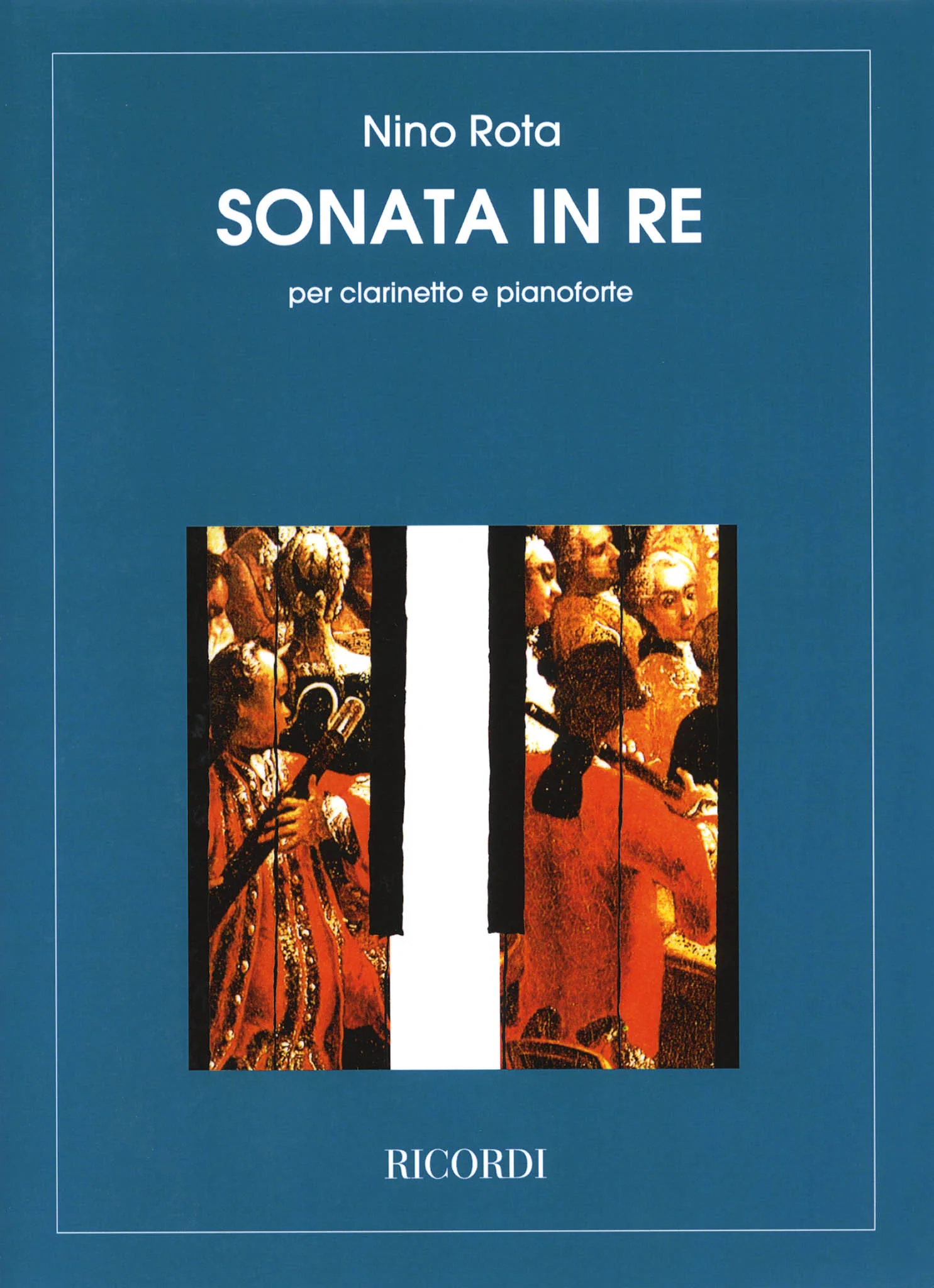
Cover of the Ricordi edition of Rota’s Sonata.
Rota had a special affection for the clarinet, writing not only this sonata for the instrument, but also an Allegro Danzante for clarinet and piano (published by Schott in 1977); a Trio for clarinet, cello and piano; and a wind quintet bearing the title Petite Offrande Musicale (written in 1943, dedicated to the composer Alfredo Casella). He also produced Lo spiritismo nella vecchia casa (Spirit Raising in the Old House)—incidental music for solo clarinet for one of Ugo Betti’s plays. This demanding composition features spectral effects and diverse atmospheres. Also worth mentioning is an interesting, melodic, and brilliant Nonet for strings and winds published by Ricordi in 1959.
The Sonata was dedicated to clarinetist Attilio Torquato Scotese (1899–1988). We know of a documented performance of the work at the Sala di musica of Mr. Bruno Giannini in Bari on January 20, 1948. Personally, I have greatly enjoyed performing this sonata both in Italy and abroad, and I have recorded it twice on compact disc. The work clearly has a lightness in character, perhaps related to Rota’s many film soundtracks. It is imbued with typical Italian lyricism and a hint of nostalgia. An uncomplicated work, it is clearly missing the bold experimentalism of his contemporaries. This is a calm, largely serene, and very lyrical work, shining in some places, yet reflective and dreamy in others.
In this sonata, Rota followed the neo-classical approach that was fashionable in the mid 20th century. Despite its simplicity, the formal structure is quite solid. Interestingly, Rota wrote for the A clarinet, perhaps thinking of the instrument’s darker and mellower sound. In studying the original manuscript, it can be seen that Rota later changed a number of details, particularly in the last movement. For example, 26 bars in the middle section of that movement were later omitted, as well as other measures just before the last page of the published version.
Unfortunately, the 1945 Ricordi first publication of the Sonata does not have measure numbers, so I will refer to staves and page numbers.
FIRST MOVEMENT: “ALLEGRETTO SCORREVOLE”6
The initial “Allegretto scorrevole” of the first movement, conceived in the typical sonata form, is presented in traditional sections with an underlying lightness and simplicity that dominates the entire work. The two main sections, in the tonic (D) and dominant (A), support two distinct themes. Melodic material is subsequently expanded through transformations that never seem unsettling. The recapitulation, which blends a few harmonic surprises from the development, brings us back to the calm and light atmosphere that characterized the opening.
In the first staves of the sonata, persistent triplets create a lyrical and cantabile mood. Emphasize the longer line, but also consider the single hairpins. It is very important to honor the long diminuendo through the third bar of the third stave before the pianissimo marking. Relax the phrase, then build up the tension into the forte marking, followed by a clear and relaxed diminuendo.
The following two patterns with 16th notes should be flowing and played mezzo forte before and forte later. At the beginning of page two of the clarinet part, we have three statements of an important eighth note pickup slurring to high E or E-flat; these should be played with good expressive emphasis. The triplet figuration at the end of the phrase should be played with freedom and a meditative feeling. Later, until the third stave of page three, we have phrases that should be approached with a dreamy character, with some figurations similar to the ones present on the first page. The tranquillo (calm) section includes groups of 16th notes which embellish the phrase. The clarinetist must be careful not to rush this section, maintaining the tranquillo character through the end of the movement. A short incipit taken from the beginning leads to a calm and thoughtful conclusion of this first movement.
SECOND MOVEMENT: “ANDANTE QUASI ADAGIO”
The central movement begins with a quiet, meditative opening. There is a small degree of contrasting material in the middle section where we should use a good amount of rubato in order to move the phrase forward. I would think about balancing the tempo (which is Andante quasi Adagio—not the opposite!) in order not to make the melodic lines too heavy, in spite of the meditative feelings clearly conveyed by Rota. The clarinetist should approach the long melodic lines in different registers with smooth and expressive feelings. The reprise is shifted an octave lower, thus generating a darker mood. With an undemanding conclusion, which effectively balances the opening mood, the work ends with a recitative-like phrase. In almost all aspects, this movement requires a very liquid quality of legato. The key of F-sharp minor was clearly chosen to evoke a particular quality and mood.
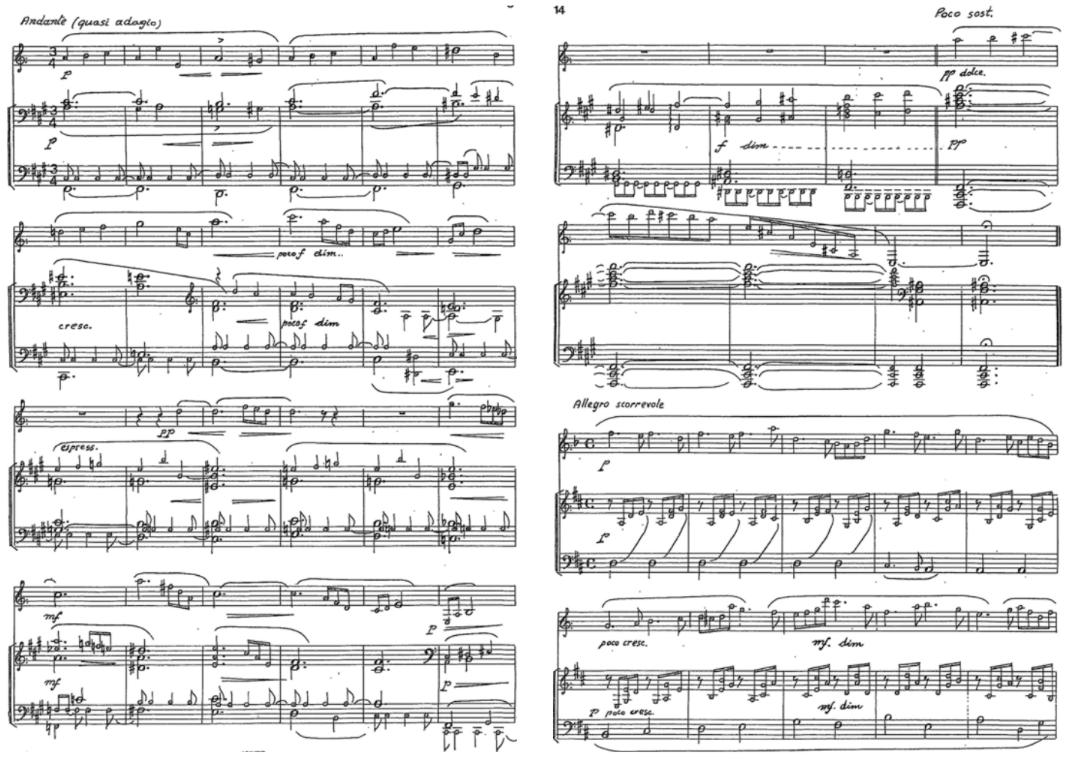
Opening of movements two and three of Rota’s Sonata.
THIRD MOVEMENT: “ALLEGRO SCORREVOLE”
In the first theme of this final movement, Rota requires a carefree, almost childish melodic approach. The tempo must be clearly thought in two. In the first phrase, think about the longer line, with a good sense of direction leading to the first bar of the third stave of page six. After this cheerful opening, the composer inserts contrasting reflective material, but be sure to maintain a flowing tempo. At the end of the last page, we have an indication of un poco animato, meant only for two staves. Note that in the Ricordi edition, there are two mistakes to be corrected in the third and fourth bars of the second stave of page seven: both of the As should be A-sharp, as appears in the original manuscript. All of these calm eighth notes through the animato serve to prepare the final part at double tempo, concluding the piece with a sparkling and impressive accelerando.
This is a lovely composition that clearly demonstrates Rota’s inventiveness and command of rich harmonies. The clarinet writing exudes a graceful charm, while the piano part is playable yet appealing. Although Rota’s writing reflects 19th century aesthetics, his works also convey the influence of many of his 20th century contemporaries. While his traditional style was sometimes criticized, he reportedly quipped, “When they tell me that in my works I am only concerned with bringing a little nostalgia and a lot of good humor and optimism, I think that is how I would like to be remembered: with a little nostalgia, a lot of optimism, and good humor.”7
ENDNOTES
1 Nicolas Slonimsky, Baker’s Biographical Dictionary of Musicians (New York: Schirmer Books, 1992), 1548.
2 Francesco Dalla Vecchia, “Nino Rota,” in Musicians and Composers of the 20th Century, edited by Alfred W. Cramer (California: Salem Press, 2009), 1241.
3 Slonimsky.
4 Vecchia, 1241.
5 Vecchia, 1243.
6 Scorrevole, meaning “flowing,” is not present in the autograph and was apparently added later.
7 Cf. Mary Kenedi, “Nino Rota and His Beautiful Sonata for Clarinet and Piano,” accessed April 14, 2026, www.gabrielblasberg.com/en/post/nino-rota-and-his-beautiful-sonata-for-clarinet-and-piano.
 Luigi Magistrelli has served as an ICA national chair for more than 20 years. He teaches at the Milan Conservatory and has performed widely in Europe, Asia, and the US. Magistrelli has recorded almost 100 CDs featuring solo and chamber music repertoire of the Classical and Romantic periods, often highlighting neglected or rediscovered clarinet literature. He has a personal clarinet collection of 250 instruments of different types and epochs. For his recordings, Magistrelli has used different types of clarinets, from the chalumeau to 5-, 8-, and 10-keyed boxwood clarinets; Müller, Albert/Baermann, Boehm, and Oehler system; clarinets in E–flat, D, B–flat, C, and A; and basset horns and low clarinets. Past recording collaborators include Dieter Klöcker and Karl Leister.
Comments are closed.