

Originally published in The Clarinet 53/3 (June 2026).
Copies of The Clarinet are available for ICA members.
Audio Reviews:
June 2026
RECORDINGS
 Dancing in a Still Life. Tasha Warren, bass clarinet; Guy Yehuda clarinet; Paquito D’Rivera, clarinet; Dave Eggar, cello; Phil Faconti, guitar; Amir Farid, piano. P. Harlin: Dance Suite for Bass Clarinet and Piano; A. Piazzolla/arr. G. Yehuda: Histoire Du Tango; N. Endicott: Riding to School with Samuel Beckett; D. Akiva: Dance Preludes; P. D’Rivera: Contradanza. Blue Griffin Recording, BGR699. Total Time: 71:02.
Tasha Warren and her award-winning collaborators give stunning performances in the album Dancing in a Still Life. The recording includes a captivating collection of dance-inspired duos featuring Warren on bass clarinet and collaborators on piano, clarinet, cello, and guitar. The various instrument combinations with bass clarinet make for a cohesive program with nice variety.
Patrick Harlin’s lively Dance Suite for Bass Clarinet and Piano opens the album with its rhythmic intensity, wide leaps and fast passagework. Amir Farid joins Warren in this three-movement work originally written for bassoonist Eric Van der Veer Varner. Harlin later recast the piece for bass clarinet, and Warren gave the premiere. The first movement begins with a catchy tune in the bass clarinet and a pulsing piano motive that becomes increasingly insistent. In the second movement, the piano introduces an introspective melody before the bass clarinet erupts in wide intervals and rapid articulated gestures. Slow pulsing piano chords return in the middle that seem to make a fleeting reference to Messiaen’s Quatuor pour la fin du temps. The third movement is a real showstopper. It bursts with energy and culminates with great intensity. Warren and Farid adeptly navigate the technical challenges with remarkable precision.
Fellow Michigan State University colleague Guy Yehuda joins Warren in a brilliant performance of Piazzolla’s Histoire Du Tango that he arranged for clarinet and bass clarinet in 2024. The arrangement of this popular work is well-written for these two instruments, and the performance is bright and filled with character. Yehuda and Warren play with a lovely vocal quality and great clarity to the articulations. They also achieve a striking dynamic range, especially in the magical softer moments. The bass clarinet solo at the opening of the second movement is particularly memorable, as is the virtuosic ending of the final movement.
Cellist Dave Eggar joins Warren for Neal Endicott’s Riding to School with Samuel Beckett. Each movement of this work is inspired by one of Beckett’s popular quotes and the composer’s interpretation of the quote. The first movement opens with rhapsodic figures and flashy interjections. The quick interplay between parts is well-paced and coordinated. The third movement conjures an other-worldly atmosphere with soft melodic fragments in the bass clarinet that float over whispered lines in the cello. Warren and Eggar show incredible tonal control. The bold fourth movement is also memorable with its fast passagework and rousing conclusion.
Daniel Akiva’s Dance Preludes was written in five movements in 2024 for bass clarinet and guitar and is dedicated to Warren. Phil Faconti joins Warren on guitar in this work that explores “movement, sound and meditation.” The first movement introduces a pensive bass clarinet solo that is followed with lovely dance-like gestures. The contrasting second movement begins with a beautifully reflective guitar solo. Warren and Faconti play with excellent balance and matching articulation styles. The playful third movement is inspired by the klezmer tune Abu’s Courtyard. Warren and Faconti achieve a nice flowing conversational quality in this movement as they seamlessly trade lines. The final movement recalls themes from the first and second movements through a more upbeat lens. Listeners will enjoy the colors explored in this vibrant work.
The album concludes in a joyous celebration with Paquito D’Rivera and Warren playing his ever-popular Contradanza. The performance is full of vitality and spontaneity. It is the perfect way to round out this album showcasing these delightful works inspired by dance.
– Justin Stanley
 American Landscape. Chad Burrow, clarinet; Amy I-Lin Cheng, piano. D. Baker: Clarinet Sonata; E. Kurtz: Logo II pour clarinette et piano; T.R. George: Sonata for clarinet and piano; R. Etezady: Bright Angel for clarinet and piano. Centaur Records, CRC 4160. Total Time: 65:01.
American Landscape is an album of four pieces for clarinet and piano written by American composers. Chad Burrow, who is professor of clarinet at the University of Michigan, was accompanied by Amy I-Lin Cheng, who serves there in the Department of Piano and Department of Chamber Music.
The first piece, Clarinet Sonata (1989), was written by jazz composer and conductor David Baker (1931-2016), who was known as the founder of the jazz studies program at Indiana University Jacobs School of Music. The work occurs in three movements: “Blues,” “Loneliness,” and “Dance.” The jazz influence is apparent in the colorful and lush harmonies, sultry melodies of the clarinet, use of glissando, comping in the piano, and complex rhythmic combinations. The third movement features a Latin flair with its use of contradanza and samba styles. The work comes to life with Burrow’s admirable nuance of color and style, expert story-telling, and precise rhythmic collaboration with Cheng.
Logo II pour clarinette et piano (1978–79), composed by Eugene Kurtz, is the second work of the album. The French influence, as is evident from the title of the piece, is derived from Kurtz’s time living in Paris, where he studied with two of Les Six, Arthur Honegger and Darius Milhaud. The first movement, “Introduction,” is a depiction of nocturnal sounds from childhood. The opening idea is reminiscent of the third movement Stravinsky’s Three Pieces, with its quick grace notes combined with repetitive melodic motives in displaced groupings. The second movement, “Breakdown,” is again reminiscent of Stravinsky, with driving, repetitive, and dissonant chords in the piano, believed to be a nod to the primitivism of The Rite of Spring. The title of this movement refers to the African American dance of the same name, which Kurtz says, is known for its “obsessive character and inexorable rhythmic flow.” The ensemble playing in this work is quite remarkable, as Burrow and Cheng navigate complex rhythms and sustained intensity.
The third piece on the album is Sonata for clarinet and piano (1967) by Thom Ritter George (b. 1942). The work occurs in four movements and sounds quintessentially American, drawing from the harmonic and melodic language of Bernstein and Copland, which can be clearly heard in the outer two movements. The simple intimacy of the second movement sparkles thanks to Burrow’s exquisite sound and mature phrasing. The third movement is understated in its melodies and sparse accompaniment, akin to some movements of Reade’s Suite from The Victorian Kitchen Garden.
The final work on the album is Bright Angel for clarinet and piano (2007) by Roshanne Etezady (b. 1973). The piece takes inspiration from the work of Mary Jane Colter, who helped create the quintessential American style of architecture at the Grand Canyon. With each movement named after one of Colter’s buildings, Etezady explains that she aims to convey “the essence of each of these structures—the ‘flow’ of each building, the use of light and space … something of their character as well.” The first movement, “Lookout,” is atmospheric in effect, created by repeated decaying sustains in the clarinet part, highlighting Burrow’s expert control of the instrument, especially in the lower dynamics. The second movement, “Phantom,” is brooding and aggressive, with extended use of chromaticism and quick runs, which show off the technical prowess of both performers. The third movement, “Kiva,” is unaccompanied clarinet, allowing for more nuance of sound through use of timbre trills and frequent registral shifts. The fourth movement, “Hermit’s Rest,” is clearly inspired by hymnal writing; it is simple in phrasing, patient in pacing, and beautiful in harmonies. The fifth movement, “Bright Angel,” is an exciting end to this work. The angularity of both intervals and rhythms drive intensely to the end, before abruptly tapering on an altissimo note—a risky and beautifully executed finale.
Bravo to Chad Burrow and Amy I-Lin Cheng on this exquisite album. This collection is a celebration of the diversity of sound that has sprouted in American composition in the post-Romantic era. The works on this album are effective and engaging, thanks in no small part to the musical conviction of both Burrow and Cheng. Each piece reflects the care and expertise brought to the performance, from thoughtful phrasing and style, attention to nuance of color and articulation, and commitment to storytelling through music. This album is a must-listen for all clarinetists!
– Kelsey Paquin
 That’s a Different Groove. Marcus Eley, clarinet; Lucerne DeSa, piano; Jason Williams, drums; Karl Vincent Wickliff, bass; Music Alive Ensemble: Rachel Jordan, violin; Amy Thiaville, violin; Franco Sixto, viola; Rachel Hsieh, cello; Yuiko Asano, piano. A. Batiste: “Swing in the Abstract” from Tune Suite No. 1; D.N. Baker: Sonata for clarinet and piano; Y. Lateef: Sonata for clarinet and piano; O. Nelson/arr. M. Eley: Sonata for alto saxophone and piano. Navona Records, NV6712. Total time: 61:00.
Marcus Eley’s That’s a Different Groove is a celebration of Black composers and music creators, featuring four works written by jazz artists. This album is an excellent introduction to four lesser-known works in the clarinet repertoire. For clarinetists, another noteworthy aspect of the album is that it features Eley’s playing during two different periods of his career: two of the pieces were recorded in the late 1990s, and two were recorded in the 2020s.
Works by Alvin Batiste and Yusef Lateef were recorded more recently. The first piece on the album, “Swing in the Abstract” from Tune Suite No. 1 by Batiste (relative of singer Jon Batiste), is a jazz ensemble work mixing clarinet alongside strings and a rhythm section. While it is not specifically a clarinet feature, Eley’s clear, direct clarinet sound makes this an enjoyable listen for clarinetists. Lateef’s Sonata for clarinet and piano is a striking homage to Brahms. The work’s four movements share titles with Brahms’s Sonata, op. 120, no. 1, and each movement begins similarly to its counterpart. The music is dense and thick, like Brahms, and contains complexly intersecting lines between clarinet and piano. The harmonies are far more dissonant, as if imagining what Brahms would sound like if he had lived 100 years later, performed jazz, and was influenced by modernism.
The older recordings on the album show how Eley’s artistry (and recording technology) has developed since the 1990s. The classic sonata by David Baker may be the most recognized work on this album; the sonata’s three movements contain written-out improvisatory lines, with each movement exploring a different jazz groove. Oliver Nelson’s Sonata for alto saxophone and piano (arranged by Eley) is written with clean lines and clear forms, balancing moments of consonance and dissonance. Nelson, a jazz woodwind player and composer, integrated influences from Ravel and Hindemith, and was also known for writing film and television music.
Taken together, the works on this album represent an effective “alternative canon” of works by composers who have not yet received the recognition they deserve.
– Erin Cameron
 Wild Winds. MiamiClarinet: Margaret Donaghue Flavin, clarinet; Dawn McConkie, clarinet; Michael Walsh, clarinet; Danielle Woolery, clarinet. E.A. Kelly: Wild Winds; D. Kaufman: Quartet for Four Abstract Expressionist Paintings; S. Kraevska: Clarinet Quartet III; B. York: Elements. Independent Release. Total Time: 48:45.
This digital release presents four contemporary works that engage an avant-garde aesthetic while remaining firmly idiomatic for the clarinet family. Featuring compositions by Elizabeth A. Kelly, Dana Kaufman, Sofia Kraevska, and Barbara York, the program offers a varied yet cohesive exploration of extended techniques, timbral nuance, and structural experimentation.
Elizabeth A. Kelly’s contribution is energetic and rhythmically vibrant, demonstrating a compelling balance between contemporary language and structural clarity. The writing is idiomatic and demands rhythmic precision, tight ensemble coordination, and confident projection of contrasting articulations and dynamic layers—all of which are effectively realized in this performance.
The work by Dana Kaufman—herself a clarinetist and pedagogue—inhabits a sound world shaped by extended techniques, including registral extremes, flutter-tonguing, and pronounced vibrato. A brief quotation of the familiar nursery rhyme Ring Around the Rosie appears, integrated with subtle irony. Importantly, these devices function not as mere sonic effects but as expressive tools within a coherent musical argument. The writing reflects a sophisticated understanding of clarinet acoustics and technical design. Rapid registral shifts and layered rhythmic passages lie idiomatically under the fingers, revealing an informed sensitivity to breath control, resonance, and instrumental response.
Sofia Kraevska’s work is thoughtfully constructed, balancing atmospheric textures with rhythmic propulsion. Her sensitivity to the clarinet’s tonal spectrum is evident as lines pass fluidly among voices in closely coordinated exchanges. The piece demands refined ensemble precision and nuanced dynamic control, rewarding performers who sustain textural clarity while shaping long arcs of tension and release.
Barbara York’s contribution provides a complementary expressive voice within the program. Known for her lyrical sensibility in other instrumental contexts, York adapts her compositional language effectively to the clarinet medium. Her harmonic palette, though modern, privileges line and contour, offering moments of introspection that contrast meaningfully with the more abstract textures elsewhere on the recording. The result is music that balances lyricism with structural integrity and moments of virtuoso playing.
Performance—individually and as an ensemble—throughout the recording is confident, technically solid, and stylistically committed, with particularly commendable work of the bass clarinetist. The quartet’s renditions of the extended techniques were precise and delivered with care. Rapid articulation passages, altissimo, and subtle coloristic shifts were rendered with clarity and poise.
There is, however, a brief instance of audible air leakage in one track. Although minor and not structurally disruptive, it is perceptible within an otherwise polished production. The overall recording quality is clear and well balanced, allowing the intricate textures to emerge distinctly.
A more substantive limitation concerns the absence of detailed digital documentation. No liner notes, performer credits, instrumentation listings, or recording data are provided. In certain passages characterized by penetrating brilliance and focused tonal projection, one might suspect the use of E-flat clarinet (Kaufman?); however, without explicit instrumentation details, this remains speculative. The lack of attribution reduces the recording’s scholarly and pedagogical utility.
In sum, Wild Winds constitutes a meaningful contribution to the contemporary clarinet repertoire. The works are adventurous yet idiomatic, technically demanding yet performable, and interpreted with evident artistry and commitment. Greater transparency in digital presentation would enhance its value for performers, educators, and researchers; nevertheless, the artistic merit of both the compositions and the performances secures this release as a noteworthy addition to the modern clarinet discography.
– Jorge Montilla Moreno
 Big Crass Monster. Whistling Hens: Jennifer Piazza-Pick, soprano; Natalie Groom, clarinet. J. Stevenson: Musical Invective; M. Dunphy: Chants; J. Brandon/arr. N. Groom: Multitudinous Stars and Spring Waters; C.D. Leiter: Dear Old Year (the memories of a matriarch). Navona Records, NV6775. Total Time: 57:00.
The ensemble Whistling Hens (Jennifer Piazza-Pick, soprano and Natalie Groom, clarinet) is dedicated to performing and commissioning works by women composers, to create an equitable awareness and financial standing for women in music. The selection of masterful works on this album is a tribute to their mission and the collaborative ecosystem that encourages creative processes to flourish and stand as exemplars of strength, determination, and artistic excellence.
Critics can support and scathe with equal deftness. Musical Invective by Jennifer Stevenson brings this to light by setting scathing critics’ words in the musical style of the scorned great composer. Highlighting the melodic qualities of the clarinet and soprano and permitting them equal footing in the collaboration, the duo flawlessly moves between the styles of Beethoven, Debussy, Webern, and Gershwin with adept musicality and technical prowess, providing an exceptional listening experience.
In Chants, Melissa Dunphy sets the poetry of New Zealand-born artist and occultist Rosaleen “Roie” Norton into a woven masterpiece, melding the lines of the clarinet and voice into a seamless dialogue. Reminiscent of the multitudes of her life, the composition flows through dynamic and poignant statements. Each poem languidly and expressively punctuates close intervals, with the emotional sensibilities uplifted through the performance. The flawless intonation, ensemble balance, and beautiful phrasing of Groom and Piazza-Pick are an exceptional testament to ensemble communication in this powerful composition.
The words of Chinese women poets are masterfully set in Jenni Brandon’s Multitudinous Stars and Spring Waters. Expressing the themes of love and longing, the haunting tones of clarinet and voice bring the women’s words to life. Tight intervals, depth of expression, and beauty of voicing by Whistling Hens resonate, synergizing the poignant words. The duo’s impeccable phrasing highlights the haunting, deeply personal texts. Originally composed for soprano and oboe, this arrangement by Natalie Groom speaks to the adaptability and resourcefulness of women throughout the centuries.
Drawing on the personal letters and notes of her great-great-grandmother, Cherise D. Leitner transforms the ordinary into the extraordinary in Dear Old Year (the memories of a matriarch). The multi-faceted expressiveness and fluidity of timbre bring to life a letter to her late husband, common cures for ailments, and daily life on a farm. Impressive in technical and musical expression, the duo musically portrays these events with equal seriousness and humor, underscoring the depth of human emotion. Leaping intervals, pointed articulations, quiet phrases, and stand-alone motions are treated with equal seriousness and playfulness, each performed at the highest musical and technical level without a hint of the underlying difficulty inherent in the scoring.
Whistling Hens’s performance displays impeccable technique, stand-out expression, and flawless ensemble communication. Languid lines are equally parsed with punctuated fragments, all performed with seemingly effortless ease. Exceptional musicality, flawless technical execution, and masterful compositions highlight the powerful scope of creativity inherent in this synergistic collaboration. The cover art and liner notes, which give equal credit to performers and composers, illustrate the ensemble’s mission to support women in music and the essential partnership between performers and composers. Artistic, musical, and technical qualities are all a win in Big Crass Monster. Bravi tutti on the production of an exceptional album that exemplifies creativity, spirit, passion, and cooperation!
– Michelle Kiec
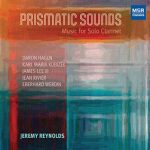 Prismatic Sounds: Music for Solo Clarinet. Jeremy Reynolds, clarinet. J. River: Les Trois “S” pour clarinette solo; E. Werdin: Impressionen für klarinette solo; K.M. Kubizek: Capriccio–6 Stücke für klarinette solo; D. Hagen: Icarus for Solo Clarinet; J. Lee III: Principal Brothers No. 3 for Solo Clarinet. MSR Classics, MS1781. Total Time: 48:53.
Unaccompanied clarinet works comprise an ever-rising percentage of our repertoire, and both recitals and albums of these works have become increasingly popular due to their versatility, variety, and accessibility. This album features five lesser-known works for unaccompanied clarinet spanning from the late 20th century to the early 21st century performed with artistry and interest by Jeremy Reynolds, professor of clarinet at the Lamont School of Music at the University of Denver.
Les Trois “S” pour clarinette solo, composed by Jean Rivier (1896–1987), is in three movements. The first movement, “Sillages” (Wakes), displays the intense control of timbre and style in all registers along with an incredible sense of time by Reynolds. The movement begins with a playful and chaotic melody, giving way to a more mellow middle section, before returning to the opening thematic material in the final section. The virtuosic ability of Reynolds is on display throughout, featuring the beauty and flexibility of his clarinet sound. “Soliloque” (Soliloquy), the second movement, is comprised of what almost sounds like one long and flowing phrase that never ends. The control and shaping of the wind that Reynolds displays is equally as impressive as his technical abilities throughout the outer movements of this work. The final movement, “Serpentins” (Streamers), is energetic and excited, similar in style to the second movement of von Koch’s Monologue No. 3 for Clarinet. Reynolds’s use of timbral variation as an element of tension building to the top of each phrase is done expertly and draws attention to the very different style of this movement, delineating it from the other two.
Eberhard Werdin’s (1911–1991) Impressionen für klarinette solo (1987) is a six-movement work. Each movement is a short miniature study in character. With no movement except the finale exceeding two minutes, it is a challenge to establish and then develop a musical character, but Reynolds achieves this with clarity and consistency. Each movement is a thoughtfully crafted musical experience. The use of extreme dynamic contrast accentuates the first and second movement’s lush phrases. Articulation and ornamentation are highlighted in the third and fourth movements, all while Reynolds continues to spin beautiful, almost never-ending phrases with the more colorful aspects of his tone. Movements five and six together create two sides of a coin with the “Burlesco” fifth movement being very angular and mysterious, and the “Finale giocondo” being the most tonally melodic movement of the work, primarily in the chalumeau register.
Capriccio–6 Stücke für klarinette solo by Karl Maria Kubizek (1925–1994) is also a work consisting of six movements. Unlike the more angular Werdin, the Kubizek is much more like a series of six short tableaus. “Allegretto con spirito” is playful and childlike in nature, and Reynolds embodies this with a lightness of articulation and clarity of phrasing that makes tricky passages sound graceful. “Adagio sensibile” is markedly darker and more introspective not just in the melodic material, but in the facet of Reynolds’s tone color that he employs here. The “Allegretto capriccioso” is much more mischievous and spans a much wider range of the clarinet, where Reynolds treats the listener to an impressive display of his altissimo prowess. “Più lento e molto espressivo” is another more reflective movement, but much less dark in atmosphere than the “Adagio sensibile.” This segues nicely to the fifth movement, “Allegro,” a never-ending energetic technical ride. The phrasing is used as a tool here to create even more tension than the melodic material could alone, sounding almost as if it doesn’t rest. The final movement, “Agitato,” connects all movements—not just in style, but in tone as well. Reynolds’s performance of light articulations and multi-voiced melodic lines throughout all ranges of the instrument is particularly remarkable here.
The fourth work on the album is Daron Hagen’s (b. 1961) Icarus for Solo Clarinet (2007). Reynolds begins from niente, highlighting his intense control of register and tone color in the lowest chalumeau, before jumping effortlessly to the altissimo. Unlike the other works on this album, this work is through-composed, climbing slowly through the registers, much as the character from mythology climbed until he rose too close to the sun. Unlike Icarus, there is no register that ever sounds as if it is too high for Reynolds—he makes the altissimo register, no matter where it originates from or is going, sound absolutely clear and unforced.
The final work on the album is Principal Brothers No. 3 for Solo Clarinet (2020), by James Lee III (b. 1975). This work was composed in 2020 amid racial tension, so Lee decided to honor four of his African American orchestral colleagues by writing short unaccompanied works for them. Principal Brothers No. 3 was written for and premiered by clarinetist Anthony McGill. The composer writes that these works all begin in ways “that are representative of their names … A for Anthony … All four of these works are rhapsodic in nature with elements of improvisation.” The first movement, “Calmly,” begins in the style named in the title, but gets worked up rather quickly, climbing to the very highest points of the altissimo. Each phrase is crafted with detail and purpose, conveying the intensity of the lines and showing off Reynolds’s deep understanding of how to create a sonic world in an unaccompanied piece. The second movement, “Playful,” reflects this spirit in the use of a light articulation style reflective of the interesting rhythmic figures crafted by Lee. Reynolds highlights these rhythmic aspects and brings them to life with clarity and insistence. The final movement, “Con Spirito,” seems to reflect a persistence of spirit reflected in the sparkling use of intense technical passage work and repeated movement to the altissimo register that is unyielding in its intensity and expertly executed by Reynolds.
This album is a must-have for any clarinetist with an interest in unaccompanied clarinet repertoire. Both the choice of works along with the thoughtful performance of each work is a masterclass in how to approach interpretation of both standard tonal and non-standard phrases in unaccompanied repertoire.
– Vanessa Davis
NEW RELEASES
 Duos. Emily Hoppe, flute; Cris Inguanti, clarinet. Redshift Records, TK559.
 Connections. Osiris J. Molina, clarinet; Jenny Grégoire, violin; Silvia Rath, violin; Jennifer Whittle, violin; Jacob Adams, viola; Moisés Molina, cello. Blue Griffin Recording, BGR717.
 Spark. Aaron Irwin, clarinet, saxophone; Mike Baggetta, guitar; Bill Campbell, drums. Adhyâropa Records, AR00167.
 Homegrown Melodies. Burnt Reeds: Teil Taliesin, oboe, English horn, ocean drum; Dylan Taliesin, clarinet; Jack Murray, soprano saxophone, alto saxophone; Jessica Lindsey, bass clarinet; Stephanie Lipka, bassoon. Albany Records, TROY2016.
 First Impressions. Trio Tempestoso: Andraž Golob, clarinet; Sanja Mlinarič, accordion; Urban Megušar, cello. Independent Release.
 Re-Fashioned. Barcelona Clarinet Players: Manuel Martínez, clarinet; Javier Vilaplana, clarinet; Martí Guasteví, basset horn; Alejandro Castillo, bass clarinet. Club del Disco.
Comments are closed.