


Originally published in The Clarinet 53/2 (March 2026).
Copies of The Clarinet are available for ICA members.
Pedagogy Corner
PART 2 — THE EXPRESSIVE EXHALE:
WHEN RIB MOVEMENT RETURNS TO THE MAP
by Shawn Copeland and Jackie McIlwain
We come to the clarinet with bodies that already know how to breathe. Often, nothing is wrong or broken. If something were anatomically compromised, the solution would not be found inside a clarinet lesson. What challenges us in performance are the ways we organize ourselves around the instrument and the ideas we hold about what exhalation should feel like when we play. These ideas arrive with force, and the force becomes interference.
In Part 1, we explored how inhalation organizes itself inside a balancing body. Breathing emerges from coordination, not from effort. That same truth guides exhalation. Yet most misunderstandings about exhalation stem from a single missing piece in our map: the ribs move. Not just a little. Not figuratively. They move in every breath—up and out on the inhale, down and in on the exhale—providing the primary structural change that allows air to flow.
When this movement is missing in someone’s internal model, the entire body must compensate. We brace our shoulders, hold our chests still, clench our abdominal wall, or try to “open” our throat. We attempt to force air into places where there is no space for it. The abdomen ends up doing work the ribs were designed for, and the throat becomes involved in ways it never needed to.
This article explores how restoring rib movement, supported by a balancing body, dissolves confusion around controlled exhalation and reveals a more expressive, grounded way of working with air.
THE RIBS ARE NOT A CAGE: HOW MOVEMENT CHANGES EVERYTHING
We often learn the anatomy of ribs without sensing what that anatomy means. Each rib connects to the spine through a set of joints—costovertebral and costotransverse—and the first ten ribs also meet the sternum through costal cartilage. These joints are designed for movement. Observe from Figure 1 how the ribs arc behind the spine, around the sides of the torso, and forward to the sternum. This curved, three-dimensional design gives the ribs as a collective structure enormous potential to change volume.
Yet the cultural word we attach to them is “rib cage.” A cage does not move—a cage traps. Even when we intellectually acknowledge rib movement, we are often told early on not to move our shoulders when we breathe. Without realizing it, we pull the shoulder girdle down over the top ribs and hold it. This reduces rib movement dramatically.
When ribs are held still underneath shoulder girdles that do not float, the torso cannot change volume. The abdomen must attempt to do the work. This is why musicians begin to push the belly out, brace through the lower back, tighten the jaw, or manipulate the throat. The system starts compensating for a missing primary driver. Tone becomes forced. Phrasing becomes effortful.
When rib movement returns to the map, the experience changes. Exhalation stops feeling like a push and becomes a release. Support stops feeling like effort and becomes the gentle slowing of a natural return. The metaphors we struggled with—all well-intentioned—fall away because the underlying coordination is restored.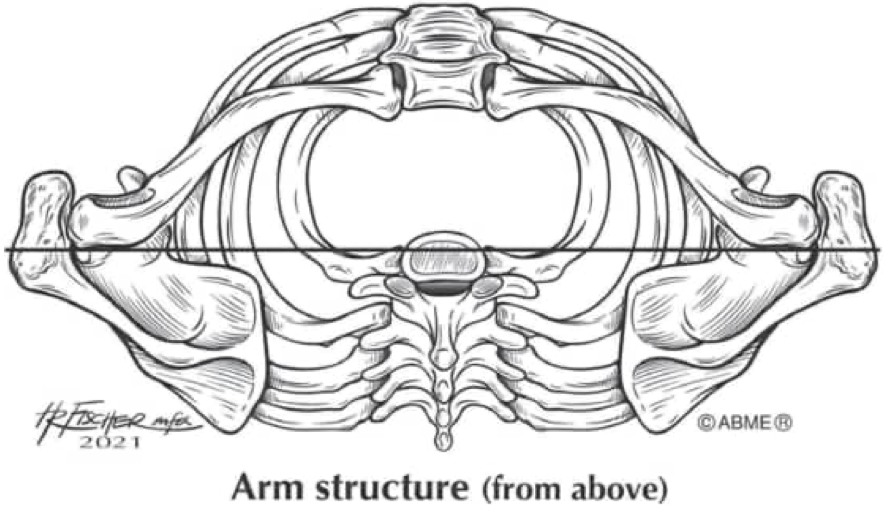
THE NATURAL EXHALE: THE BODY’S RETURN TO BALANCE
The natural exhale begins the moment the inhale completes its work. Ribs descend through their joints, changing the shape of the torso in a way that allows air to leave without effort. The diaphragm, which descends only a few centimeters on inhalation, returns to its domed resting state.
The abdominal wall responds with an elastic inwardness. The organs that fill the entire upper and lower torso glide gently upward to their resting position. The pelvic floor follows by rebounding upwards. The spine lengthens subtly as each curve reorganizes in response to the change in internal pressure. This entire sequence is built into our design. It does not require correction; it requires permission.
MAPPING THE UPPER AIRWAY WITHOUT INTERFERENCE
Remember, the airways in the head and neck remain open when the pharyngeal muscles are at rest. These muscles are designed for swallowing, not breathing. They contract as a group, like any sphincter system.
Bracing the abdomen—particularly pressing outward—often triggers a reflexive contraction in these pharyngeal muscles. This is Valsalva’s maneuver, a protective stabilization strategy meant for lifting a significant load, not for musical expression.
HOW RIB MOVEMENT ORGANIZES EVERYTHING ELSE
When ribs move, the rest of the system calibrates around that movement. When ribs do not move, everything else must work harder than it was designed to. The difference between those two experiences is immediate and profound.
Experience: Take a moment and bring the “ribcage” metaphor into your imagination. As you think about your ribs being a cage, follow this through by tightening your shoulders and notice the changes throughout your body. What is the quality of the breath? How does this impact the capacity of your breath? How does this impact balance throughout your whole body, particularly your neck, pelvis, and knees (if you are standing). Now let go of that idea and take a few breaths to re-establish your breathing patterns. The next image that we wish for you to work with is lifting the two handles of a water bucket, as if you lift the bucket off the ground. This is a good image to have of how the ribs move. Let that image materialize in movement throughout your torso, allowing your shoulders to float over the ribs and move with each breath, and noticing the large swinging movement of the ribs.
MISUNDERSTANDINGS THAT ARISE FROM A STILL RIB CAGE
THE MYTH OF SCARCE AIR
Many clarinetists carry a hidden belief that air is scarce. We ration it, holding on to it as if to save it. This creates a habitual stopping of the exhale well before the body’s natural end.1 What remains inside the lungs is stale air—high in carbon dioxide—which we then refill on top of. The result is what we often call a “breathing traffic jam”: air coming in while the body is asking to release.
The reflexive inhale disappears under these conditions. Rib descent and diaphragm rise are interrupted. We lose access to the effortless cycle we felt as infants.
MISGUIDED CUES BORN FROM RIB IMMOBILITY
Well-intentioned instructions that inadvertently freeze rib movement:
- “Breathe low.”
- “Don’t move your shoulders.”
- “Open your throat.”
- “Support from the diaphragm.”
- “Push the belly out.”
- “Always take a full breath.”
Each of these directions makes sense only when rib movement is missing. Once ribs return to their role, these cues lose their purpose.
EFFECTS ON CLARINET PLAYING
When ribs do not move:
- Tone becomes effortful from overblowing
- Players either overcompensate or under-support
- They feel out of breath despite having air
- Articulation becomes restricted
This is not a breathing issue, but an issue of the map.
THE EXHALE THAT LEADS TO THE NEXT INHALE
COMPLETING THE EXHALE
An expressive exhale is not pushing beyond the residual lung volume, just releasing to the body’s honest end. When the exhale is allowed to finish, the tissues rebound naturally. Ribs begin their swing upward. The diaphragm descends. The inhale arrives on its own.
THE REFLEXIVE INHALE
This inhale is:
- Fast
- Full
- quiet
- and perfectly timed
It comes from the spring of the costal cartilage, the availability of the clavicles, and the readiness of the diaphragm.
Experience: Play a warm-up passage that you can play continuously, such as the Klosé Scales. Take a breath after each scale and notice how your body responds to this stacking of air. Then, play through the scales without stopping until you simply cannot produce sound anymore. Do not circular breath, and do not push past your residual lung volume. This may feel uncomfortable or foreign at first, but allow the sound and breath to end naturally. You will likely be able to play a lot longer than you expect. As the breath ends, resist the urge to close your throat (a glottal stop) and hold your breath. Simply wait until your body reflexively inhales.
CLARINET APPLICATION
SHAPING THE EXHALE INTO THE RESISTANCE
There are multiple points of resistance in clarinet artistry: the reed strength, the mouthpiece facing, the barrel taper, the bore of the instrument, in addition to the tongue shape, jaw pressure, and aperture opening. We want to allow the tongue to guide the airstream by allowing the throat to remain easy, balancing the internal pressure with only the engagement necessary to balance the other points of resistance. Let the embouchure engage to seal without gripping; it can remain flexible and responsive to our musical ideas.
LETTING RIB MOVEMENT INFLUENCE TONE
When ribs and upper torso remain available, tone becomes less driven and more resonant. Avoid fixing the shoulders; upper ribs must participate.
BREATH CHOICE
Take only the inhale that matches the phrase. Let the previous exhale determine the quality of the next breath.
QUESTIONS TO DEEPEN YOUR CRAFT
How clearly do I sense my ribs (high, low, front, back, and sides) moving on exhale?
- As I play loudly, where do I feel engagement?
- As I play softly, where do I feel engagement?
- Where do I habitually stop my breath cycle?
- When does my throat join the exhale unnecessarily?
- Do I trust the natural timing of the reflexive inhale?
CONCLUSION: THE BODY KNOWS THE WAY HOME
When rib movement returns to our map, the breathing mechanism reorganizes itself. Exhalation becomes expressive. The breath cycle resumes, and phrasing regains its fluidity. The expressive exhale is not something we create—it is something we allow.
ENDNOTES
1 This does not include the remaining residual lung volume (RV). We cannot fully exhale the air from our lungs. If we did this, our lungs would stick together on the inside. While we can, we do not want to move into RV for clarinet playing, as doing so requires extra effort for the subsequent inhalation.

Shawn L. Copeland is a pioneer in the fields of musician wellness and performance training. His innovative, creative, and transformational approach has set him apart as a multidimensional musician, pedagogue, and entrepreneur. His unique methods have established him as a leader, culminating in the founding of mBODYed, LLC, a company that is reshaping the landscape of performance training for musicians, actors, and dancers. Shawn is a performing artist and clinician for Buffet Crampon USA, Gonzalez Reeds, Inc., and the Silverstein Group.

Jackie McIlwain, D.M., is a passionate clarinet pedagogue whose innovative teaching infuses principles of Body Mapping and Alexander Technique, providing fresh ideas and perspectives that not only help her students grow musically but also challenge them to incorporate their whole selves into their music. Dr. McIlwain has been at the University of Southern Mississippi since 2013 and currently serves as associate professor of clarinet. She is also a Buffet Crampon performing artist and Vandoren artist-clinician.
Comments are closed.