


Originally published in The Clarinet 53/2 (March 2026).
Copies of The Clarinet are available for ICA members.
Book and Music Reviews:
March 2026
BOOKS
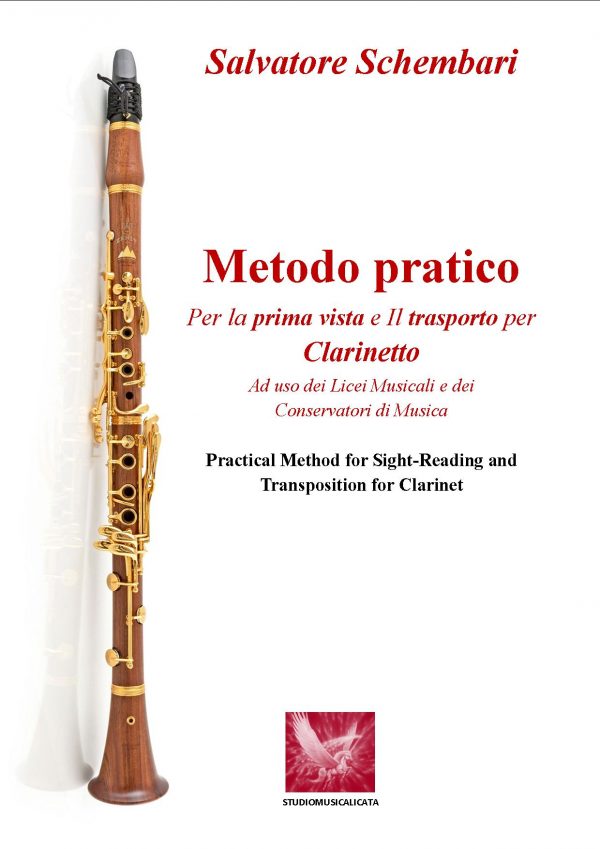 Salvatore Schembari. Practical Method for Sight-Reading and Transposition for Clarinet. Pachino (SR): Studiomusicalicata Edizioni Musicali, 2025. €20. Purchase Link.
Salvatore Schembari is a clarinet player who is quite active, both as a chamber music performer and as a composer. A former member of the National Army Band, he has written hundreds of compositions of various kinds (for wind band, clarinet ensembles, operas, etc.). Now, he is clarinet teacher at the Trapani Conservatory (Sicily). This new publication on sight-reading and transposition could be of interest—not only to students who will have careers as orchestral players, but also to those who would like to develop their skills and mental flexibility in practicing, reading new pieces, and gaining command of what they have just learned. Transposition is something quite usual for a professional orchestral player, with the clarinet being a transposing instrument. Quite often, this technique can be learned following a theoretical process. There are only a few methods of this kind written in the past; I can cite G. Cappelli’s G. Piccolo Metodo per imparare a trasportare (Edition Pucci) or R. Stark’s Die Kunst der Transposition, op. 28 (Edition Elite). Schembari has been able to conceive in his method the right and practical études in order to improve this skill. He also added significant orchestral excerpts from the Italian opera repertoire where C or A clarinets are needed. We can find even a solo piece of Rossini (Variations in C major), originally thought for oboe but then destined for the C clarinet.
Highly recommended!
– Luigi Magistrelli
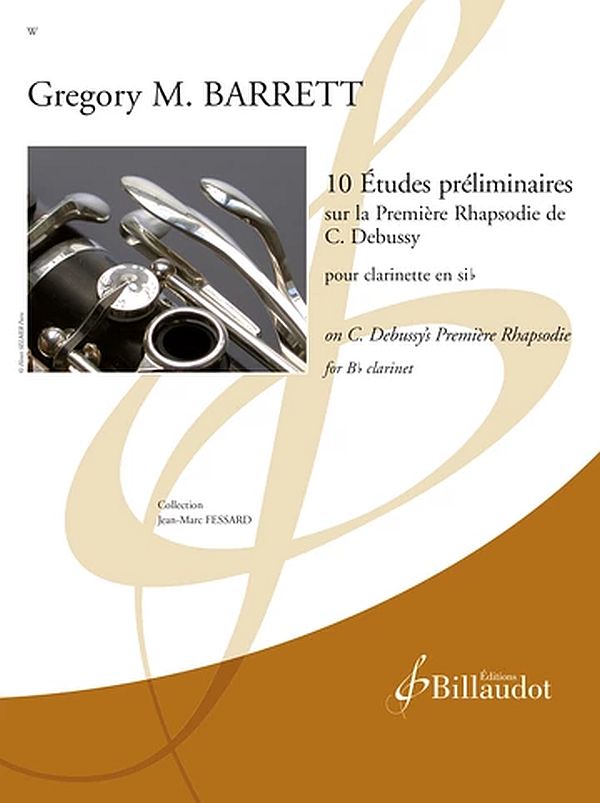 Gregory M. Barrett. 10 Études préliminaires on C. Debussy’s Première Rhapsodie for B–flat clarinet. Paris: Éditions Billaudot, 2025. $35.96. Purchase Link.
A fantastic approach to learning Debussy’s Première Rhapsodie—meticulously researched, organized, and presented! This set of études guides the clarinetist towards mastery of the many technical challenges in Debussy’s Première Rhapsodie. The collection of 10 études is far more than a cursory overview or general masterclass approach. Barrett first presents a thematic table with short excerpts from each étude to introduce this collection, immediately drawing the clarinetist to the score as the fundamental basis for study. The uniqueness of this approach is that the clarinetist is guided through a practice method that uses the composer’s score to develop the necessary technique to master this work. Each étude lists a timing and a difficulty grade—intermediate (6) to advanced (8). French-to-English translations are listed at the bottom of each étude to clarify indications such as Réveusement lent (“Dreamily slow”). Through this method, the player studies awkward intervals, complex rhythms, required finger patterns, unusual alternate fingerings—with a helpful key diagram, articulation patterns, underlying harmonic patterns, and studies on how to practice rapid scale passages—all presented in a very digestible, sequential, methodical, and musical manner. As I worked through these études, I found myself feeling as if I was practicing an actual piece of repertoire, not a series of exercises that were facilitating learning the repertoire at a later point. It should be noted that this work is part of a collection of contributions to Billaudot publications by Jean-Marc Fessard, a French clarinetist who directs very innovative and creative clarinet publications for Billaudot. In my opinion, this work (and unique pedagogical approach) should be a required study for all students (and professors). I hope Barrett’s work inspires others to develop similar study materials for other core works in our clarinet repertoire.
– John Cipolla
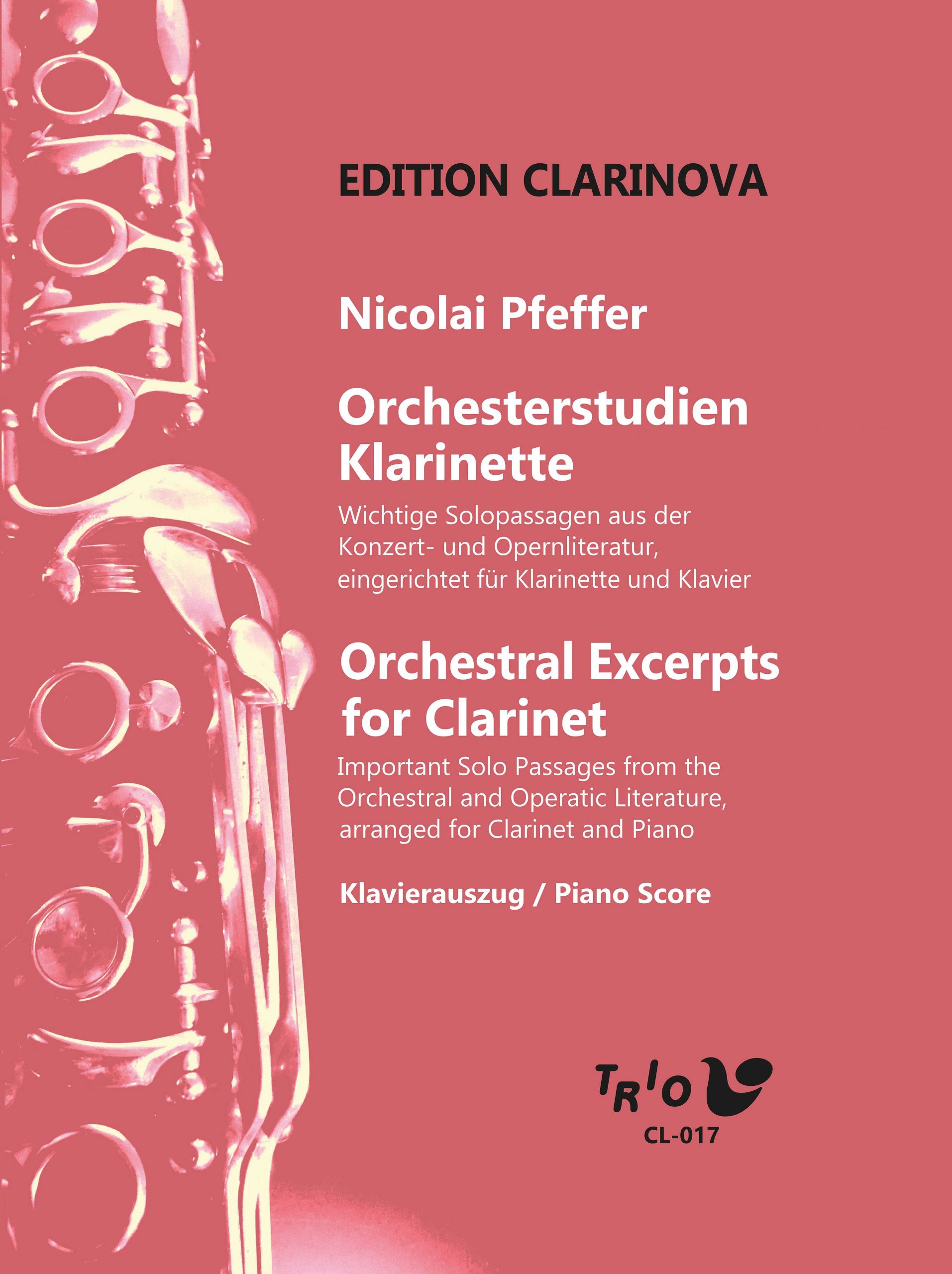 Nicolai Pfeffer. Orchestral Excerpts for Clarinet: Important Passages from the Orchestral and Operatic Literature, arranged for Clarinet and Piano. Edition Clarinova. Mettenheim, Germany: TRIO Musik Edition, 2025. €79. Purchase Link.
Nicolai Pfeffer is quite well known in Germany and in the international clarinet panorama not only for his high level of artistic activity, but also for his great commitment in the field of editing new interesting publications. In past years, he worked on the clarinet repertoire of Stamitz, Crusell, Rossini, Bassi, Gade, Bruch, Zemlinsky, etc., and also with notable publishing houses, such as Henle Verlag. Some years ago, in 2013, he started an important project related to orchestral excerpts with piano accompaniment.
As he states in the preface of this publication, it is aimed at clarinetists, whether students or professional musicians, and offers a professional, practice-oriented tool for the intensive study of central audition passages from concert and operatic literature. The clarinet has had a prominent role in the orchestral repertoire beginning with Haydn, Mozart, Beethoven, and then in the Romantic, modern, and contemporary periods with Brahms, Schumann, Tchaikovsky, Wagner, Rossini, Verdi, Puccini (in the golden era of Italian opera), Mahler, Stravinsky, and Shostakovich. All of them, and many other composers, exploited the clarinet’s endless potential to the maximum. The long list of solos in this publication includes important and celebrated solos, and of course, the most demanding ones. It is surely a good way to develop and spread knowledge in this field. All students, both professional players and amateurs, could benefit from this exhaustive compendium of orchestral excerpts, which follow a precise structure and is organized by period (and in some cases, by genre). The piano part provided is an important tool for the full comprehension of the harmonic texture. The text has all of the necessary pedagogical details, and some helpful hints are suggested in this beautiful publication.
The preface is rich in explanations about the approach Pfeffer used in compiling these orchestral solos. On the piano score (consisting of almost 200 pages!), there are useful notes regarding all the excerpts and composers treated. Quite helpful for the clarinetists! The German publishing house Trio Musik Clarinova, founded by Michael Nowotny, has a nice clarinet catalogue with a good number of clarinet gems, and these orchestral solos are one of them. Pfeffer has done a smart and accurate job offering a very valuable help for all the students who want to fully understand the excerpts in the inner details, both from the soloistic and harmonic point of view. Also, this volume is a very significant help for educational purposes and for audition preparation.
Bravo!
– Luigi Magistrelli
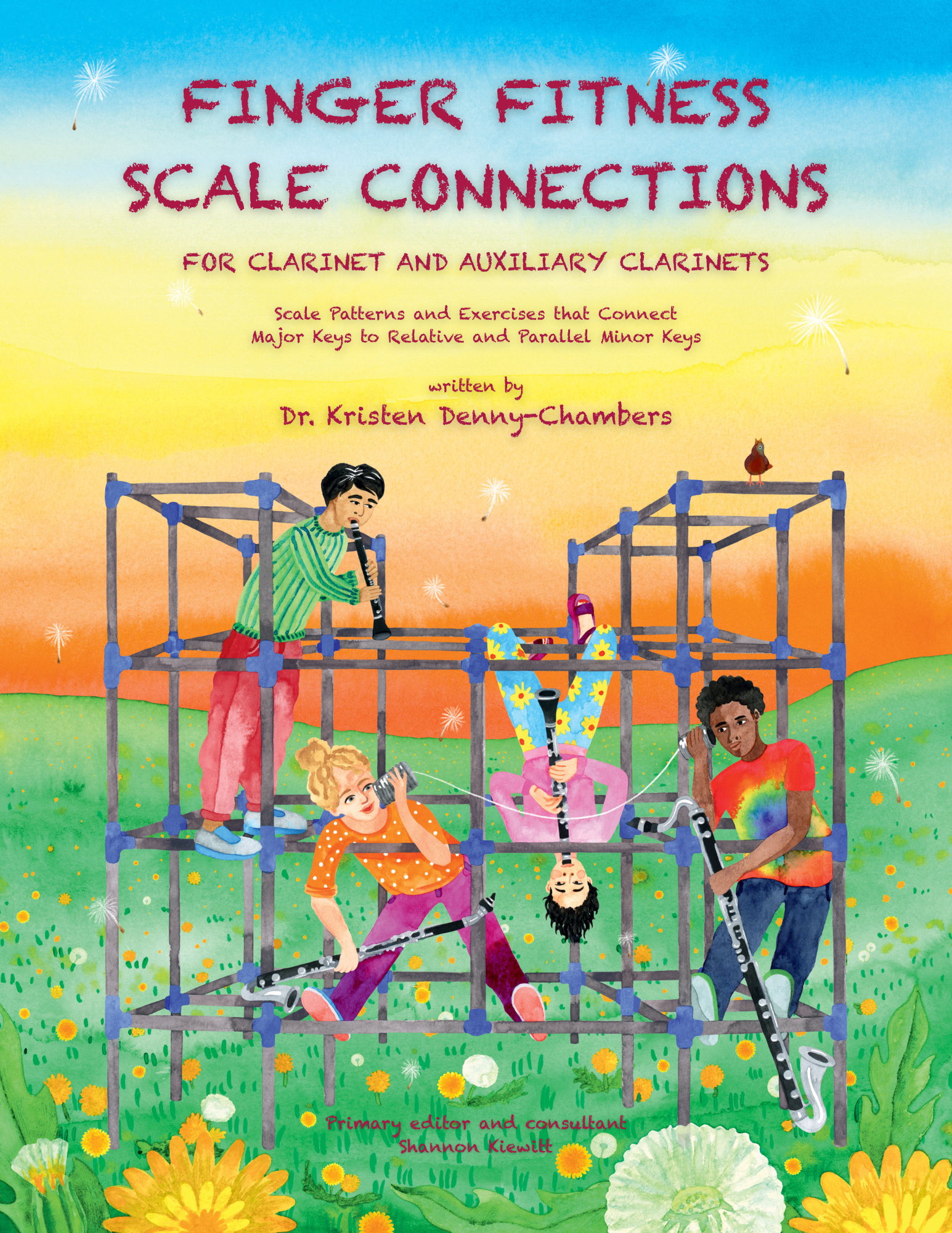 Kristen Denny-Chambers. Finger Fitness Scale Connections for Clarinet and Auxiliary Clarinets. Clarinet Playground, 2025. 169 pages. $38 (print or digital). Purchase Link.
Clarinetist, composer, and pedagogue Kristen Denny-Chambers released the fifth book in her series devoted to the development of finger technique, Finger Fitness Scale Connections. Like her three books entitled Finger Fitness Études, the author wrote Scale Connections for both clarinet and auxiliary clarinets, focusing on the improvement of the full range of each instrument (down to low C, where applicable). Denny-Chambers credits Shannon Kiewitt as her primary editor, and the colorful cover art is the work of Hélène Baum.
The purpose of Finger Fitness Scale Connections is to assist clarinetists with comprehending the fundamental building blocks used to write Western art music and to develop the techniques written in this book to ensure ease in performing much of this genre of repertoire. Denny-Chambers introduces the organizational approach of the book, followed by three concise and easy-to-understand prefaces. The first preface provides tips on breathing while using a metronome—essentially inserting rests to stay in time—and teaches alternatives for simplifying chromatic studies, if needed. It also contains basic articulation pattern ideas and covers contextual approaches to common fingering problems.
What follows is a tutorial on the intervallic construction of chromatic, major, and minor scales, along with an explanation of relative and parallel minors in relation to major scales. Denny-Chambers uses perhaps one of the most recognizable works in our repertoire, Mozart’s Clarinet Concerto (first movement themes), to illustrate the transitions from C major to C Minor and E-flat Major, all closely related keys. The third preface describes intervals, chord construction, scale degrees, Roman numeral labels, and how they function within major and minor keys, as well as chord symbols.
Just like the prefaces, Denny-Chambers writes the exercises in three clear sections. Part One organizes each key by grouping major and relative minor scales in all three forms. She includes 23 exercises for all 12 keys, as well as the enharmonic equivalent for G-flat Major/E-flat Minor (F-sharp Major/D-sharp Minor). Each key features short exercises on two-octave scales, connections between major and minor scales, extended scales, interrupted scales, thirds, arpeggios, running scales with arpeggios, arpeggios with lower neighbors, dominant and diminished chords, chord progression studies, variations of scales and arpeggios, variations of scales and thirds, chromatic studies, and articulation studies. Part Two contains the first 14 exercises from the first part for each of the 12 parallel major and minor keys, with the addition of the enharmonic again for G-flat (F-sharp). The third part is divided into two sections—relative groupings and parallel groupings—and presents only the extended-range keys on auxiliary clarinets.
The book concludes with three short appendices, the first of which includes exercises and studies on long tones focusing on sound quality, consistency, and dynamics. It also features a Hindemith-inspired study, a Copland-inspired study, and an original étude. Appendix B is the author’s complete daily warm-up, which develops embouchure, agility of fingers through scale and chord patterns, and register connections. Appendix C consists of supplemental materials featuring chromatic scale studies, reed buzzing exercises that prioritize gentle articulation interruptions, and finally, staccato exercises.
Kristen Denny-Chambers offers a comprehensive yet easily digestible method for practicing functional scale patterns commonly found in our Western art music repertoire in her latest book, Finger Fitness Scale Connections. It is a logical and welcome fifth addition to her series of books on building finger technique. We are fortunate to have an author producing materials who is committed to continuously seeking creative ways to empower musicians of all levels to improve their musicianship skills.
– Meghan Merciers
MUSIC
 David Baker. And Then… for Bass Clarinet & Piano (2001). St. Louis, MO: Lauren Keiser Music Publishing, 2025. $59.99. Purchase Link. Performance Link.
For anyone familiar with the jazz world, the name David Baker sparks immediate recognition and respect. As a trombonist, he played with numerous luminaries in the jazz world, as well as being a member of some notable and respected groups. He is best known, however, for his legacy as an educator, author, and composer.
Baker founded the jazz studies program at Indiana University in the 1960s, a time when very few such programs existed. It was through his five-decade career at Indiana that he became a prolific author, influencing generations of jazz musicians through his books and articles. It is through this lens of Baker as performer, educator, and advocate for jazz that audiences can best appreciate his piece for bass clarinet and piano. Baker described his music as representative of the “third stream” movement, a style that blended aspects of classical and jazz music. As such, this piece can sit comfortably in a sound world that has its feet in both styles while not strictly adhering to either.
Commissioned in 2001 by fellow Indiana faculty member Howard Klug, Baker’s And Then… consists of three movements: “The Song Also Rises,” “On Wings of Song,” and “The Apprentice’s Sources.” At 19 minutes in length, it has the gravitas to stand as a focal point for a recital. It requires only standard techniques, but its integral use of altissimo notes and pitches down to low C makes this a piece that is best suited for devoted bass clarinetists with a strong technical command of the instrument. This new edition gives thoughtful attention to page turns, allowing a performer to play from a paper score (an increasingly rare quality when so many new pieces are intended for performers who play their music on an iPad).
The first movement begins in a contrapuntal style that echoes the music of J.S. Bach. It then leads into syncopated figures, belying the jazz emphasis of Baker’s musical perspective. This progression from Baroque stylings into jazz is perhaps a window into the meaning behind the title, And Then… The rhythmic, energetic sections of the movement give the energy and vitality of jazz music without necessarily quoting any of it directly. The exciting push to the end leads up to a high C, a fitting resolution for an energetic buildup.
The second movement, refreshingly, is more than just a slow contrast to the first. Yes, it has lyrical passages befitting of its title, “On Wings of Song.” But it also evolves into a flowing section that capitalizes on some signature jazz figures to create its energy. Nonetheless, it still feels very much its own creation as opposed to a stereotypical written-out jazz piece. And that’s what makes this piece work so well. It’s written by a composer who is fluent in the idiom, but the motives that spring forth are fresh developments of the flowing material that characterizes the movement.
The third movement, “The Apprentice’s Sources,” is no doubt a play on the title of Dukas’s Sorcerer’s Apprentice. I was prepared to hear some version of a call back to the Dukas work, and when listening to the two back-to-back, one might even hear some thematic similarities. But they’re subtle to the point that I wonder whether they’re more a product of my own expectations than an intentional part of Baker’s composition. Either way, the return of the syncopated rhythm from the first movement helps keep the movement rolling along with moments that feel like expert improvisations, a challenging thing to notate so that it comes across naturally and organically. It works charmingly, and the glissando to an altissimo B-flat to end the piece feels both exciting and just right—an excellent closer for a program.
– Gregory Oakes
 Joseph Hallman. Concerto for Bass Clarinet. Tacoma, WA: Alea Publishing & Recording, 2024. $25.00 (solo part and piano reduction), $50.00 (full score and parts). Purchase Link. Performance Link.
Joseph Hallman’s Concerto for Bass Clarinet was originally composed in 2007 for bass clarinetist Calvin Falwell, who premiered it with members of the Philadelphia Orchestra. It is a significant contribution to the somewhat limited repertoire for bass clarinet and truly showcases it as a solo instrument, fully utilizing both its expressive and technical capabilities. Written for solo bass clarinet, trumpet, trombone, tuba, violin, viola, and bass, it is one of a series of chamber concerti that Hallman composed for members of the Philadelphia Orchestra. No extended techniques are required by the bass clarinetist, but a full-range bass clarinet is necessary.
This neoclassical work contains three movements in a fast-slow-fast structure, with a total duration of about 16 minutes. The first movement opens with a slow introduction that ends with a short but dramatic cadenza-like section for the bass clarinet. The main section of the movement features skillful contrapuntal writing, with the bass clarinet primarily playing fast, slurred sixteenth notes against the chamber ensemble’s crisp, staccato interjections, allowing the soloist to be heard. The first movement ends with a dissipation of energy that creates a natural transition to the second movement, which is more contemplative in nature. In this movement, the bass clarinetist will need exceptional control with sustained playing above the staff, going up to a high G. The third movement features the soloist and chamber ensemble trading roles with melody/accompaniment and engaging in a spirited conversational style. Because of the thicker texture, this movement may require more attention to balance.
This is an excellent addition to the bass clarinet repertoire. It is technically challenging, musically gratifying, and accessible for the listener. The composer’s website contains links to recordings of this and other pieces of interest to clarinetists, such as Nostalgias for wind quintet and bass clarinet and Duet for clarinet and bassoon.
– Robyn Jones
 Johanny Navarro. Danzón for Clarinet and Piano, 2022. Johannynavarro.com. Purchase Link. Performance Link.
Johanny Navarro is a Puerto Rican composer whose style is rooted in Afro-Caribbean musical aesthetics. Danzón, composed in 2022, was her first work for clarinet and was followed by Illegué for clarinet and alto saxophone in 2024. Her output includes a handful of orchestral works and a multitude of stage and chamber music. Her music has been performed across the globe and has been commissioned by the American Lyric Theater, Multicultural Music Group, Inc., Boston Opera Collaborative, The Catholic University of America Symphony Orchestra, American Harp Society, Inc., The Olga Iglesias Project, The Victory Players, Puerto Rico Symphony Orchestra, Puerto Rico Philharmonic Orchestra, California State University Bakersfield Singers, and Emory Symphony Orchestra. More information on the composer can be found at johannynavarro.com, and can be accessed in both English and Spanish.
Danzón was commissioned by Coastal Carolina University and dedicated “with love and admiration to an extraordinary artist and human being,” Eric Schultz, Assistant Professor of Music (Clarinet) at Coastal Carolina University and GRAMMY-nominated for Music Educator of the Year. A reference recording of this work can be found on Schultz’s 2024 debut solo album Polyglot, which features multicultural works written for him by Iván Enrique Rodriguez, Chia-Yu Hsu, and Gabriel Bouche Caro.
In the program notes, Navarro explains that Danzón aims to evoke feelings of nostalgia and melancholy. The term danzón translates to “dance.” The genre of danzón originated in Cuba in the 19th century and explores the idea of dancers admiring each other from afar and, with each new sensual melody, wandering closer to each other. Navarro uses this concept as the premise for each theme. She explains that the work “paints and depicts the relationship between music and dance, dancers and movements, and colors and rhythm.”
Danzón is composed in one movement, loosely following the traditional Cuban danzón form, which was originally coined by Cuban musician and bandleader Miguel Faílde in 1879: an introduction followed by a typical rondo form (ABACA). The primary melody (A), introduced in m. 21, is distinctly tuneful, allowing the listener to easily follow its return. Navarro’s writing is quite representative of Afro-Cuban style, which can be heard in the lush harmonies, sensual melodies, and easily identifiable Afro-Cuban rhythms. Complete and segmented use of the African-derived clave rhythm appears frequently in the piano accompaniment as well as the solo clarinet line.
Although not explicitly notated, Schultz’s recording reveals that performers may take artistic liberties, a practice almost expected in this Latin-jazz style. He adds grace-note ornamentation (and in some cases leaves out notated ornamentation), an improvised cadenza at the fermata at m. 181, and occasional growling. The addition of personalized yet stylistically appropriate improvisatory elements add playfulness and a hint of virtuosity.
Johanny Navarro’s Danzón is a delight to listen to. The charming melodies, rhythmically and harmonically provocative accompaniment, and quintessential Afro-Cuban style make this piece worthy of a warm welcome into the clarinet repertoire.
– Kelsey Paquin
 Sam Sadigursky. 24 Rhythm Duets for Clarinet. Words Project Music, 2024. $15. Purchase Link. Performance Link.
24 Rhythm Duets for Clarinet by Sam Sadigursky is a well-needed addition to the repertoire for two clarinets. Fresh and relevant, they fill an important niche for listenable and artistically pleasing duets from both a performance and pedagogical perspective.
Sam Sadigursky is a dynamic performer and composer with a background in a wide range of genres and experiences. He is a member of the Phillip Glass Ensemble, a seasoned Broadway performer, and a diverse collaborator. This depth and breadth of performance experience can be seen and heard in his études and duets for clarinet, as well as his other compositions.
Sam’s compositional style is the perfect blend between contemporary and classical, emotionally moving and cinematic. His writing in these duets is marvelously reminiscent of Danny Elfman, J.S. Bach, Phillip Glass, and Zoë Keating. A book of clarinet duets can rarely be viewed as an entire album of work, evolving into different characters as they progress through various keys and moods. This is not only music that you want to play; it is also music that you want to listen to.
For performers, this is the perfect addition to any recital. Idiomatically written for the clarinet, they feel comfortable to play even as they are challenging. They require the performers to be in sync, not only rhythmically, but also musically and emotionally. Sadigursky’s music is entertaining, not just to a clarinet audience, but also to the public at large.
From a pedagogical perspective, these are solid gold. Written in a voice that echoes our current emotions and zeitgeist, these duets are steeped in elegant counterpoint and nuance. They can be used to teach not only rhythm and clarinet technique, but also mood and harmony. Sam’s harmonic language goes anywhere from atonality to Baroque to popular music.
The well-published book is easy to read and contains 24 duets from about 45 seconds in length to two minutes. This span keeps them readily digestible and enjoyable, avoiding some of the needless repetition of ideas that could weigh down the experience. The imaginative titles include “Frictions,” “Irish,” “Doo-Wop,” “Paquito,” “Confucius,” “Secrets,” and “Balkan-ish.” These words perfectly encapsulate the wonderful vibe of each of the pieces and serve as an extra element to his imaginative writing.
I suspect that every music aficionado will have a favorite duet out of this set. I was especially captivated by the moody “Minutes,” in which the two clarinets alternately meet up and separate again. Sometimes they interrupt each other, and sometimes they support. It’s so much like a conversation that one could also put a movie or a conversation into this one movement alone.
All the duets have a similar engagement that makes you want to keep playing or listening.
Now that these pieces are in publication, it is hard to see how we managed without them. Fresh in their compositional approach and effortlessly engaging to play, they are the works that you want on your music stand. Sam Sadigursky’s 24 Rhythmic Duets for Clarinet are an essential addition to the repertoire for two clarinets.
– Stephanie Zelnick
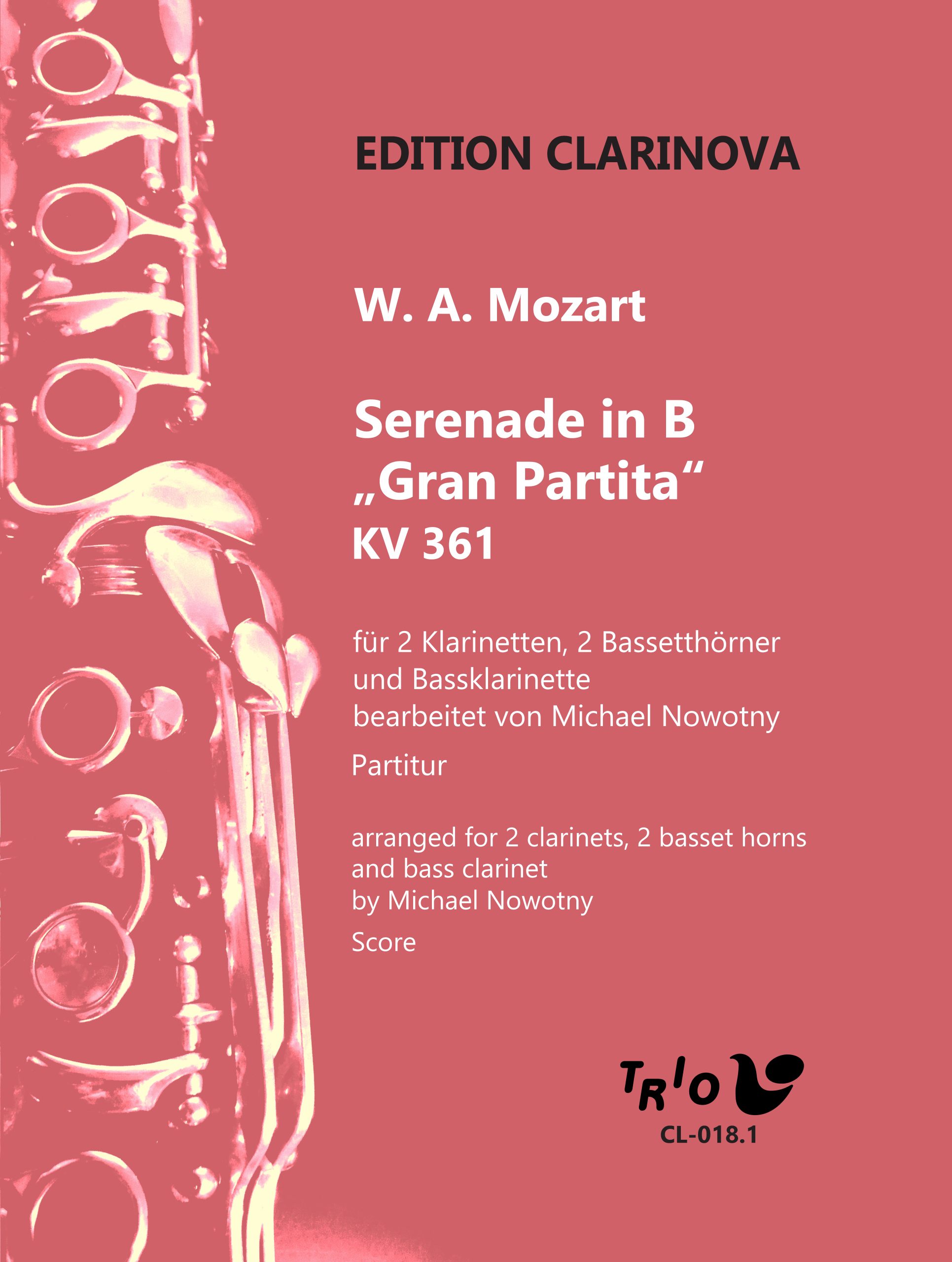 Wolfgang Amadeus Mozart. Serenade “Gran Partita,” K. 361. Arranged for two clarinets, two basset horns, and bass clarinet by Michael Nowotny. Edition Clarinova. Mettenheim, Germany: TRIO Musik Edition, 2025. Score €24.80, score and parts €49, alto clarinet additional part €5.95. Purchase Link.
Mozart wrote a good number of wind Divertimenti and Serenades scored for wind sextet and wind octet. The great Serenade, K. 361, known as the “Gran Partita” (not by Mozart), is undoubtedly the pinnacle of this genre. Wind ensembles were quite common in the last decades of the 18th century at some Austrian, German, and Bohemian courts. Mozart experimented with a new and never considered type of instrumental combination using wind instruments (after the Trio, K. 498, with clarinet, viola, and piano, and the wonderful Quintet, K. 452, for piano and winds). He added to the usual wind octet group two horns, two basset horns, and prescribed the double bass as a timbral reinforcement of the bass line. An anonymous wind octet arrangement of “Gran Partita” had been done in the late classical period, and also numerous other arrangements of various instrumental combinations followed during the Romantic and modern ages. Michael Nowotny conceived a new original and peculiar arrangement putting together two clarinets, two basset horns, and a bass clarinet. Actually not an easy thing to be able to condense the parts of 13 instruments in a decent way! The outcome is quite good and surprising. He used as a reference the Henle Urtext Edition of 2005. It will be a real precious opportunity for both students and professional clarinetists to perform this gem in a clarinet quintet combination. An alto clarinet part (instead of the second basset horn) can be provided on demand.
– Luigi Magistrelli
Comments are closed.