


Originally published in The Clarinet 53/2 (March 2026).
Copies of The Clarinet are available for ICA members.
Audio Reviews:
March 2026
RECORDINGS
 Songs of Sea and Stone. Jeremy Reynolds, clarinet; Corey Mackey, clarinet; Margaret McDonald, piano; Janáček Philharmonic Ostrava, Jiří Petrdlík, conductor. J. Brandon: Sea Songs: California Coast for clarinet and piano; Sea Songs: Mobula Ray for solo clarinet; The Mountain for two clarinets; Daydreams for solo clarinet; Fin de la Tierra: Land’s End for clarinet and chamber orchestra. Navona Records, NV6757. Total Time: 70:00.
Songs of Sea and Stone is an enchanting collection of world premiere recordings featuring clarinet works by Jenni Brandon. Inspired by curious sea creatures, majestic scenes of nature, and the human experience, this album is dazzling from beginning to end. Jeremy Reynolds’s warm tone, facile technique, and beautiful musicality send the listener on a journey like no other.
Opening with Sea Songs: California Coast for clarinet and piano, we are introduced to three delightful vignettes. The “California Spiny Lobster” graces us with pure curiosity. Reynolds and pianist Margaret McDonald match musical phrases and articulation perfectly as the music details the mysterious movements of this nocturnal, cave-dwelling crustation. “Leopard Shark” is expansive and majestic. Reynolds boasts effortlessly long lines which are complimented by the delicate twinkling in the piano. In the “California Moray Eel,” we find a mix of mystery, humor, and majesty, throughout which Reynolds maintains a lovely tone in all ranges. The ensemble between Reynolds and McDonald is impeccable and their musicality brings these charming movements to life.
Sea Songs: Mobula Ray for solo clarinet is the album’s next adventure. This work captures the smooth, underwater swimming as well as the leaps, splashes, twirls, and flips of the mobula ray, often called the “acrobats of the sea.” Reynolds shows off his vast palette of textures and colors throughout the piece. Opening from nothing, Reynolds demonstrates complete control over the instrument at the softest of the dynamics with impressive and steady crescendos and decrescendos. Maintaining warmth in the sound, he whips through runs ending in resonance fingerings painting a stunning representation of these unique creatures.
Moving from the sea to the stone, The Mountain, a duo for two clarinets, pulls the very best qualities two clarinets can achieve. Corey Mackey and Jeremy Reynolds navigate the piece with stunning intonation bringing out clear overtones that make this piece quite special. Boasting immaculate ensemble, Mackey and Reynolds complement each other in tone and timbre while quickly trading notes back and forth. Brandon’s composition depicts fresh breaths of air, jagged rocks, and whirling winds making this piece a highlight of the album.
Daydreams for solo clarinet focuses on the human experience. “Walking: Labyrinth” is an inquisitive movement, asking the question: What’s around the corner? Reynolds exercises his command of the clarinet’s range of color, playfully singing through each musical phrase. Next, while maintaining a sweet tone, Reynolds takes us twirling and floating through beautifully performed arpeggios in “The Figure Skater: Spinning.” “The Singer: Bel Canto Jazz” shows off Reynolds’s rich chalumeau register while he bounces between jazzy rhythms and lyrical passages. The piece ends with “Sleeping: Dreaming of the Day” which is an introspective lullaby-like movement. Reynolds creates an intimate setting as he glides smoothly through the registers of the clarinet. This movement is a delightful ending to an endearing piece of music.
The album culminates with an illustrious concerto, Fin de la Tierra, featuring Reynolds with the Janáček Philharmonic Ostrava under the direction of Jiří Petrdlík. The orchestration is expertly done utilizing the lowest and highest voices with Reynolds dovetailing seamlessly with the orchestra. It evokes images of shimmering water splashing against a rocky shore and hordes of sea life leaping from the ocean to the sky. Reynolds dances with bird-like passages in between phrases that encapsulate the wonder of a child. Through an oscillation between lilting dances and glistening water, the concerto finds itself in a tender waltzing moment. Reynolds sings through the ranges of his instrument at an increasingly quick pace all the while his characteristically warm sound following him all the way into the altissimo. His cadenza is not only technically impressive, but musically sensitive. His articulation is clean with just the right amount of front to each note followed by pearls of tone.
The partnership between Brandon’s compelling compositions and Reynolds’s gifted performance is absolutely stunning. Reynolds performs with such character, control, and musicality which brings each piece to life. This album is wonderfully programmed and executed. This is one you will want to come back to time and again!
– Sarah Manasreh-Decker

Dedications: Clarinet Trios of Beethoven and Brahms. Robert DiLutis, clarinet; Carrie Bean Stute, cello; Rita Sloan, piano. L. van Beethoven: Trio in B–flat Major, op. 11; J. Brahms: Trio in A Minor, op. 114. Centaur Records, CRC 4150. Total Time: 46:39.
Dedications brings together clarinetist Robert DiLutis, cellist Carrie Bean Stute, and pianist Rita Sloan for an intimate exploration of two cornerstones of the clarinet trio repertoire: Beethoven’s Trio in B-flat Major, op. 11, and Brahms’s Trio in A Minor, op. 114. The result is an album that presents fresh interpretations of these two celebrated works by three seasoned chamber musicians.
The first movement of Beethoven’s Trio, op. 11 is performed with remarkable clarity and playfulness. DiLutis’s light articulation and vibrant tone quality gives the music a sparkling buoyancy. Stute’s lyricism shines in the opening of the second movement, giving shape to the movement’s gentle introspection. Throughout the trio, Sloan’s piano playing glimmers with elegant precision, providing both rhythmic vitality and a strong harmonic foundation. The group’s musical cohesion is exceptional—each of the musicians plays with sensitivity to balance, blend, and phrasing.
Trio in A Minor, op. 114 by Johannes Brahms brings an autumnal shift in tone and color. The ensemble’s ability to phrase with depth and expressive weight is highlighted in the first movement. Here, Sloan’s unwavering musicality provides both brilliance and cohesion. Her ability to spark contrast and shape the harmonic backdrop enriches the ensemble’s texture throughout. The second movement unfolds with exquisite sensitivity. The long, singing lines are beautifully shaped by DiLutis and Stute. DiLutis’s clarinet sound rings with richness and overtones, floating effortlessly above the ensemble in the upper register without ever becoming strident. The third movement provides lively contrast with its folk-like rhythms and melodies. DiLutis negotiates the wide leaps with ease and charm. In the finale, the players return to the darker mood while maintaining a sense of forward motion in the syncopated melodic lines.
The recording’s natural reverb adds warmth and space, giving the music a sense of intimacy and resonance. Liner notes provide concise background on the works and the performers. Overall, Dedications stands as a thoughtfully crafted album that highlights both the beauty of these masterworks and the exceptional artistry of Sloan, DiLutis, and Stute.
– Kylie Stultz-Dessent
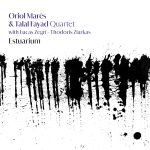 Estuarium. Oriol Marès, clarinet, bass clarinet; Talal Fayad, oud, electric oud; Lucas Zegrí, percussion, drums; Thodoris Ziarkas, double bass. Oriol Marès & Talal Fayad Quartet: Basho; Gitme; Calle 52; Kasi Lama; Imi Unut; Focus; Double; Ma7Dood; Girona. AudioMaze, OTQ001. Total time: 46:56.
In their debut album, Estuarium, the Oriol Marès and Talal Fayad Quartet offers listeners a modern interpretation of the diverse musical landscape of the Mediterranean. Fusing Latin polyrhythms with Arabic maqam traditions and jazz improvisation, the quartet’s nine original compositions blend “tradition and modernity … reimagining the region’s musical plural identity.”
Comprising Spanish clarinetist Oriol Marès, Syrian oud player Talal Fayad, Spanish percussionist Lucas Zegrí, and Greek bassist Thodoris Ziarkas, the quartet’s collective expertise spans traditions including European classical music, Latin and contemporary jazz, Iberian folk idioms, maqam-based music, Balkan music, flamenco, and North African grooves. Established after Marès and Fayad collaborated on a project dedicated to creating cross-cultural artistic conversation, the quartet presents a clear dialogue between the four voices of the ensemble, honoring each musical tradition it draws from while offering a fresh, personal interpretation and blending the styles into an imaginative and innovative new sound.
The album opens with Basho, named after Matsuo Bashō and inspired by his haiku, “Oh, tranquility! Penetrating the very rock, A cicada’s voice.” The piece begins with a meditative and improvisational oud line before being joined by the rest of the quartet and gradually evolving into a dance. Marès plays with a dark, resonant, and flexible tone, matching the oud in both tone quality and wide pitch bending as they play in unison. The quartet plays with a high level of musical sensitivity as the melody seamlessly shifts between members of the ensemble.
Improvisation and the development of simple melodic gestures into a complex and cohesive groove are central to the pieces presented in Estuarium. The quartet also makes ample use of unison playing between the clarinet, oud, and bass. Whether this forms a large part of the piece or only occurs for a moment, the unique texture this creates is both striking and grounding every time it occurs. In Imi Unut, the masterful dialogue and musical finesse between Marès and Fayad is especially clear, as Marès’s clarinet melodies smoothly and naturally morph out of Fayad’s oud flourishes.
Zegrí’s and Ziarkas’s skill and mastery of their instruments is evident throughout the album in their exceptional support for the clarinet and oud melodies, but also in the moments where the funky double bass lines and shimmering percussion are given opportunities to shine out of the texture, such as in Ma7Dood. Girona pays tribute to the city that inspired and cultivated the ensemble and was inspired by some of the quartet’s earliest improvisations, providing a brief but sentimental conclusion to the album.
In every piece, Marès plays with a warm, flexible sound, effortlessly modifying his tone to align with the character of the moment. At times dark and contemplative and at others bright, sparkling, and playful, the wide range of colors he employs is impressive and engaging. Through microtonal nuances, vibrato ranging from subtle to thick, vast articulation variety, and virtuosic flexibility and control, Marès navigates the nuances and character of each piece in a way that feels effortless and spontaneous. He plays with remarkable range and nuance and demonstrates masterful sensitivity as an ensemble member, sometimes employing a dark, flexible tone that expertly matches the sound of the oud, at others emerging from the texture with a brilliantly focused and soloistic clarinet timbre, and still at others employing techniques such as slap tongue in Calle 52 that evoke the sound of a double bass.
The Oriol Marès & Talal Fayad Quartet pays homage to the diversity of Mediterranean musical traditions in Estuarium, and through their unique blend of styles, cultures, and sounds creates a truly refreshing, beautiful, and enthralling sonic experience.
– Sarah Korneisel Jaegers
 BitterSweet. Mark Wolbers, E-flat clarinet, basset horn; Timothy Smith, piano. K. Benshoof: BitterSweet for E-flat clarinet and piano; S. Berg: Divertimento for solo basset horn; Rituals of Antiquity for solo E-flat clarinet; G. Fauré/trans. M. Wolbers: Chant Funéraire for E-flat clarinet and piano; R. Schumann/trans. M. Wolbers: Adagio and Allegro, op. 70 for basset horn and piano; W.A. Mozart/arr. Y. Ettlinger/trans. M. Wolbers: Four Church Sonatas, no. 17, K. 336 for basset horn and piano; A. Reed: March Variations for E-flat clarinet and piano. Independent Release. Total Time: 52:36.
Mark Wolbers’s new album BitterSweet presents the listener with a very unique combination of solo works for E-flat clarinet and basset horn with piano. Those well-versed with the extended clarinet family will know Wolbers for his work in promoting these instruments, particularly the alto voice, of which the album liner notes state the basset horn is his favorite. The album alternates between works for E-flat clarinet and basset horn and is a mix of new compositions and transcriptions.
The album begins with the title track, BitterSweet, for E-flat clarinet and piano by Ken Benshoof. Originally composed for flute in 2021, Benshoof reworked the piece for E-flat clarinet on Wolbers’s suggestion in 2022. Wolbers achieves a remarkably full tone on the E-flat clarinet in this playful yet reflective work. The composer’s use of periodic pitch bends alludes to a sense of melancholy and Wolbers executes them with a refined smoothness.
The following work is the newly commissioned Divertimento (2024) for solo basset horn by Stephanie Berg. Each of the five movements is relatively short, between around two to three-and-a-half minutes. The first, “Vigorously,” dances between the bottom and top ranges of the basset horn. This is followed by “Tenderly,” offering sweet melodies in both high and low registers. “Aggressively” presents driving fast triplet figures beginning in the low register before moving into the middle register and ending with a gentle motif at the end. “Pensive” uses long, delicate, crescendo notes to craft its contemplative melody. The final movement, “Brightly,” explores triplet motifs through the high and low registers. The work showcases Wolbers’s excellent control of the basset horn—nimble, powerful, and lyrical—throughout its full range. There is limited solo repertoire for basset horn, and Berg’s Divertimento is a fun and accessible work that will become an important addition.
The next track is Wolbers’s transcription of Gabriel Fauré’s Chant Funéraire for E-flat clarinet and piano. His resounding and resonant playing on the small clarinet is particularly welcome on this majestic work, bringing life into this funeral song. It’s just a pity that the recording is slightly marred by a recurring background noise of what sounds like a creaking chair or piano bench.
This is followed by Robert Schumann’s Adagio and Allegro, op. 70, originally for horn and piano, performed on the basset horn in a transcription that suits the instrument very well. Wolbers remarks in his program notes that it was written the same year as the Fantasiestücke. Hearing Adagio and Allegro, op. 70 on the basset horn highlights some similarities in the works, making them nice complements within the clarinet repertoire.
Stephanie Berg’s Rituals of Antiquity (2021) for solo E-flat clarinet is in four two-minute movements (“I. of the Earth,” “II. of the Flora and Fauna,” “III. of the Air,” “IV. of the Sky”) depicting these elemental forces. The fourth movement opens with a particularly effective echo effect through Wolbers’s excellent dynamic control of the instrument.
Mozart’s Church Sonata, K. 336 almost seems out of place on this album, but I welcome any opportunity to hear more basset horn! And, as Mozart is one of the first and few composers to have truly made use of the basset horn, a tribute to him does seem fitting. The transcription of the original work for two violins, organ, and continuo was arranged for clarinet and piano by Yona Ettlinger, and Wolbers adapted it to use the extended range of the basset horn, as his program notes state, “to unwind arpeggios written to fit the more limited compass of a regular clarinet,” much like performing the concerto on the basset clarinet. Wolbers’s playing sings in the upper register and is powerful when he descends into the bottom range. The cadenza, which is his own, is an especially lovely use of the basset horn in sound, character, range, and harmonic sophistication. For me, it’s the most captivating section of the piece.
The album closes with Alfred Reed’s March Variations for E-flat clarinet. Written in 1966, this work is part of a second suite of educational pieces Reed wrote for the clarinet family, each suite comprised of five movements, and each movement for a different member of the clarinet family, from E-flat to contrabass. Wolbers’s crisp articulation and robust character make this a delightful end to the album.
Throughout BitterSweet, Wolbers demonstrates his rich, beautiful sound, full of depth and color; his technical mastery; and his lyrical musicianship on both the E-flat clarinet and basset horn. It is a wonderful addition to the library of solo recordings for these lesser-used members of the clarinet family and we hope that it will bring them more recognition with these new contributions.
– Jason Alder
 The Lily of Killarney. Robert Plane, clarinet; Benjamin Frith, piano. M. Balfe/arr. C. le Thière: Fantasia on The Bohemian Girl; E. Tomlinson: Canzonetta; T. Dunhill: Phantasy Suite, op. 91; R. Gipps: Cool Running Water, op. 77; J. Holbrooke: The Butterfly of the Ballet, op. 55 no. 6; Canzonetta (Spring Song), op. 55 no. 8; J. Benedict/arr. H. Rogerson: Fantasia on The Lily of Killarney; E. Maconchy: Fantasia; T. Pitfield: Conversation Piece; C. Raybould: The Wistful Shepherd (A Reverie); H. Ferguson: Four Short Pieces; W.V. Wallace/arr. C. le Thière: Fantasia on Maritana. Mike Purton Recording, MPR118. Total Time: 79:31.
Robert Plane’s work to showcase clarinet repertoire from Britain and Ireland continues with this recent album, The Lily of Killarney. Plane has had a distinguished playing career as a soloist, chamber musician, recording artist, former principal clarinetist of the BBC National Orchestra of Wales, the City of Birmingham Symphony Orchestra, and Royal Northern Sinfonia and is currently Head of Woodwind Performance at the Royal Welsh College of Music and Drama. In this latest album, Plane presents a wealth of British and Irish music both new and old with pianist Benjamin Frith. With a listening time of almost 80 minutes, the recording’s focus is three fantasias based on 19th-century Irish operas (two arranged by Charles le Thière and one by Howard Rogerson). The recording also features standard repertoire by Dunhill and Ferguson while also exposing the listener to works by seven other composers. A delightful though substantial undertaking!
The centerpieces of this album, the three fantasias, harken back to those of Italian operas by Luigi Bassi and Donato Lovreglio. These fantasias, based on themes of the “Irish Ring” of operas popular in the mid-1800s in London, include the expected virtuosic passages, full of rubato and bravura. The synchronization of the rubato throughout the album is perfectly sequenced between Plane and Frith, a testament perhaps to their long history of performing and recording together. Plane’s committed, invested interpretations throughout seem even more so in the title work, The Lily of Killarney. Such an expressive offering here with vibrato employed!
Much of the musical material throughout the album is most melodious. As I listened to the recording in the main administration building on campus, passersby would stop to listen for a time and remark about the welcome, peaceful music! The most adventurous work, harmonically and rhythmically, is Elizabeth Maconchy’s 1979 Fantasia, which exhibits influences of Bartok.
Aside from the ample music, the recording includes much more. The cover art has an attractive, perhaps Irish landscape that sets the tone for the music within. The booklet provides a wealth of information about these works, including an introduction by Howard Rogerson, who edited two of the fantasias arranged by Thière and arranged the third. Rogerson’s story of finding Thière’s arrangements and preparing the third arrangement during the enforced downtime of COVID-19 is fascinating and inspiring. All three works are now available through Forton Music as digital download or via shipping. Another feature of the booklet is insightful paragraphs on each of the 12 compositions. For instance, of particular interest was Ruth Gipps’s Cool Running Water, op. 77, originally scored for bass flute and piano and transcribed for clarinet in A, likely for Gipps’s husband, clarinetist Robert Baker. Gipps’s music is enjoying a current rebirth, including this premiere recording of this transcription.
The digital submission received by this reviewer also included Plane’s article published in the Autumn 2025 issue of Clarinet and Saxophone Magazine, the quarterly publication of the Clarinet and Saxophone Society of Great Britain. The article is recommended as it is full of expanded information about the works recorded and the inspiration for the recording. This is a successful resource of clarinet and piano music of Britain and Ireland! The recording quality is impressive, even on my laptop speakers. Plane’s clarinet tone is cored, sparkly, and even through the registers, without even a hint of spread at top of the clarion register. Highly recommended!
– Gail Lehto Zugger
 The Song Also Rises. Sarah Watts, bass clarinet; Kim Davenport, piano. F.B. Price/arr. S. Watts: Six selected songs; M.J. Solomon: The Mindlessness of It All; S. Coleridge-Taylor/arr. S. Watts: Sorrow Songs, op. 57; D.N. Baker: And Then… Alea Recording, AR010. Total Time: 62:00.
The Song Also Rises, the premiere studio recording of bass clarinetist and arranger Sarah Watts and pianist Kim Davenport, delivers a captivating collection of works from four composers of African descent spanning 150 years. According to the program notes, the title of the album is “a play on words, an overdue elevation of forgotten or underperformed (recently discovered) masterworks …” While these works may currently be underperformed, the outstanding playing of both Watts and Davenport will serve in bringing these wonderful works into standard repertoire lists.
The album begins with a set of six selected art songs by Florence B. Price, which were beautifully arranged by Watts for bass clarinet and piano, showcasing the full range of the bass clarinet. Watts not only performs with a velvety altissimo register, but also with a full rich sound in the lower register. According to program notes, Watts performed from the vocal score, which truly elevated this recording with thoughtful phrasing throughout this set of art songs.
The album continues with The Mindlessness of It All, a two-movement work by accomplished and award-winning composer Malcolm Solomon. This piece, inspired by tragedies such as the Sandy Hook shooting, George Floyd, and Breonna Taylor, truly takes the listener on a musical journey. The first movement begins with intense, technical passages between the two instruments, as if in an argument that does not end with any resolution. The second movement begins with low tone clusters in the piano and the bass clarinet playing a somber melody, slowly building up until the two instruments combine into a spiritual. This is a truly moving piece and the technical prowess of both Watts and Davenport facilitates the telling of this powerful story.
Next on the album is Sorrow Songs, op. 57 by Samuel Coleridge-Taylor. This set of six songs was also arranged by Watts and again showcases her wonderful talent in arranging. The bass clarinet playing on these arrangements is hauntingly beautiful, with smooth entrances and exceptional phrasing.
The album concludes with a work by David N. Baker, And Then…, a three-movement work with bits of jazz elements scattered throughout. The first movement, “The Song Also Rises,” begins and ends with a contrapuntal melody between the bass clarinet and piano with a middle section that resembles that of a Miles Davis tune. The second movement, “On Wings of Song,” is simply beautiful with Watts playing a melody that is both jazzy and soulful. The final movement, “The Apprentice’s Sources,” features a syncopated melody interspersed with jazz licks, before a race to the finish. Overall, this is a superb album from beginning to end, showcasing both amazingly talented performers and moving compositions/arrangements for bass clarinet and piano.
– Jeremy Wohletz
 Clarinet Concertos. Peter Cigleris, clarinet; Győr Symphonic Band, László Marosi and Ferenc Szabó, conductors. F. Hidas: Concerto Semplice; S. Milton: Clarinet Concerto; D. Maslanka: Clarinet Concerto; S. Yagisawa: Clarinet Concerto. Somm Recordings, SOMMCD 0705. Total Time: 79:55.
Peter Cigleris lends a supported soulful sound to the lovely balance of the Győr Symphonic Band who play with precision and aplomb in Frigyes Hidas’s Concerto Semplice. The playful character of the Allegro giocoso movement is sustained through the modulations and increased drama and technical demands, which create a sense of adventure. The Sostenuto movement opens with a pastorale sound and includes a beautiful tutti with the clarinet section and an extended cadenza with colorful sound across all the registers. It is especially exciting to hear the seamless technique and compelling sensitivity in phrasing. The closing Allegro benefits from dramatic flair and athletic yet supple articulations. The Győr Symphonic Band balances the soloist with fantastic sensitivity.
“Fragments with Cadenza” opens Simon Milton’s Clarinet Concerto, showing compelling artistry throughout the registers of the clarinet, interweaving with the dystopian tapestry of wind band sound with devastating simplicity. The following movement, “Ecstasy: Moderately and expressively” creates and builds tension largely due to Peter Cigleris’s singing quality and flexibility in the altissimo register. “The Finale: With humour” shows verve and poignant expression as smooth, expressive articulations reach the stratosphere with an explosive commanding presence.
The Maslanka Concerto is a powerful and wistful composition featuring virtuosic section playing and fantastic connections across the ensemble in the delicate texture of the opening “Lamentation.” The altissimo of the clarinet is crystallized icing on top of the impeccable ensemble intonation, but Maslanka also gives us a delightfully delicate quiet interlude with piano. The concluding “Dance” movement is tightly wound and expertly timed, showing off László Marosi’s excellent rapport with the Győr Symphonic Band. Small explosions of sound crash around the ensemble without taking away from the builds and sudden drops in texture. The woodwinds are especially successful at rippling their runs across the ensemble with great energy and control. A fantastic interlude in the low clarinets sets up the virtuosic exchanges between soloist and winds, before yet another athletic cadenza, and a perfectly spun gossamer texture between clarinet and piano with thrilling niente entrances and delicate musicianship. The power generated by both the pianist and Cigleris at the end of this interlude is intense and inspiring, as the ensemble returns with the soaring melody and triumphant textures; yet the final notes slip away gently in the clarinet and piano.
The closing Clarinet Concerto in one movement shines with toccata style articulations that can be a little terse and aggressive due to the nature of the piece. Satoshi Yagisawa’s writing also showcases Peter Cigleris’s flexible arpeggiations, evenness of sound, and an impressive range of dynamics in the cadenza. Ferenc Szabó, the founder of the Győr Symphonic Band, leads this epic work of almost 18 minutes. Featuring tender melodies and busy forward motion, Peter Cigleris’s authoritative playing and mastery of the technique and style, with nods to cadential trills and a small fugue, send the exciting concerto racing to its end. It should be noted that the lyrical Adagio—subtitled “Lamentation”—is often performed separately (as per the program notes).
– Andrea Vos-Rochefort
NEW RELEASES
Dancing in a Still Life. Tasha Warren, bass clarinet; Guy Yehuda, clarinet; Paquito D’Rivera, clarinet; Dave Eggar, cello; Phil Faconti, guitar; Amir Farid, piano. Blue Griffin Recording, BGR699.

Wild Winds. MiamiClarinet Quartet: Margaret Donaghue Flavin, clarinet; Dawn McConkie, clarinet; Michael Walsh, clarinet; Danielle Woolery, clarinet. Independent Release.

Charles Harford Lloyd: Chamber Music for Clarinet. Matthew Nelson, clarinet; Alexander Volpov, cello; Chad Sloan, baritone; Anna Petrova, piano. Toccata Classics, TOCC 0768.
Wonderings and Other Revelations. Nancy Braithwaite, clarinet; with several guest performers. Etcetera Records, KTC 1835.

Live from Tivoli. Jonas Frølund, clarinet; Jakob Weber, snare drum; Danish Chamber Orchestra, Adam Fischer, conductor. OUR Recordings, 9.70861.

The World is Waiting for the Sunrise. Zodiac Trio: Kliment Krylovsky, clarinet; Vanessa Mollard, violin; Riko Higuma, piano. Blue Griffin Recording, BGR679.

Moxie. Chamber Winds of South Dakota, Don Linn, conductor. Independent Release.

Bach, Berio, Boulez: Music for Solo Clarinet. Marek Švejkar, clarinet. Supraphon, SU 4362-2.
Boreas Trio. Cassie Keogh, clarinet; Matthew Patnode, saxophone; Tyler Wottrich, piano. Independent Release.

Big Crass Monster. Whistling Hens: Jennifer Piazza-Pick, soprano; Natalie Groom, clarinet. Navona Records, NV6775.

Gardners at Home. Égide Duo: Joshua Gardner, clarinet; Stefanie Gardner, bass clarinet. Soundset Recordings, SR1184.

Vibraciones del Alma. Francisco José Cantó Carrillo, clarinet; Ángela Moraza Molina, piano. Calle440, 022025.
Comments are closed.