

Originally published in The Clarinet 53/3 (June 2026).
Copies of The Clarinet are available for ICA members.
The First Generation of Professional Clarinetists Trained in the People’s Republic of China
An international cultural exchange helped establish China’s earliest clarinet pedagogy and performance standards.
by Tie Bai
COMMEMORATING THE 70TH ANNIVERSARY OF THE GERMAN EXPERT TRAINING PROGRAM (1956–1957)
HISTORICAL BACKGROUND
In 2026, the Chinese clarinet community commemorates the 70th anniversary of the German Expert Training Program of 1956-1957, a landmark event in the early development of professional wind performance education in the People’s Republic of China. Organized only seven years after the founding of the nation, this initiative represented the first nationally coordinated and systematic professional wind-instrument training program in modern Chinese music history.1 Its historical significance is profound, as it directly cultivated the first substantial cohort of clarinetists trained according to modern professional standards in China.
In 1956, the Central Philharmonic Society was formally established under the Ministry of Culture. With governmental approval, several leading music specialists from the German Democratic Republic (the former East Germany) were invited to China to provide instruction in multiple disciplines, including conducting and wind instruments.2 Music conservatories, orchestras, military ensembles, and professional performing organizations throughout the country submitted candidates for admission. To ensure both selectivity and instructional quality, the Ministry of Culture established four wind-instrument expert classes and stipulated that each institution could recommend only one candidate.
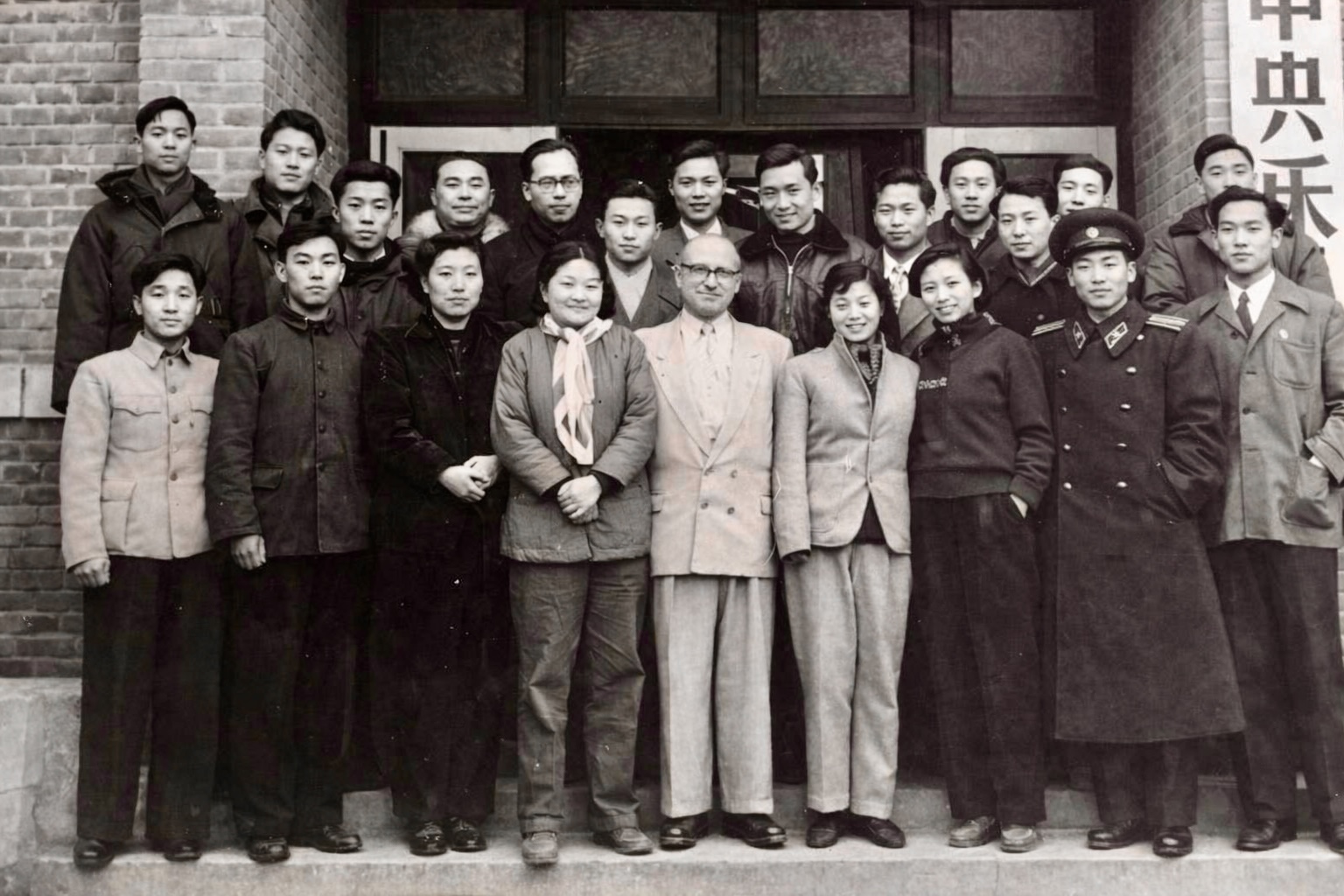
Oskar Christmann with clarinet students during the German Expert Training Program, 1956. Photo courtesy of Bai Zhemin’s personal archive.
THE CLARINET EXPERT: OSKAR CHRISTMANN
The clarinet expert appointed to the German Training Program was Oskar Christmann, a mid 20th-century German clarinet pedagogue identified in surviving program documents as a German woodwind expert from Dresden, German Democratic Republic.3 Christmann’s artistic background was rooted in the Austro-German tradition, and his pedagogical philosophy reflected the hallmarks of the German clarinet school: tonal focus, stable intonation, refined technique, and a clear understanding of the clarinet’s structural role within orchestral texture.4
In 1956, Christmann was invited by the Ministry of Culture of the People’s Republic of China to serve as a foreign expert and assumed responsibility for all clarinet instruction within the Central Philharmonic Society. He personally conducted entrance examinations for prospective students, evaluating candidates on technical ability, repertoire familiarity, musical understanding, and artistic insight through discussion of orchestral literature and performance experience.
Following these examinations, 10 students were formally admitted to the national clarinet expert class, representing conservatories, orchestras, military ensembles, and performing organizations throughout China. They included Bai Wenshun of the Yanbian Song and Dance Ensemble (Jilin Province), Gu Peng of the Shanghai Opera House, Li Shuming of the Shanghai Symphony Orchestra, Liang Yu of the Central Opera House, Liu Houpeng of the Beijing Children’s Theatre, Mu Lidi of the PLA Military Band, Wang Zhijian of the Central Conservatory of Music, Yang Jinrong of the Shanghai Conservatory of Music, Yu Qixiong of the Central-South Military Region, and Zhou Dan of the Shenyang Conservatory of Music. Together, these musicians formed the earliest nationally selected cohort of systematically trained professional clarinetists in the People’s Republic of China.
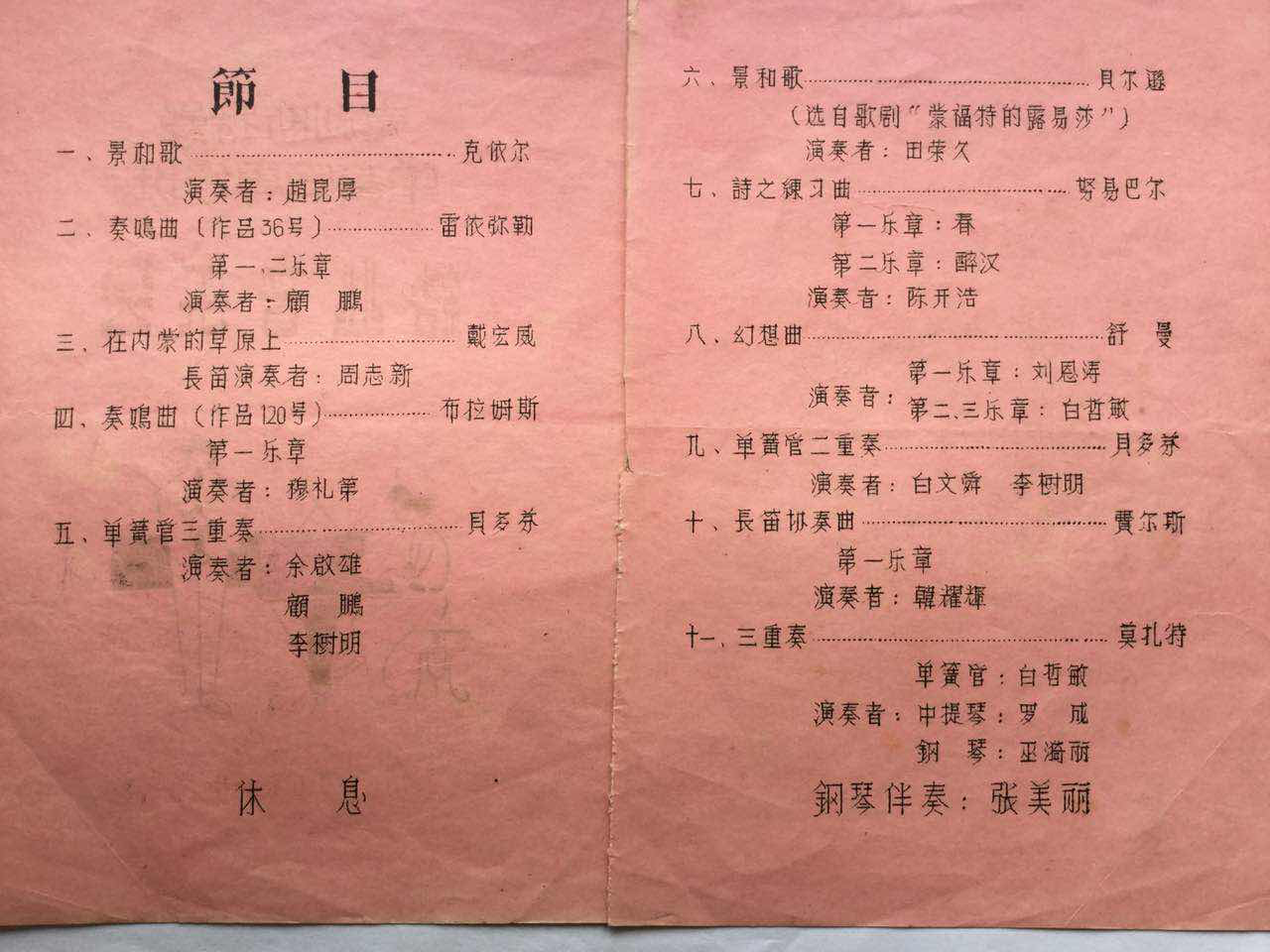
In addition to these nationally selected participants, several clarinetists from the Central Philharmonic Society also studied directly with Christmann as formal members of the training program, including Bai Zhemin (later principal clarinetist of the Central Philharmonic Society), Chen Kaihao, Liu Entao, and Tian Rongjiu. Because of their active roles within the orchestra, these musicians received not only individual clarinet instruction, but also extensive ensemble and orchestral training under Christmann’s supervision.
Additional participants attended as auditors, and at least one candidate received private instruction outside the formal program.
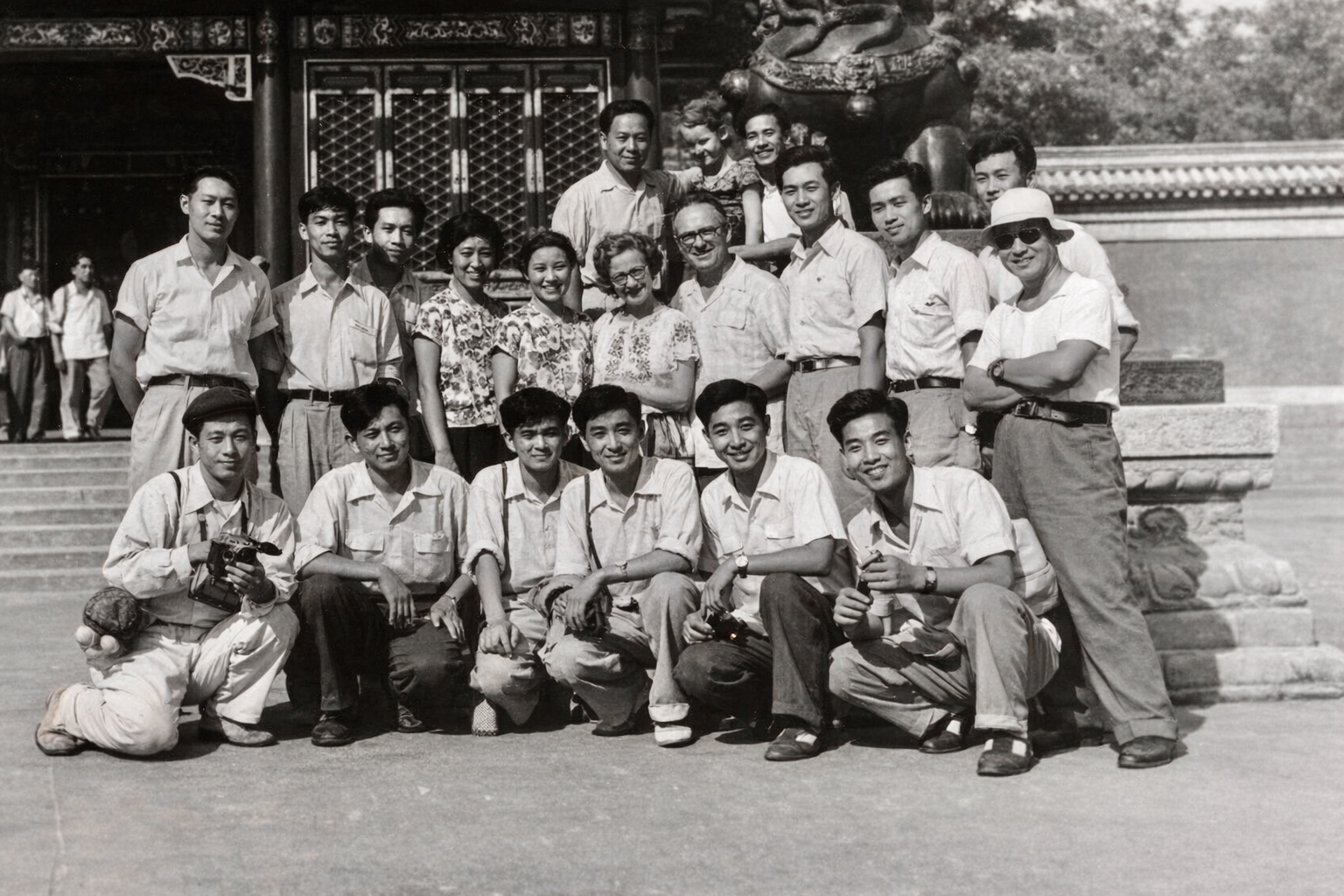
Oskar Christmann with clarinet students during the German Expert Training Program, 1956. Photo courtesy of Bai Zhemin’s personal archive.
PROFESSIONAL INSTRUCTION WITHIN THE CENTRAL PHILHARMONIC SOCIETY
Beyond the formal expert class, Christmann also provided daily instruction within the Central Philharmonic Society, working closely with both the clarinet and flute sections. His teaching addressed technical development, ensemble coordination, phrasing, balance, and interpretation in accordance with the conductor’s artistic intentions. This sustained pedagogical work contributed significantly to the establishment of professional standards in China’s earliest orchestral wind performance practice and helped shape the artistic development of China’s emerging national symphonic ensemble tradition.
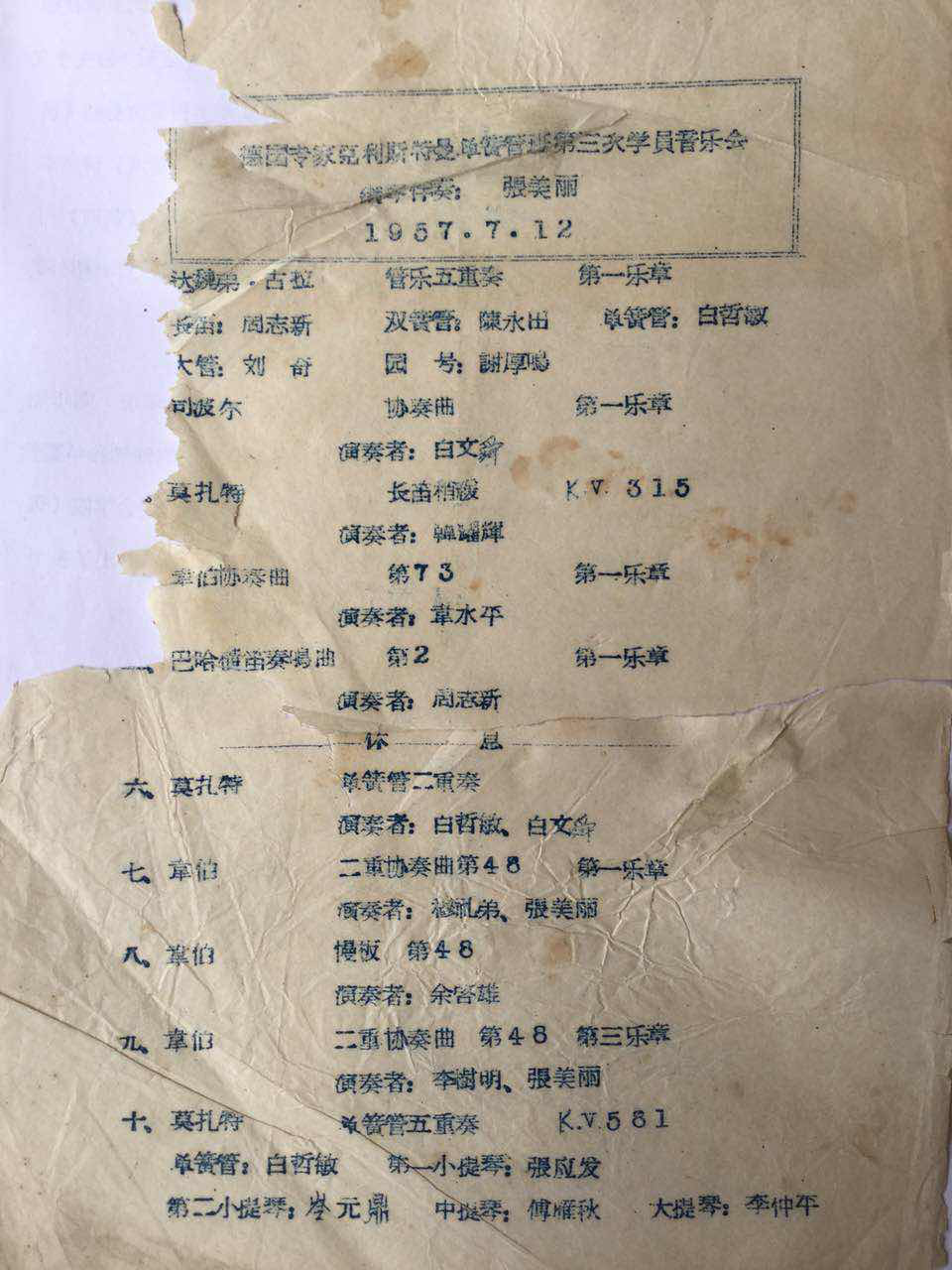
Concert program of the German Expert Training Program, 1957. Photo courtesy of Bai Zhemin’s personal archive.
TEACHING CONTENT AND ARTISTIC PHILOSOPHY
Christmann’s teaching style was rigorous yet pragmatic. Notably, he did not require students to adopt German-system clarinets, and most participants continued performing on French-system instruments throughout the training period. His curriculum emphasized technical exercises, études, solo repertoire, sight-reading, and stylistic versatility.
Repertoire studied during the program included arrangements of works by Johann Sebastian Bach, compositions by Paul Hindemith, and various unaccompanied clarinet works. Some handwritten pedagogical materials from this period have survived in private archives, providing rare documentary evidence of the teaching content employed during the program.5 Together with preserved concert programs and photographs, these materials constitute some of the few surviving primary documents related to the German Expert Training Program.
STUDENT LIFE AND EDUCATIONAL OUTCOMES
The educational environment of the German Expert Training Program was disciplined, focused, and performance oriented. Students regularly presented public concerts during the training period, and programs from both interim student recitals and the final concert remain preserved as valuable historical documentation.
Beyond formal lessons, teacher–student relationships developed through shared travel and social activities, fostering a collaborative and collegial atmosphere. Photographic records from the period further document the interpersonal dynamics and educational environment of the program.
Upon completion of the program, participants returned to institutions throughout China, where many became leading performers, principal orchestral musicians, and pioneering pedagogues in conservatories and professional ensembles. Through their artistic leadership and teaching, they disseminated the pedagogical principles acquired during the program and helped establish the foundation of modern clarinet performance and education in China.
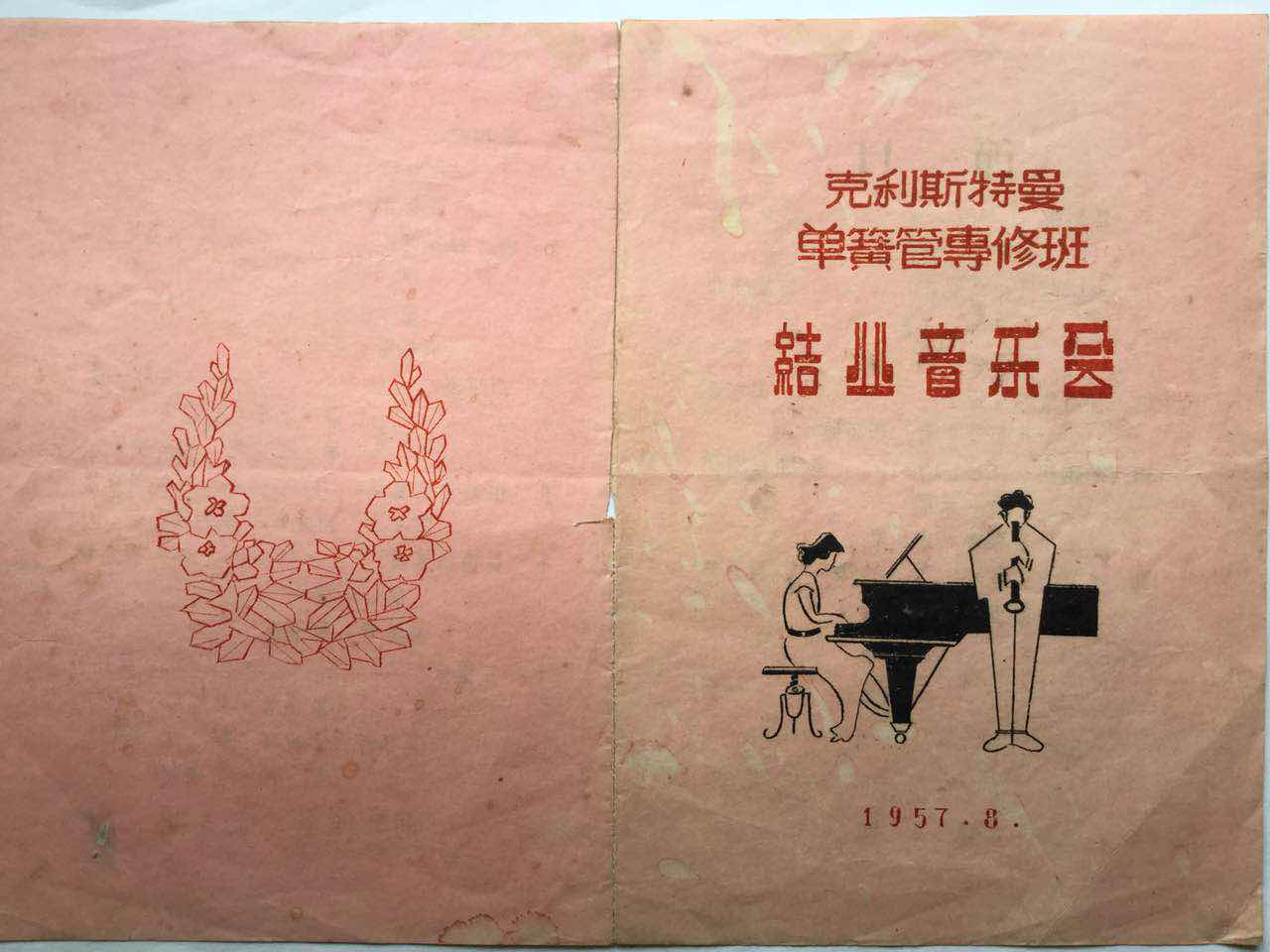
Final concert program of the German Expert Training Program, 1957. Photo courtesy of Bai Zhemin’s personal archive.
CONCLUSION
Although the German Expert Training Program lasted for only one year, its impact on the development of clarinet performance and pedagogy in China was profound and enduring. Oskar Christmann played a pivotal role not only in training the first substantial cohort of professionally educated clarinetists in the People’s Republic of China, but also in shaping the performance standards of China’s earliest national orchestral clarinet section.
As the Chinese musical community commemorates the 70th anniversary of this landmark initiative, renewed scholarly attention to the German Expert Training Program offers an important opportunity not only to honor its historical legacy, but also to better understand the origins of China’s modern clarinet pedagogy and professional performance tradition. This formative chapter in Chinese clarinet history deserves continued scholarly research, preservation, and recognition within the broader history of global clarinet pedagogy.
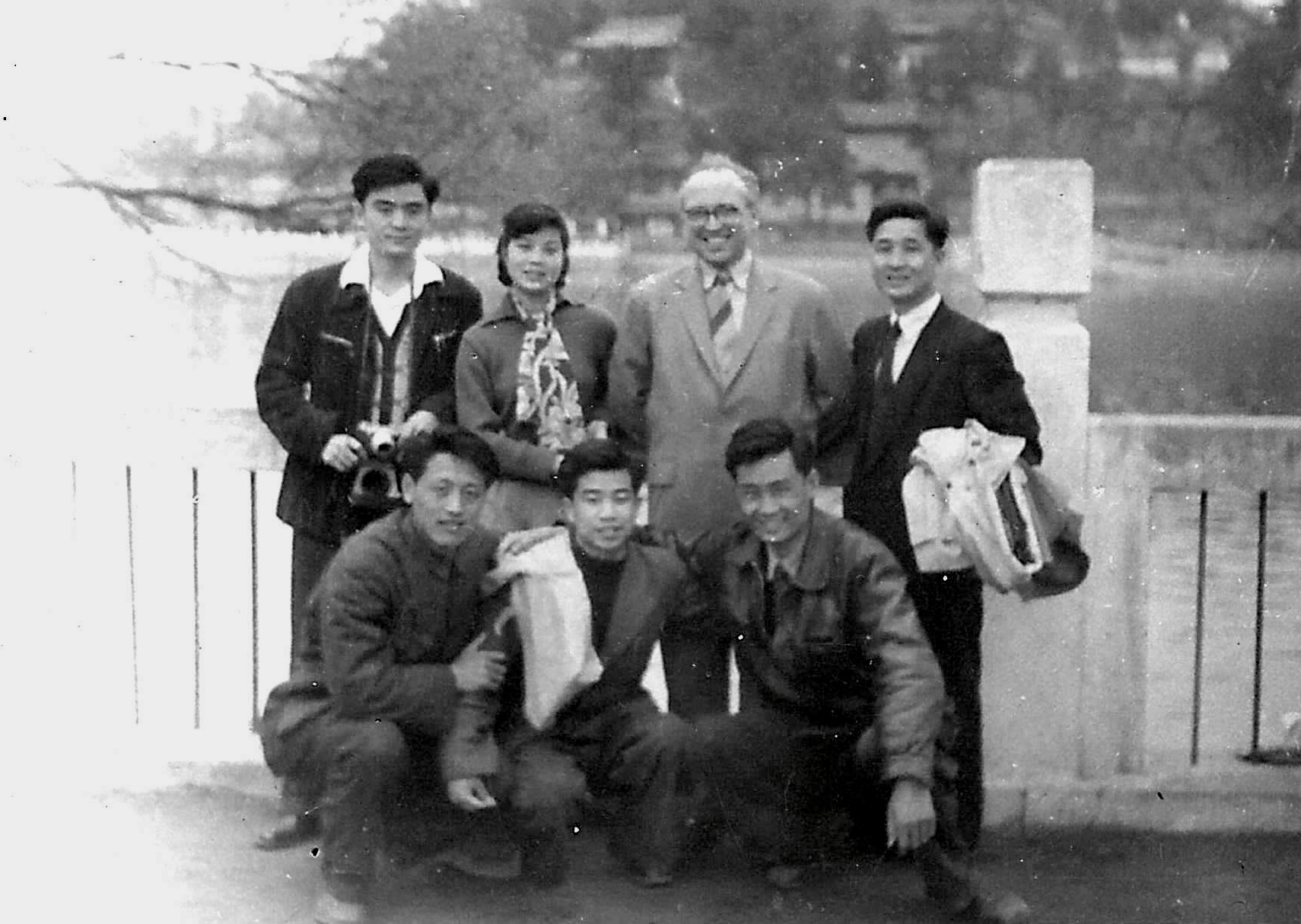
Oskar Christmann with clarinet students during the German Expert Training Program, 1956. Photo courtesy of Bai Zhemin’s personal archive.
ACKNOWLEDGMENTS
The author extends heartfelt gratitude to the surviving participants and witnesses of the German Expert Training Program—including Bai Wenshun, Bai Zhemin, Li Shuming, Mu Lidi, Wang Zhijian, Yang Jinrong, and others—whose firsthand recollections, preserved documents, and historical insights have made possible the reconstruction of this important chapter in Chinese clarinet history. Through interviews conducted by the author over many years in China, Hong Kong, and the United States, these individuals generously shared invaluable oral histories, photographs, concert programs, and archival materials essential to the preparation of this article.
ARCHIVAL NOTE
Primary-source materials referenced in this article—including interview recordings, transcripts, original photographs, concert programs, handwritten documents, and related archival materials—are preserved in the author’s private research archive.
ENDNOTES
1 Personal interviews were conducted by the author with surviving participants of the German Expert Training Program, including with Bai Wenshun, Bai Zhemin, Li Shuming, Mu Lidi, Wang Zhijian, Yang Jinrong, and others, over multiple years in China, Hong Kong, and the United States. Audio recordings, interview transcripts, and supporting archival materials are preserved in the author’s private research archive.
2 Oskar Christmann is identified as a “German Woodwind Expert, Dresden” in a written evaluation prepared for student Yang Jinrong during the German Expert Training Program. Document is preserved in the author’s private archival collection.
3 Ibid.
4 Christmann’s pedagogical philosophy and stylistic orientation are reconstructed from oral recollections of former participants and teaching materials preserved from the training period.
5. Private pedagogical manuscripts, handwritten teaching materials, and preserved archival documents were provided by participants of the German Expert Training Program.
 Tie Bai graduated from the University of Southern California. He has performed in the United States, Europe, and Asia, and has participated in International Clarinet Association conferences in Paris, Columbus, Tokyo, Atlanta, and Assisi. His recording 20th Century’s Dedication was recommended by The Clarinet as a reference for clarinet repertoire. Bai has served as a juror for several international competitions, including the Beijing International Clarinet Competition, the Japan Clarinet Competition, and the International Clarinetist Corona Competition. In 1998, he founded the Beijing International Clarinet Festival and served as the Festival Director. He has since been involved in organizing and directing several festivals, including the 2025 Shanghai International Clarinet Festival. He previously served as Professor of Clarinet at Bethesda University in Los Angeles.
Comments are closed.