


Originally published in The Clarinet 53/1 (December 2025).
Copies of The Clarinet are available for ICA members.
Audio Reviews:
December 2025
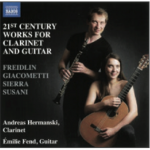 21st Century Works for Clarinet and Guitar. Andreas Hermanski, clarinet; Émilie Fend, guitar. G. Susani: Sonata for Clarinet and Guitar; A. Giacometti: The Prideful Cry of Amazonian Forest op. 191, op. Br. 31; J. Freidlin: Kafka Sonata; Mist Over the Lake; R. Sierra: Duo-Sonata for Clarinet and Guitar. Naxos, 8.579168. Total Time: 66:10.
Clarinetist Andreas Hermanski is a highly acclaimed soloist and chamber musician performing throughout Europe and the US. He currently teaches at the conservatory in the Hanseatic City of Rostock. Émilie Fend is a renowned guitarist who has won numerous competitions and performs as a soloist internationally.
The album opens with Giacomo Susani’s Sonata for Clarinet and Guitar which the composer says is written modally and suggestive of the early 20th century neo-classical style. The energetic first movement displays excellent interplay between players with clear delineation of melody and accompaniment. There are a couple of instances of intonation disagreement, however the technique and ensemble tightness are very well demonstrated. The second movement highlights the color pallet of Fend’s expressive playing. Very sensitive playing is exhibited by both performers; Hermanski’s legato ability and singing style are most notable here. The work concludes with a lively, spirited bookend recalling the first movement motives and characters, performed with excellent precision.
The second work, Antonio Giacometti’s The Prideful Cry of Amazonian Forest, op. 191, op. Br. 31, written in 2022, highlights Hermanski’s fluency in extended techniques. His beautifully executed multiphonics and sensitive pitch bends are very commendable. Particularly notable are Hermanski’s very carefully controlled portamenti delicately handed off to the guitarist.
Jan Friedlin’s Kafka Sonata opens with a prologue performed beautifully by Hermanski and Fend. Inner movements feature very precise ensemble playing and playful characterizations. The final movement exhibits the most Kafkaesque elements of unease and complexity especially in a harmonic sense. Overall, the duo’s unity of interpretation and technique are excellent.
Roberto Sierra is probably the most well-known composer featured on this album. His work, Duo-Sonata for Clarinet and Guitar, was commissioned by Hermanski and Fend and written in 2021. This work is the most impressive offering on this album in terms of technical and rhythmical precision by both performers as well as the impeccable blend and lyricism created by Hermanski and Fend. The dramatic elements of this work are amply conveyed through their dynamic and highly refined playing. Hermanski’s beauty of tone is particularly remarkable in this work
The album concludes with a soliloquy by Jan Freidlin, Mist Over the Lake, written in 1999. This somewhat melancholic work evokes a feeling of hopefulness and optimism. This performance is very heartfelt and expressive. There’s a very palpable sense of lyricism and unified interpretation in Hermanski’s and Fend’s playing.
This album is an invaluable contribution to the recorded collaborative clarinet canon and is a brilliant display of musical excellence by both performers.
– Kenneth Long
 All the Light of Our Sphere. Glenn Dickson, clarinet, Boss DD20, Zoom G1X; Bob Familiar, Rhodes MK8-FX, Expressive-E Osmose, Singular Sound Aeros Loop Studio, Soma Laboratories Cosmos Drifting Memory Station, Chase Bliss CXM 1978. G. Dickson and B. Familiar: When fortune laid the Trojans low; Words set free from doubt; Just one inch in a hundred years; It haunts me still; Sweet seed from bitter fruit; Pretending she was someone else; All the light of our sphere; When the mist thins; And even yours is mine. Sounds Familiar. Total Time: 54:09.
Clarinetist and composer Glenn Dickson joins electronic and ambient composer Bob Familiar as Dickson & Familiar in their first album together, All the Light of Our Sphere, released in May 2025 on Sounds Familiar. The album features original compositions written and performed by the duo, blending genres from ambient electronic and minimalist music to klezmer, classical, and rock. These influences come together in lush, immersive soundscapes that feel both intricate and expansive.
Dickson is a versatile musician with a background in klezmer, jazz, rock, Balkan, and ambient styles, known for his work with Naftule’s Dream and the Shirim Klezmer Orchestra. Familiar brings his expertise in electronic sound design and improvisation, coupled with deep experience in sound recording, mixing, and mastering.
This album showcases their DIY sensibility and creative synergy. Each track is performed live by the two musicians without overdubs, using a combination of analog and digital pedals, loopers, and synthesizers. Glenn Dickson plays the clarinet through a Boss DD-20 Giga Delay and a Zoom G1X pedal board, creating long, fluid melodies that loop into clarinet choirs stretching across the stereo field. Bob Familiar uses a Rhodes MK8-FX keyboard with effects, the Expressive-E Osmose (a polyphonic synthesizer), the Singular Sound Aeros Loop Studio, Soma Laboratories’ Cosmos Drifting Memory Station, and the Chase Bliss CXM 1978 reverb pedal to craft Brian Eno-esque textures—at times delicate and present, at others, thick and enveloping. The technology itself becomes an extension of the instruments, expanding the sonic palette and blending seamlessly with the clarinet’s tone.
The opening track, When fortune laid the Trojans low, begins with Dickson’s distinctive clarinet sound drenched in reverb and long delay, layered over bubbling electronic textures and ambient creaks. The sixth track, Pretending she was someone else, highlights Dickson’s tonal range—from dark and haunting to powerful, strident solos that cut through a rich, almost orchestral backdrop. My favorite track on the album is And even yours is mine. The synth keyboard melody, combined with ambient chords and subtle tremolos, feels deeply earnest.
All the Light of Our Sphere is a beautiful addition to any ambient or experimental playlist. Its pacing is deliberate, inviting the listener to slow down in a frenetic world. The album deserves to be experienced in full, allowing the listener to appreciate the care in its recording and mixing. There are profoundly human touches—like the sound of Dickson’s breath, bending tones, and wisps of air at the edges of notes—that add emotional depth and authenticity. The synths’ movement across the stereo field further enriches the listening experience, adding a spatial, dimensional quality that makes the album truly come alive.
– Ford Fourqurean
 Mentors. Gaia Gaibazzi, clarinet; Clarissa Carafa, piano. M. Reger: Albumblatt in E-flat Major; Tarantella in G Minor; Sonata in A-flat Major, op. 49, no. 1 for clarinet and piano; R. Schumann: Fantasy Pieces, op. 73 for clarinet and piano; J. Brahms: Sonata in F Minor, op. 120, no. 1 for clarinet and piano. Da Vinci Classics, C00963. Total Time: 60:40.
Gaia Gaibazzi is an award-winning Italian clarinetist and bass clarinetist who has performed at major concert halls across Europe. Her breathtaking sound and musicianship take center stage in the album Mentors: Max Reger, Robert Schumann, and Johannes Brahms.
The recording begins with Max Reger’s Albumblatt in E-flat Major (1902). Gaibazzi’s musical sensitivity is immediately present. Her tone is incredibly warm, centered, and vibrant. Carafa’s gentle piano support emerges from the texture, expertly complementing Gaibazzi. A single movement work, Albumblatt in E-flat Major offers the opportunity for the clarinetist to showcase their mastery of the musical line through a beautiful twisting melody that flowers and wilts throughout. Gabazzi’s use of tone color deepens the rubato and dynamic contrast, creating a rich, warm tapestry with the piano.
Schumann’s Fantasy Pieces, op. 73 for clarinet and piano (1849) follow. Often, performers will push and pull the tempi throughout. In such interpretations, the eighth notes and eighth note triplets can lose rhythmic integrity, creating a wash of sound. Gaibazzi and Carafa choose another interpretation, rhythmically interlocking the figures as written. In the first movement, Gaibazzi performs the melodic line as though it is endless. They choose to end the movement in time, with no ritard. The second movement’s tempo allows the duo space to provide musical nuance and for both parts to be heard clearly. Moving to the B section of the movement, Gaibazzi and Carafa pull out the stops, allowing for intense rubato, timbral changes to increase intensity, and pinpoint accuracy. Gaibazzi’s command of her color and volume are astounding. The collaboration between the duo is incredible. They move into the final movement attacca. At the beginning of the third movement Gaibazzi’s color blossoms in intensity, and we hear the full expression of her tone, rich, full, and beautifully balanced with lots of power. Choices were made in this performance that were at times unexpected, but not outside of what works within the musical context Schumann established.
Gaibazzi and Carafa’s performance of Reger’s Tarantella in G Minor (1902) is a fun and interesting interpretation of the work. Gaibazzi pries every bit of tension out of the melodic line that she can, supported so thoughtfully by Carafa while maintaining the dance-like feeling expected in a tarantella. Reger’s tonal language is complex, but with the clear phrasing and light articulation, Gaibazzi’s performance elucidates it. She peels back the layers of the music to show us exactly what she wants us to hear, with stunning accuracy.
In their performance of the Brahms Sonata in F Minor, op. 120, no. 1 (1894) Gaibazzi and Carafa show us a completely different side of a very standard clarinet work. Gaibazzi’s interpretation of the very first theme is thoughtful and technically well-executed, conveying both the intensity of the music while being careful that each line has clear direction and is crafted to crest at exactly the right moment. There is as much dynamic contrast and intensity as anyone would expect from a clarinetist of this caliber, and the collaboration between the two musicians is world-class. What is truly outstanding is how Gaibazzi effortlessly uses every extreme of her tone, dynamic palette, and articulation. The return of the first theme is like a glorious sunrise after a night of rain, refreshing and enveloping. The second movement is beautifully simple in its clean interpretation of the melody, with the collaboration between Gaibazzi and Carafa perfect in its simplicity, allowing the clarinet tone to take center stage. Their performance sounds as if they have magically lightened the texture, making every note crystal clear. Somehow, the landler-like third movement sounds much more heavily scored than it is, simply by the fullness the duo creates together through tone quality and note length. We can hear the full, warm, and balanced color of Gaibazzi’s sound even more clearly as she plays forte. Her tone quality is balanced and ringing. The fourth movement opening in the piano gives Carafa an opportunity to show off her magnificent articulation; each note and rhythm played with precision. We hear the playfulness of this duo clearly. Gaibazzi and Carafa perform as an extension of each other throughout this sonata, and the result is breathtaking.
Gaibazzi uses the slightly darker side of her tone quality in the first movement of Reger’s Sonata in A-flat Major, op. 49, no. 1 (1900). The duo uses similar performance techniques in this sonata as they did in the Brahms, to excellent effect because of the even thicker and more complex harmonic language. Gaibazzi and Carafa craft clear phrases throughout. The juxtaposition of extreme dynamics, articulation, and character changes happens much more quickly here than in the Brahms, and the duo revel in it. It is clear in the writing of Reger’s Sonata how much the Brahms Sonatas inspired him, as they follow a similar roadmap, but in his own ultra-romantic style. The second movement is a lovely moment of semi-simplicity between two very emotionally intense movements. Gaibazzi’s playful interpretation is complemented by Carafa throughout.
The cover art of three simple, elegant, and nuanced gold leaves reflects well what we hear throughout this album: thoughtful and fresh interpretations of standard clarinet repertoire by two world-class musicians that are well-crafted and expertly executed.
– Vanessa Davis
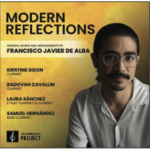 Modern Reflections. Kristine Dizon, clarinet; Radovan Cavallin, clarinet; Laura Sánchez, E-flat clarinet, clarinet; Samuel Hernández, bass clarinet. F.J. de Alba: Spring; Unstoppable Machines; Reverberations; The Sleep of Reason Produces Monsters; Loop 101 South; P. Grainger/arr. F.J. de Alba: Mock Morris; Eastern Intermezzo; Country Gardens; Handel in the Strand; Spoon River; M. De Falla/arr. F.J. de Alba: La Vida Breve. Modern Artist Project. Total Time: 49:48.
Modern Reflections is a captivating recording showcasing original compositions and arrangements for clarinet quartet by clarinetist-composer-arranger Francisco Javier de Alba. The performers—Kristine Dizon (soprano clarinet), Radovan Cavallin (soprano clarinet), Laura Sánchez (soprano and E-flat clarinet), and Samuel Hernández (bass clarinet)—bring his music to life with a shared artistry and precision.
Several aspects of this project make it particularly compelling. First, it offers a blend of newly composed works and finely crafted arrangements for clarinet quartet. Second, the ensemble members share a professional connection to Spain through their association with the Gran Canaria Philharmonic Orchestra. Having witnessed the fluctuating presence of clarinet ensemble recordings throughout my career, I find it encouraging—and refreshing—to encounter a release like this. It also provides a fascinating window into the vibrant clarinet scene in the Canary Islands.
Artistically, the album is remarkably well-rounded. While the prevailing aesthetic leans toward a Central European sensibility—reflecting the musical heritage of composers from that region—the program spans a striking range of styles: Spanish dance, American folk song, minimalism, and the timeless British folk melodies, among others. Whether original or arranged, each work bears the imprint of de Alba’s deep understanding of the instrument, rooted in his training within one of the finest traditions of clarinet playing.
Dizon’s decision to entrust the entire musical content—both compositions and arrangements—to de Alba is worthy of praise. The repertoire highlights the clarinet quartet’s full expressive range, and the ensemble’s performances illuminate every facet. The Spring series radiates optimism, Grainger’s folk song settings function almost as a cohesive suite, and the two Spanish dances add exuberance and intricate rhythmic vitality. I did note that the closing work bore an unnecessary resemblance to an existing piece and that the album might have benefited from a more substantial final statement.
As an ensemble, the quartet captures each mood, character, and texture with remarkable balance, intonation, and unity of tone. Individually and collectively, the musicians demonstrate a consistently high level of artistry, meeting every technical and interpretive demand. After a slightly airy, diffuse sonority in the opening track, the group quickly settles into a focused, resonant sound that carries through the remainder of the album.
In sum, Modern Reflections is a worthy addition to the clarinet quartet discography—expertly written, expertly played, and full of character. I recommend it enthusiastically.
– Jorge Montilla Moreno
 Kinan Azmeh and CityBand: Live in Berlin. Kinan Azmeh, clarinet; Kyle Sanna, guitar; Josh Myers, bass; John Hadfield, drums. K. Azmeh: The Queen Commanded; The Translator; Daraa; Jisreen; “Dance” from The Fence, The Rooftop, and The Distant Sea; Wedding; K. Sanna: Galileo Galilee. Dreyer Gaido, 21163. Total Time: 64:13.
The album Live in Berlin was released in February 2025 by Kinan Azmeh and CityBand, a self-deemed Arab-Jazz Quartet. The album is the result of the live recording from a 2021 performance at the Pierre Boulez Saal in Berlin. The album is available in audiophile HD format as well as physical CD. Its release was celebrated with performances in New York, North Carolina, the Netherlands, and Germany. The quartet is led by Syrian-born, Brooklyn-based composer and clarinetist Kinan Azmeh, and comprised of guitarist Kyle Sanna, drummer John Hadfield, and double bassist Josh Myers.
In the liner notes, Azmeh offers insight into how meaningful and personal this project was:
Most of this music was composed and performed during a difficult time of my life that began with the Syrian uprising in 2011, music that is inspired by anger, sadness, frustration, and above all the need to hold on to one’s optimism, hope and creative tools in the face of atrocities. It moves me profoundly to be sharing this album with the world as my Syrian people are able to sing again after their long and costly struggle against tyranny and dictatorship. This album is dedicated to all who believe that making music is also an act of freedom.
The album is dedicated to Kinan’s father, Bachar Azmeh.
The style of the performance can best be described as a fusion of classical and jazz with flavors of Eastern European and Middle Eastern traditions. These styles can be heard in the modal melodic language that alternates between meditative harmonic stasis and a highly energetic and intricate rhythmic drive that is ornamented by virtuosic, highly expressive soloist improvisation.
Each of the seven tracks offers new and creative melodies that move seamlessly from section to section. The faster tunes often create a texturally-interesting groove, which provides the underpinning to highlight a soloist. The themes are interesting and creative, often taking surprising melodic turns that keeps the listener on their toes.
The ensemble playing is incredible. The quartet is rhythmically tight and produces a vast array of musical textures while also featuring and celebrating each musician’s admirable individual craft. It is clear that the ensemble has a unified artistic vision for their music.
The influence of Eastern European traditions is apparent in the wide vibrato, growling, and pitch-bending of the clarinet, akin to the klezmer performance style. Azmeh’s playing is supremely expressive; his soft and subdued singing in the lower register is heartfelt and seductive, truly mimicking the nuances of the emotive human voice. His more virtuosic improvisations are confident, energetic, and full of conviction. He has incredible malleability of sound and style that mesmerizes the listener through all 60-plus minutes of the album.
I give this album my highest recommendation. It is well-suited for anyone interested in jazz, Eastern European inspired music, looking to broaden their musical horizons, or just enjoy highly expressive music played at the highest level.
– Kelsey Paquin
 Excursions. The Vuorovesi Trio: Diane Boyd Schultz, flute; Mary Lindsey Bailey, oboe; Osiris J. Molina, clarinet. M. Quayle: Petite Suite; J. Landers: Six Pieces; C. Kingsland: Soap Bubbles; J. Burel: Defensive Masquerade; G. Cohen: Trio No. 2; M. Kibbe: Trio, op. 46; S. Lias: Particle Accelerator. Blue Griffin Recording, BGR681. Total Time: 62:00.
In 2025 The Vuorovesi Trio, made up of University of Alabama School of Music faculty Osiris J. Molina, clarinet, Diane Boyd Schultz, flute, and Mary Lindsey Bailey, oboe, released their album Excursions on Blue Griffin Records. The album is made up of works by living American composers. The trio states in the liner notes that in choosing these composers they, “ … aim to promote the voices shaping the future of classical music and engage the vibrant cultural landscape of America today.” These goals are evident in the contrasting styles of the works included on the album.
Excursions begins with Matthew Quayle’s Petite Suite, a three-movement work that blends traditional forms with contemporary harmonies and style. The driving scherzo movement showcases the trio’s admirable technique and unity of articulation. Next on the album is Six Pieces by Joseph Landers. Molina’s clear, rich chalumeau tone is of particular note in the fifth movement of this work. Chappell Kingsland’s Soap Bubbles is the next work on the album and is the only single-movement piece. It opens with quick arpeggiated runs in all instruments, reminiscent of the title. These quick, technical figures are interspersed with languid melodies and jaunty staccato sections that display the wonderful sense of blend and stylistic flexibility that the trio employs. Next is Joshua Burel’s Defensive Masquerade. In the performance of this work, the trio expertly executes the fun syncopation of the first movement juxtaposed with the peaceful minimalism of the second movement and the dance-like intensity of the third, making this piece a highpoint of the album.
Graham Cohen’s Trio No. 2 begins quietly with lush harmonies, reminiscent of Copland. This five-movement piece runs the gamut of luxurious slow lines, to light, quick figures in the final presto movement. It leads beautifully into the Trio, op. 46 by Michael Kibbe. This work, written in 1979, is the oldest on the album, but sounds fresh and complements the other works, which were all composed between 2002 and 2020. In particular, the second and third movements of Kibbe’s trio contain some nice clarinet lines, which truly sing with Molina’s clear, fluid playing.
Particle Accelerator by Stephen Lias concludes the album. The first movement of this piece is at the same time exciting and adorable. The trio handles the quick changes in articulation and the perpetual motion from bouncy to heavy and back with grace and skill. The haunting second movement features a piercing oboe line, glittering flute runs, and smooth, comforting support from the clarinet. The final movement of the work and the album features blazing technique and articulation in all three instruments which intertwine flawlessly. This concludes the album with energy and excitement.
If this album, as The Vuorovesi Trio hopes, represents the future of American chamber music, there is cause for optimism indeed.
– Madelyn Moore
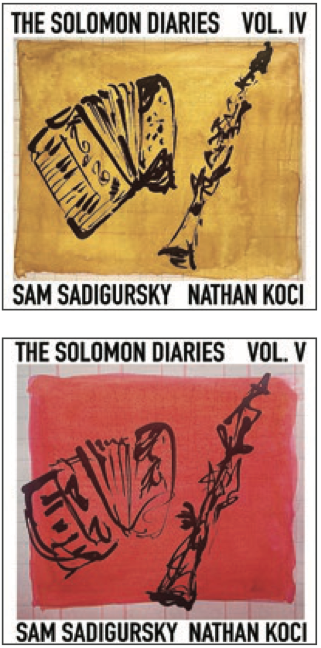 The Solomon Diaries, Volumes IV and V. Sam Sadigursky, clarinet; Nathan Koci, accordion; with guest artists: Matt Darriau, kaval, alto saxophone; Meg Okura, violin; Joe Brent, mandolin; Timo Andres, piano; Danny Fox, piano. S. Sadigursky and N. Koci: Lev’s Loops (for Ljova); Pearl’s Lullaby; Second Hand (for Guy Klucevsek; Refugee 3/8; Mirrors; One for Kathleen (for Kathleen Sullivan); Slow Motions (for Andy Statman); Swell; Janie Claire; Fire at 168 Gibber; River; Favorites; Lucky (for Sara); Migrations; Home Theme; Strut; Supreme; What You Sow; Knots; VNP Hora (for Isaac Sadigursky); Six Miles at Midnight. Adhyaropa Records. Total Time: 41:18 [Vol. IV]; 37:22 [Vol. V].
The Solomon Diaries (Volumes IV and V) is a new two-disc set released by Sam Sadigursky (clarinet, Philip Glass Ensemble) and Nathan Koci (accordion, Broadway productions including Illinoise). The music is inspired by the Borscht Belt region in New York, a Jewish cultural area which rose to prominence in the 1950s and 1960s. Each track is a unique gem, playing with influences from klezmer, minimalism, and even Irish jig. The material is so varied that the album never feels stagnant. Sadigursky and Koci both play superbly well, and quality audio production gives each performer—and their well-recognized guest artists—the chance to showcase their musicianship and style. Many of the album’s tracks are dedicated to other musicians. Of particular interest to clarinetists is Slow Motions, dedicated to klezmer clarinetist Andy Statman. Sadigursky pays homage to Statman’s signature playing style with sensitive vibrato and a memorable, yearning melody. Throughout both volumes, Sadigursky is a shape-shifter of timbre, molding his playing perfectly to the style of each tune—while maintaining a classically appealing tone. Together, Sadigursky and Koci’s playing blend exceptionally well and create a colorful timbral blend. This is an album worth enjoying to in its entirety!
– Erin Cameron
 Diamond Quills. Charisma: Roslyn Dunlop, clarinet; Julia Ryder, cello; David Miller, piano. K. Beilharz: Diamond Quills; D. Blom: Fearless Dreams; F. Wilcox: Snow; M. Smith: Poppy Re-Imagined; A. Ghandar: Flowing Water and Birds; R.L. Page: Being and Time; C. Bonshek: Out on the Wind; K. Abbott: Music for Demons; W. Suiter: Clarinet Calling; K. Beaugeais: The Last Flight of Saint-Ex. Independent Release. Total Time: 51:10 [disc 1]; 43:09 [disc 2].
The Australian ensemble Charisma shares a delightful collection of works written by Australian women composers in their two-disc album entitled Diamond Quills. Clarinetist Roslyn Dunlop, cellist Julia Ryder and pianist David Miller present compelling performances of these 10 works, some of which were written for the ensemble over the past 20 years. Listeners will appreciate their virtuosity, fine musicianship and sensitivity. Highlights of the compilation are discussed below.
The collection opens with the piece that inspired the album title: Kristy Beilharz’s work for bass clarinet, cello and piano, Diamond Quills (A study of time, death, and the harbour). In the program notes, Beilharz reveals that the piece depicts nighttime scenes at the Sydney Harbor. The opening draws listeners into an unexpected sound world with interesting effects and timbres including string plucking, flutter tonguing and other extended techniques. The brief second movement features a metronomic-like tapping that underlies an intricate dialogue between bass clarinet and piano. Concluding the piece is an intense third movement with five bell-like figures that reference Kenneth Slessor’s poem, Five Bells. The ensemble adeptly plays the fast passagework and wide-ranging intervals—especially the alternating figures in the high register. Dunlop shows impressive control in the upper range.
Felicity Wilcox’s Snow, written in three movements, evokes images of a snowstorm and its many characters. The attractive swirling melody in the clarinet and bouncy piano accompaniment in the first movement perfectly capture the essence of flurries. Wilcox calls for neat sonic effects that involve trills, harmonics, and also recurring articulated patterns in varied registers that occasionally prove challenging for consistency of response. The substantive soft dynamics the ensemble achieves are magical. The louder moments are powerful but can use more tonal focus. Wilcox’s eloquent melodic writing is showcased in the striking second movement with lyrical lines that ebb and flow above minimal accompaniment.
Corrina Bonshek’s delightful Out on the Wind is a real treat. She writes that the piece is a “musical meditation on wind, birdsong, and flight in different guises.” Bonshek’s music is bright, joyous, and accessible. After a short introduction, the clarinet and cello trade bird calls and other figures. The ensemble gives the lines a lovely vocal quality and seems to relish the diversity of characters in this playful piece.
Another standout is Katy Abbott’s Music for Demons for bass clarinet, cello and piano. The dramatic opening brings Messiaen’s Quatuor pour la fin du temps to mind with its jarring chords in a unified rhythm as does a later cello melody with piano accompaniment. Abbott reveals that the work is inspired by Matthew Quick’s painting Pure Obsession which depicts space invaders. Portions of the piece are rhythmically complex with articulated passages that bounce around in various registers. The ensemble expertly navigates these technical challenges.
Katia Beaugeais’s evocative Last Flight of Saint-Ex rounds out the album. The plane crash of the French writer and pilot, Antoine de Saint-Exupéry in 1944 is the inspiration for this piece. Crisp articulations in the clarinet set the work into motion. Dunlop gives great clarity to these articulations, although some in the upper register seem forced and inconsistent in terms of response. A mournful cello solo provides a moment of contrast before the intensity returns with descending figures and fast passagework that could depict the plane spiraling out of control.
Listeners will enjoy this varied collection of works that the Charisma ensemble presents. They play with great artistry and conviction, and it is a pleasure to hear such excellent performances.
– Justin Stanley
NEW RELEASES

Prismatic Sounds. Jeremy Reynolds, clarinet. MSR Classics, MS 1781.

Songs of Sea and Stone. Jeremy Reynolds, clarinet; Corey Mackey, clarinet; Margaret McDonald, piano; Janáček Philharmonic Ostrava, JiříPetrdlík, conductor. Navona Records, NV6757.
Estuarium. Oriol Marès, clarinet, bass clarinet; Talal Fayad, oud, electric oud; Lucas Zegrí, percussion, drums; Thodoris Ziarkas, double bass. AudioMaze, OTQ001.
EFX: The Live Concerto Recordings. Christopher Mothersole, clarinet; University of West Georgia Wind Ensemble, Josh Byrd conductor. Independent Release.
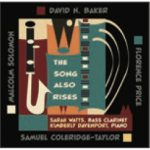
The Song Also Rises. Sarah Watts, bass clarinet; Kim Davenport, piano. Alea Recording, AR010.
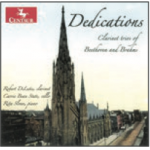
Dedications. Robert DiLutis, clarinet; Carrie Bean Stute, cello; Rita Sloan, piano. Centaur Records, CRC 4150.
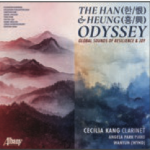
The Han(한/恨) and Heung(흥/興) Odyssey: Global Sounds of Resilience and Joy. Cecilia Kang, clarinet; Angela Park, piano; WanYun (WYHD) ensemble. Albany Records, TROY2005.
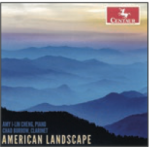
American Landscape. Chad Burrow, clarinet; Amy I-Lin Cheng, piano. Centaur Records, CRC 4160.
Comments are closed.