


Originally published in The Clarinet 53/1 (December 2025).
Copies of The Clarinet are available for ICA members.
Music Reviews:
December 2025
MUSIC
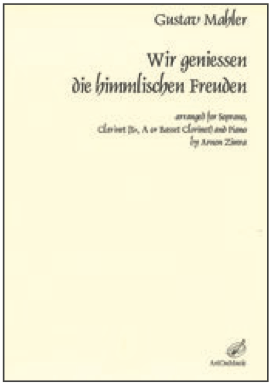 Gustav Mahler. Symphony No. 4, Movement 4, “Wir Geniessen die himmlische Freuden” for soprano, B-flat/A clarinet (optional basset clarinet), and piano. Arranged by Arnon Zimra. ArtOnMusic Publishers. $40 or €40. [email protected].
Any clarinetist who has played Gustav Mahler’s Fourth Symphony knows how much fun it is to play the fourth movement: animal sounds and sleigh bells, a soprano, and it all starts with a clarinet solo! Luckily enough, there is an excellent new arrangement of the movement to add to the clarinet chamber repertoire, arranged for soprano, clarinet (in B-flat/A with optional basset clarinet), and piano by composer Arnon Zimra.
The arrangement is masterfully done with intriguing lines for the clarinet that are pulled primarily from the orchestral clarinet, flute, and violin lines. Although not a clarinetist himself, Zimra clearly knows how to write idiomatically for the clarinet. The way the clarinet weaves through the piano part and intertwines with the voice, we could almost imagine Mahler composing this trio version himself. We do not hear this arrangement as a weakened version of the original symphonic movement, missing the instruments we are used to hearing. Instead, this trio is successful as a reimagined and new version of this musical material.
As well as being a prolific composer, Zimra is a pianist and recording artist. There are several versions of this trio arrangement available to listen to on streaming services, including one performed by Zimra as pianist. He has also written another Mahler arrangement for the same instrumentation, Vier Lieder eines Fahrenden Gesellen. Zimra’s Mahler arrangements are a delightful addition to the chamber repertoire for clarinet and voice.
The soprano line is unaltered from the original, which is convenient for the singer. The clarinet part is to be performed on both A and B-flat clarinets, with an optional several bars for the basset clarinet at the end of the work. The only slight disappointment from this piece is that there are not more opportunities to play the basset notes if the player chooses to use the basset clarinet.
The score is well done by ArtOnMusic Publishing. However, it should be noted that this publishing company does not seem to exist currently. It seems a challenge to obtain a printed copy of this work, although it seems to be available on several websites for free. The most reliable way to purchase a copy is to reach out to the composer at the email address listed above. The poem is printed at the beginning of the edition in both German and English, which is helpful for the musicians. Published in 2007, the arrangement has already become a much-loved recital work for clarinetists and vocalists. I expect it will remain a popular choice as it effectively retains the spirit of Mahler’s symphonic masterpiece.
– Marie Ross
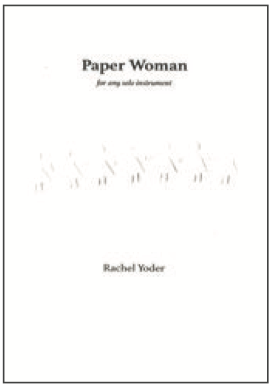 Rachel Yoder. Paper Woman for solo instrumentalist. www.ClarinetAllMusic.com, 2025. $5. RachelYoderClarinet.com.
Paper Woman is more than simply a piece of music. It’s a message, it’s a lesson, it’s inclusive, and it’s educational. In the program notes, Yoder writes, “In jazz slang, a ‘paper man’ was someone who could not improvise. The inversion of language to Paper Woman provides us with an intention to contemplate.”
Conceived and created to highlight the historical scarcity of women in the jazz and improvisation scene, this piece provides an accessible and inclusive entry point for experimenting with improvisation, while also being a valuable addition to the repertoire for experienced improvisers looking to expand their horizons further.
The piece is instructional and composed of five movements: “Jazzwoman,” “Sidewoman,” “Reedwoman,” “Frontwoman,” and “Paperwoman.” There are no given notes—just written instructions that give poetic and reflective instructions to inspire. There is also a blank staff that may be used for outlining pitch decisions.
For players who are afraid to step on the road to improvisation, this work tackles imposter syndrome head-on in a way that acknowledges the fear of improvising but permits one to gently gain confidence until you realize that, actually, you can do it.
This is a powerful work that provides players, teachers, and educators with a valuable tool that not only highlights the constraints of learning in a classical environment dominated by sheet music, but also brings to light historical inequalities and the importance of acknowledging that, as players and listeners, we can and are being more accepting of all. Paper Woman is a composition that can be a private improvisation confidence builder in the practice room, or a thought-provoking piece of performance art in a concert. For players who want to delve into improvisation, there is no better start than this work.
Paper Woman exists only on paper; it must not be reproduced electronically. Paper copies may be reproduced for the audience.
—Sarah Watts
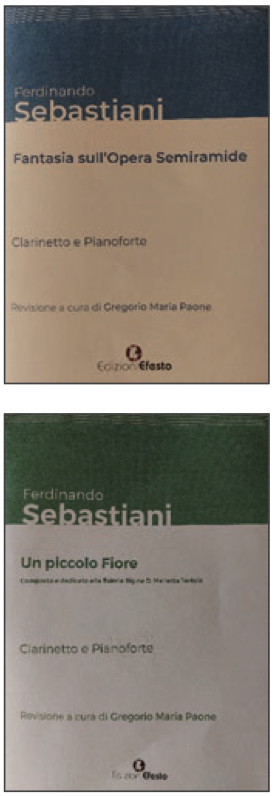 Ferdinado Sebastiani. Fantasy on Rossini’s Semiramide for B-flat clarinet and piano. Edizioni Efesto. €7.90. www.edizioniefesto.it/?s=sebastiani
Ferdinando Sebastiani. Un piccolo fiore (A Small Flower) for B-flat clarinet and piano. Edizioni Efesto. €7.90. Edited by Gregorio Maria Paone. www.edizioniefesto.it/?s=sebastiani
Ferdinando Sebastiani (1803-1860) was a quite significant clarinetist in the context of the Neapolitan School of the 19th century in Italy. He could be considered the real founder of that clarinet school. We can remember that peculiar clarinet school today also because it had as a main principle the technique of playing with the reed on top of the mouthpiece, and Sebastiani was one of the very first clarinetists to adopt this technique. He was principal clarinet at the San Carlo Theatre Orchestra and Cappella Palatina Orchestra also taught at Real Collegio di Musica. He wrote a Clarinet Method, quite popular in those times, but it has fallen out of favor. In this Method, he explains in detail all the advantages of using the reed above technique, claiming that in this way, all the articulations could be better executed. He studied at Collegio di Musica di San Sebastiano under the guidance of Michele Rupp, a well-known teacher and principal clarinet at various Neapolitan orchestras. Sebastiani, as a virtuoso player, was so well regarded in the Neapolitan scene that he had a 30-year career in three different orchestras. One says that he was giving the tuning A to the orchestra instead of the oboe!
Verdi knew him and dedicated to him some clarinet solos from his celebrated operas. The critic and composer Lauro Rossi described him in a review entitled “Prima Donna of the San Carlo Orchestra.” He composed a good number of clarinet compositions, including three solo compositions with orchestra, some clarinet duets, the aforementioned Method, and some opera fantasies employing themes of Verdi, Rossini, Bellini, and Donizetti (also according to a usual practice of those times in Italy). Many other Italian clarinetists had the dual role of performers and composers (see Cavallini, Carulli, Bassi, Mirko, Spadina, Cappelli, Della Giacoma, etc).
Gregorio Maria Paone is a young clarinet player from southern Italy who obtained various degrees from different Italian universities. He is a performer and capable researcher. He also wrote a specific book on Ferdinando Sebastiani, published, like the two pieces presented here, by Efesto. The little and unpretentious fantasy Un piccolo fiore (a small flower) has themes taken from the third act of Gaetano Donizetti’s Lucia di Lammermoor and was dedicated to Esimia Signorina Marietta Tortola, probably a friend of the composer. The other Fantasy is more elaborate and demanding, having a famous theme from Semiramide of Rossini with florid writing, some written-out cadenzas, and a brilliant show-off style final part. We must say thank you to both Gregorio Maria Paone and Efesto Editions for rediscovering these two nice compositions of Sebastiani. Now, we can have more operatic fantasies to consider in addition to the well-known ones of Bassi (Rigoletto) and Lovreglio (Traviata).
– Luigi Magistrelli
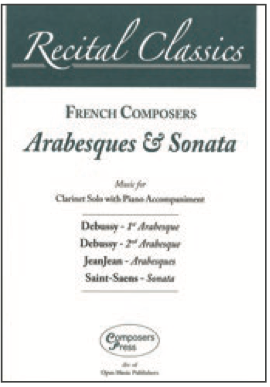 Debussy/Jeanjean/Saint-Saëns. Recital Classics: French Composers—Arabesques and Sonata for Clarinet Solo with Piano Accompaniment. Opus Music Publications. $21.95. Opus Music Publications.
Published by the Composers Press division of Opus Music Publishers, this collection of French music contains two arrangements and two clean editions of standard French works for clarinet and piano. Collections such as this offer a great opportunity for people who may be on a budget to expand their music libraries and their repertoire. Composers Press produced editions of these works that are both highly practical and pleasing to the eye. The engraving is crystal clear; both the piano score and clarinet part are slightly enlarged, making it more accessible to read and perform from. The pages also fold in nicely with no forcing, allowing for the original part to stay in good shape through several rehearsals and performances. Page turns were thought through from the point of view of each musician involved and are not awkward. The clarinet part of each piece is collected into one single booklet and is clearly marked, with ample space beneath each staff for writing instructions and reminders. There are no questionable markings (broken noteheads, incomplete measures, or unclear slurs), making this an excellent choice for students.
Both Debussy Arabesques are adapted from the original piano compositions. Originally published in 1910 by Durand, arranger Alfred Piguet preserved as much of the essence of the original work, creating a clarinet line by taking an already composed line from the work and scoring it as a solo. In the First Arabesque, the key signature is changed from the original four sharps to two flats, making it more accessible for younger clarinetists. The clarinet part is taken from the right-hand of the original piano composition, with added articulations to clear up any issues that could arise from the range of the line as it is transposed against the very low range of the piano part. There are moments where the melodic right hand is placed back into the piano part, and the clarinet is scored with longer held textural notes, adding variety to the arrangement and an opportunity for the clarinetist and pianist to trade melodic fragments. Similar compositional devices are employed in the transcription of the Second Arabesque as well, to excellent effect. These are wonderful works for younger students to begin to explore the phrasing and style of French clarinet music, without as much of the very intense technical filigree.
This edition of the Jeanjean Arabesques and Saint-Saëns Sonata is presented in a very clean and visually clear way. Though both works are readily available, this publisher cleaned up and enlarged both the clarinet and piano parts, a pragmatic change that makes it easier to read and work with. Both works remain in their original keys, and traditional standard markings are preserved. The appeal of this collection is that we are presented with four very clear and clean scores: two excellent arrangements of accessible French-style music that students can experiment with and learn from, and two standard pieces of repertoire, one of which is a shorter piece, containing a variety of stylistic attributes consistent with the French compositional style of the time. This collection is highly recommended.
– Vanessa Davis
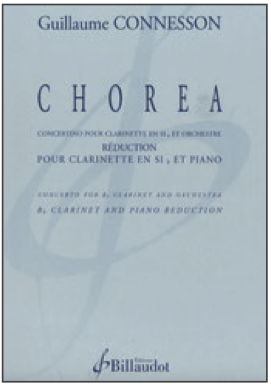 Guillaume Connesson. Chorea: Concertino for B-flat clarinet and orchestra. Editions Billaudot, 2025. €22.11. Reduction for B-flat clarinet and piano. Billaudot.
Born in 1970 in Boulogne-Billancourt, Guillaume Connesson is one of the world’s most frequently performed contemporary French composers. He has won numerous prizes, and his music has been performed and/or commissioned by the Orchestre National de France, the National Symphony, the Cincinnati Symphony, and the BBC Symphony, as well as the Philadelphia and Royal Concertgebouw Orchestras. He received first prizes from the Paris Conservatoire in choral direction, history of music, analysis, electro-acoustics, and orchestration. He has held many prestigious residences and is currently professor of orchestration at the Aubervilliers—La Courneuve Conservatory in France.
Connesson’s major compositional influences include Couperin, Wagner, Debussy, Ravel, Richard Strauss, Stravinsky, Messiaen, Dutilleux, Steve Reich, John Adams, John Williams, and James Brown. He has written orchestral compositions, concerti, vocal works, stage and film compositions, operas, and chamber pieces, many of which include the clarinet. The Chorea: Concertino for B-flat clarinet and orchestra is his first clarinet concerto, although he did write a saxophone concerto in 2015 (A Kind of Trane) that can also be played on the clarinet.
Connesson writes that Chorea “is an imaginary ballet in concertino form for clarinet and string orchestra.” Chorea, which comes from the Greek word for dance, is a neurological condition characterized by jerky, involuntary motions, and the piece aims to rhythmically reflect this. “Using the term ‘entrée de ballet,’ characteristic of 18th-century opera-ballet, it unfolds in three contrasting movements, with a cadenza linking the slow movement to the finale,” writes Connesson. This 12-minute piece, commissioned by the 7th International Jacques Lancelot Clarinet Competition in 2025, was dedicated to clarinetist and composer Aude Camus. The first movement, “Entrée Funky,” with quarter note equals 126, marked Molto animato, is a continuous movement of funk rhythms that develop over an incessant pulse, writes the composer. The second movement, “Entrée Nocturne,” is marked “very slow” and molto rubato at a quarter note equals 48. The composer describes this as a “’pas-de-deux’ in which chromatic lines intertwine in the mystery of night.” This is the opportunity for the clarinetist and pianist to demonstrate lyricism. This movement leads attacca into the third movement, which is a cadenza for the clarinetist alone, entitled “Cadence-Pantomime,” which leads attacca into the fourth movement, “Entrée en Rondo.” The composer writes that this movement has “two themes, one of pure exultant vitality, the other a quasi-vocal line. It is in this climate of sunny entertainment that my miniature ballet concertante ends.” The finale is marked “Very lively” at a quarter note equals 126.
For the clarinetist, the piece requires finger dexterity and fast tonguing, ease in the altissimo, and comfort with frequent meter changes. There are also duple against triple patterns between the clarinet and accompaniment part, so ensemble can be challenging. Of course, Chorea also requires musical imagination, especially to execute the cadenza successfully. The first and fourth movements are the trickiest for ensemble. The piano reduction is also technically demanding, and precise rhythm is required. The highest note in the clarinet part is an altissimo B-flat at the end of the piece.
No recording of Chorea, either with orchestra or with piano, is currently available, but hopefully one will be soon. As indicated above, the individual parts are demanding but could be played by advanced master’s or doctoral students, with particular attention to rhythm and ensemble.
Chorea’s unique character, programmatic context, and excellent writing for the clarinet make it a wonderful addition to the repertoire. It is a true gift to receive this clarinet concerto by such a preeminent composer! We look forward to hearing its first recording.
– Rebecca Rischin
 Artemis Aifotiti. Concertino for B-flat clarinet and string orchestra. Self-published, 2015. Artemis Aifotiti.
Composed in 2015, the Clarinet Concertino by Cypriot composer Artemis Aifotiti (b. 1986) offers 12 minutes of colorful and texturally intriguing soundscapes. Aifotiti’s Clarinet Concertino was commissioned by and dedicated to the Commandaria Orchestra, who premiered the work in 2016 with clarinet soloist George Georgiou and conductor Francis Guy. The Cyprus Wine Museum established the Commandaria Orchestra in 2009 to implement its visions and promote Cypriot culture, noting on its website that “the word ‘orchestra’ has its roots in the word orchos, which during the Homeric years meant ‘row of vines’ and is related with the cult of Dionysus.” Aifotiti’s work certainly contains its share of Dionysian revelry.
Aifotiti pairs the clarinet with a string orchestra, using extended techniques in the strings to maximize the orchestra’s tonal palette. Each of the Concertino’s three movements employs contrasting lyrical and rhythmic elements, though each manifests uniquely.
The first and longest of the movements opens with an introspective Andante espressivo, its warm imitative figures incorporating each string part before the clarinet enters with its expressive commentary. The long sensitive lines eventually give way to a “playful” 6/8, in which the clarinet executes multi-octave leaps, and the strings play pizzicato as the harmony becomes more dissonant and the overall texture fragments. The clarinet part here includes some difficult technical passages that require a range to altissimo B, as well as quick articulation. Aifotiti reins in the jubilation as quickly as it began, setting an effective but complicated syncopated pulsation in the strings (clashing triplet and duple syncopations between parts) against the clarinet’s molto legato lines. Her clarinetist becomes a musical dancer in the wild cadenza, where she specifically allows the performer to choose dynamics, articulation, and phrasing, though suggestions are included. The playful 6/8 returns at the conclusion of the cadenza, but with a breathlessness that is compounded by the abruptness of the movement’s ending.
The second movement, like the first, begins with layered entrances in the string parts, though the long note values here create a sense of stasis. Aifotiti colors this stillness with mutes, and pitches move from one to the other via glissando, as though there is great resistance between them. These string colors progress with spectral harmonics and tremolos while the clarinet probes the space produced within these sounds. A leggiero/legato section, in which the clarinet’s 32nd notes murmur quietly through held sonorities in the strings, gives way to longer values infused with tremendous energy and motion from rapid grace note figures, eventually reaching a dynamic climax on altissimo A before retreating to stillness and, ultimately, silence.
The final movement, a rousing Vivace, begins in a disorienting 10/8 meter, its first eight measures divided 2+2+3+3 and the following twelve measures 3+3+2+2. It then settles into a more familiar 4/4, where the clarinet executes virtuosic and even manic outbursts above harmonies sustained in the strings. By way of contrast, Aifotiti defines the final minute of this movement with cascades of 16th note septuplets and quintuplets throughout the orchestra, creating a dazzlingly fluid texture.
– Matthew Nelson
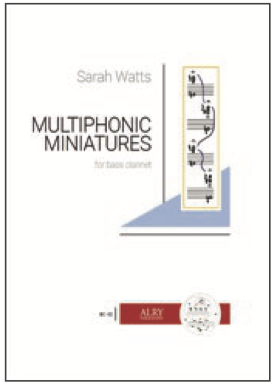 Sarah Watts. Multiphonic Miniatures for bass clarinet. Alry Publications, 2023. 64 pages. $24. Alry Publications. Partial Performance & Lecture: YouTube Link.
Low-clarinet specialist, multiphonics scholar, award-winning performer, and composer Sarah Watts wrote Multiphonic Miniatures, a set of 24 enjoyable and accessible studies for learning and performing multiphonics, funded through Arts Council England. The author suggests that the ideal way to approach performing these miniatures is by studying her earlier research, Spectral Immersions: A Comprehensive Guide to the Theory and Practice of Bass Clarinet Multiphonics, which she references throughout. Divided into four parts, each short composition is written in either a graphic or free-form notational style, allowing flexibility with time so that multiphonics can speak without the added pressure of rigid timing.
Multiphonic Miniatures explores extended techniques beyond multiphonics, and Watts provides clear instructions along with fingering guides specific to each work. She gives detailed approaches for preparation, with a clear emphasis on the performer’s decision-making skills. Descriptions of the inspiration behind individual miniatures include vivid imagery, some with color photographs and illustrations.
Part one employs free-form notation, with instructions to play with ample fluidity in terms of time and space. There is a focus on an expanded range from written low C to altissimo C and on timbral trills, as well as microtones. The set includes Type 1 multiphonics, achieved by manipulating the harmonic series through changes in embouchure, voicing, and air pressure, as well as Type 2, using specified fingerings. This section concludes with Choice and Chance, which incorporates all the techniques presented in the first five works, and it pays homage to Domaines by Pierre Boulez.
The miniatures progress in part two to include sound effects and increasing complexity. However, the instructions are so clear that these clever visual scores do not seem daunting to attempt. Shhh Shh Sssss includes written vocalizations and symbols, which can vary depending on the performer’s interpretation. In Throw the Dice, the player uses chance operations, with the performance of the work dictated by the number showing face up when the die lands. Two musicians can perform this and the following étude, Snakes and Ladders, allowing for playful collaboration.
Watts draws inspiration from the Scottish Isle of Raasay in part three, and the studies beautifully incorporate elements of the local culture, music, artists, and geography. Reflections introduces under-blown multiphonics, which produce undertones, rather than overtones. Haar includes the use of Dyad multiphonics to emulate distant ships’ horns, which are tricky to achieve, requiring very soft dynamics. Both Cuillin View and Dun Caan employ bagpipe drones. Finally, Screapadal Imagined is related to an earlier composition, Screapadal, using some of the same multiphonics.
Comprised entirely of graphic scores, the fourth and final section of Multiphonic Miniatures requires performers to make several artistic choices. Elephant enables the performer to develop spectral glissando skills based on the harmonic series of the three lowest notes on the low C instrument using Type 1 multiphonics. Eric Dolphy is derived from the vibraphone part of the legendary jazz musician’s Out to Lunch, and like the legend himself, performers must improvise. Eric Dolphy is also the name of Sarah’s cat, and delightful photographs pepper the score for inspiration. The set concludes with clarEquality, written in deference to the ideals of inclusivity espoused by the Facebook group and website created in 2023. Performers are encouraged to pick fourteen multiphonics from the four types introduced throughout each section of miniatures.
Multiphonic Miniatures is an ingenious method for learning multiphonics, and we are fortunate to have this addition by Sarah Watts in the bass clarinet repertoire.
– Meghan Merciers
 Stephanie Berg. Divertimento for solo bassett horn or bass clarinet. Self-published, 2024. Performance Link.
Stephanie Berg is a St. Louis-based composer and clarinetist who has had performances with the St. Louis Symphony, the Rochester Philharmonic, Alarm Will Sound, and many other ensembles across the US. She has written over 40 works in the last 15 years. Several of those feature her own instrumental family. These include a solo E-flat clarinet piece; a duet for clarinet and bass clarinet; a work for soprano, clarinet, and piano; two pieces for clarinet and piano; and another for clarinet and harpsichord.
Her most recent work for clarinet is Divertimento for solo basset horn (or bass clarinet). As the title implies, this is a suite of short movements, each with a distinctive character. Its five movements are titled “Vigorously,” “Tenderly,” “Aggressively,” “Pensive,” and “Brightly.”
The composer describes this work as “mostly atonal,” but my own take on the work is that it is somewhat pan-tonal. Each movement centers on a particular pitch and treats it as a “tonic” of sorts, deviating from it frequently but always returning “home.” For example, the first movement centers around the written pitch E-flat, demonstrating what composer Virko Baley would say is “on” E-flat rather than “in” E-flat.
One of the key characteristics of this work is its use of the wide leaps of which the clarinet is so capable. These leaps are used in different ways, depending on the context of the work. In the first movement, for example, the leaps are quite bold and daring, moving quickly from one register to the next. In the second movement, however, these leaps are used in a much more lyrical sense. In any case, it is obvious that the composer knows the instrument very well and exploits the ability of the basset horn (or any other clarinet) to negotiate these large leaps.
While the piece is challenging in many respects, it uses no extended techniques such as multiphonics, microtones, flutter-tonguing, pitch bends, or any other techniques that would not be requested by a composer such as Mozart. It’s just that the harmonic language is significantly different.
The overall range is quite wide, covering three octaves and a perfect fifth, from the lowest C (bass clarinetists will need a low C instrument) to an altissimo G. This is truly a piece written for a low clarinet. It spends quite a bit of its time in the lowest stock and a half, and as a result of that, the composer probably does not intend this piece to be played on a standard B-flat clarinet, nor would this reviewer recommend that.
This is a wonderful set of short pieces that I would highly recommend for someone looking to explore low clarinet repertoire further.
– Timothy Bonefant
Comments are closed.